
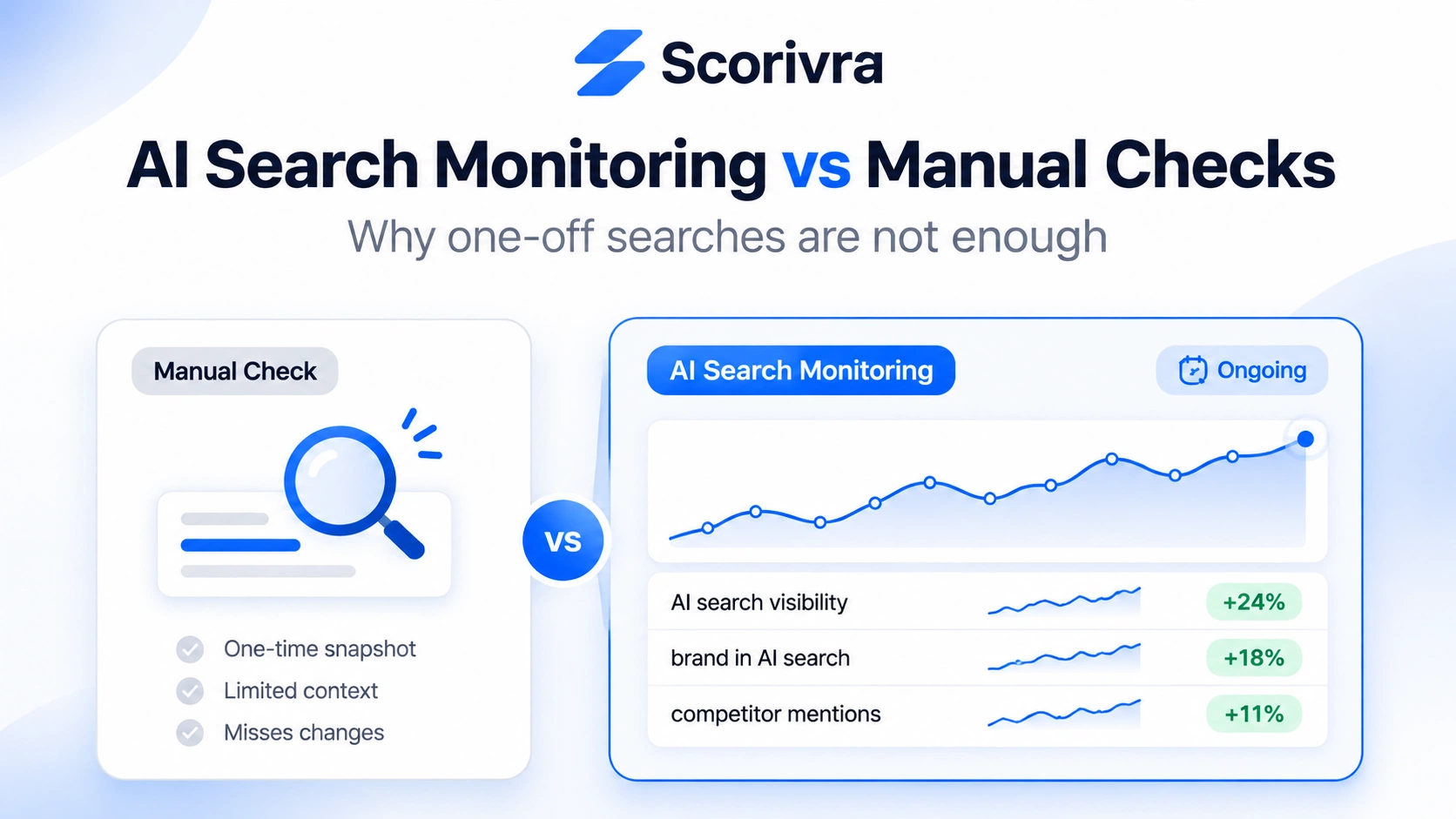
Checking whether your business appears in AI search results seems simple. You ask a relevant question, read the response, and look for your business name.
But what if a slightly different question produces different recommendations? What if a competitor appears tomorrow when they were absent today?
A single search tells you what happened in one response. It does not reveal how consistently your business appears across relevant questions or how its visibility changes over time.
That is where ongoing AI search monitoring differs from occasional manual checks.
1. What Are the Limitations of Manual AI Searches?
Manual searches are a useful starting point.
For example, a dental practice in Bristol might ask an AI search tool, "Which dentists offer teeth whitening in Bristol?"
The response may reveal whether the practice is mentioned, which competitors appear, and whether its website is cited.
However, the result only represents that particular search.
AI-generated answers can vary depending on question wording, search context, available information, and changes in the underlying systems.
A business appearing in one response does not mean it will appear consistently. Similarly, being absent once does not establish that it is never recommended.
Manual checking also becomes increasingly time-consuming when businesses need to examine numerous questions, competitors, and reporting periods.
2. Manual Checks vs Continuous AI Monitoring
The main difference is whether businesses can collect consistent, comparable information over time.
| Factor | Manual Checks | Ongoing Monitoring |
|---|---|---|
| Frequency | Occasional | Scheduled |
| Search questions | May vary | Consistent question sets |
| Historical results | Manually recorded | Organised for comparison |
| Competitor analysis | Individual observations | Repeated comparisons |
| Time required | Increases with each check | Reduces repetitive work |
Consider a business tracking 20 questions across three AI search experiences.
Checking each question once requires 60 searches. Repeating those checks daily for 30 days means 1,800 individual searches, before recording or analysing the results.
This illustrative calculation shows why manual checking can become difficult to maintain at scale.
Ongoing monitoring makes the process more systematic, allowing businesses to compare results collected under defined measurement conditions.
It does not guarantee identical AI responses or represent every search performed by potential customers.
3. What Should Businesses Monitor?
Effective AI search monitoring involves more than checking whether a business appears.
Three measurements are particularly useful.
Brand mentions
Track how often your business is explicitly mentioned across relevant questions.
For example, appearing in 12 out of 40 monitored responses represents a 30% mention rate within that sample.
This does not mean that 30% of all AI searches recommend your business.
Website citations
A business can be mentioned without its website being cited.
Citation tracking helps distinguish between AI-generated recommendations and responses that reference your website as a supporting source.
These are different visibility signals and should be measured separately.
Competitor visibility
Monitoring competing businesses helps put your own results into context.
If competitors repeatedly appear for questions where your company is absent, those questions may deserve further investigation.
However, the results alone do not explain why one business was included and another was not.
Comparing these measurements over time provides a clearer picture than relying on isolated searches.
4. When Is an AI Monitoring Tool Worth Using?
Manual checks may be sufficient when a business is exploring AI search for the first time or investigating a specific response.
Ongoing monitoring becomes more valuable when the business needs regular reporting, consistent question tracking, or repeated competitor comparisons.
Scorivra helps businesses monitor their visibility in AI-generated answers, including:
- Brand mentions across tracked questions.
- Website citations in AI responses.
- Competitor appearances and Share of Voice.
- Visibility changes across monitoring periods.
Instead of performing disconnected searches and comparing results manually, businesses can review structured monitoring data to identify changes and opportunities for further investigation.
Monitoring does not directly improve AI recommendations. It provides information businesses can use to make better-informed decisions.
Frequently Asked Questions
Can I check AI search visibility manually?
Yes. Manual searches can help identify individual mentions, citations, and competitors. However, repeated checks using consistent questions are needed to build a more comparable record over time.
Does AI search monitoring automatically improve visibility?
No. Monitoring measures observed results rather than controlling AI-generated recommendations. It can identify patterns and potential issues, but it does not guarantee better visibility.
Conclusion
Manual AI searches are useful for initial exploration, but isolated results provide limited evidence about a business's overall visibility. Consistent monitoring makes it easier to compare brand mentions, website citations, and competitor appearances across relevant questions.
For businesses that need regular visibility analysis, Scorivra offers a structured way to track AI search results over time and identify where further investigation may be worthwhile.