
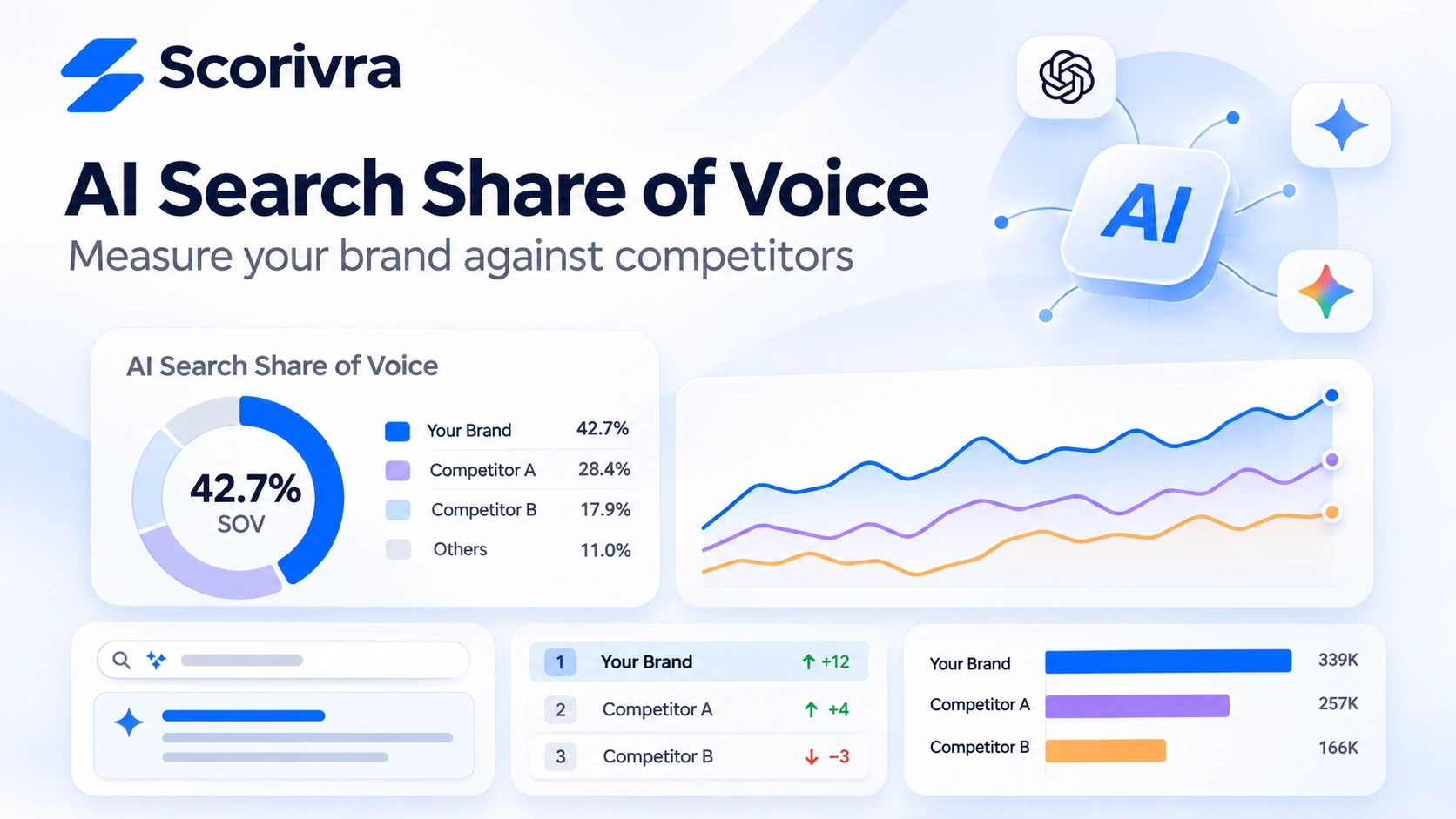
When someone asks AI to recommend a product, service, or business, several competing brands may appear in the same answer. Being mentioned is useful, but it does not tell you how much visibility your brand has compared with the alternatives.
That is where AI Search Share of Voice (SOV) becomes valuable.
Rather than looking at individual mentions, Share of Voice helps you understand your brand's relative presence across a defined set of AI search questions.
However, the metric is only meaningful when you understand what is being measured, which competitors are included, and how the results are calculated.
1. What Is Share of Voice in AI Search?
AI Search Share of Voice measures a brand's share of competitive visibility within a specific set of AI-generated answers.
Traditional Share of Voice can refer to a brand's proportion of advertising exposure, media coverage, or organic search visibility. In AI search, the concept is applied to how frequently brands appear in responses to relevant questions.
For example, a software company might monitor questions such as:
- "Which project management tools are suitable for small teams?"
- "What are the best alternatives to traditional project management software?"
- "Which platforms offer project tracking and team collaboration?"
If competing products appear repeatedly while your brand is rarely mentioned, your relative AI search visibility may be limited.
Importantly, Share of Voice does not represent your percentage of all AI searches worldwide. It describes visibility within the questions, platforms, competitors, and measurement period being analysed.
2. How Is AI Search Share of Voice Calculated?
There is no single universal calculation method used by every AI visibility platform.
One straightforward approach is to divide the number of times a brand is mentioned by the total mentions recorded for all brands included in a competitive comparison.
Illustrative formula:
Share of Voice (%) = (Your Brand Mentions / Total Tracked Brand Mentions) × 100
Consider a hypothetical set of AI search results:
| Brand | Recorded mentions | Share of Voice |
|---|---|---|
| Your Brand | 30 | 30% |
| Competitor A | 45 | 45% |
| Competitor B | 25 | 25% |
| Total | 100 | 100% |
In this example, your brand accounts for 30% of the recorded mentions.
This does not mean that 30% of potential customers will discover or choose your business.
It simply means that your brand received 30% of the counted mentions under this example's measurement rules.
Other methodologies may consider answer positions, question weights, repeated measurements, or additional competitive signals. Results from different tools should not be compared without checking their definitions.
The example above illustrates one possible calculation. It is not a specification of Scorivra's internal SOV formula.
3. Share of Voice vs. Mentions and Citations
These three AI visibility metrics are related, but they answer different questions.
| Metric | What It Measures |
|---|---|
| Brand Mentions | Whether your brand appears in an AI-generated answer |
| Citations | Whether your website is referenced as a source |
| Share of Voice | Your brand's relative visibility compared with tracked competitors |
Imagine that your company appears in 40% of the AI answers you monitor.
That could look encouraging. But if major competitors appear in 70% or 80% of those answers, your competitive position tells a different story.
Likewise, your brand may receive frequent mentions without your website being cited.
A mention indicates brand presence. A citation indicates that your website was referenced. Neither guarantees that someone visited your website.
Share of Voice adds competitive context to these measurements, helping you distinguish your own visibility from the visibility available to other businesses.
4. How to Compare Share of Voice With Competitors
A meaningful comparison begins with a consistent measurement scope.
First, define the customer questions that matter to your business. These should reflect situations where someone might genuinely compare available products or services.
Next, identify competitors that serve similar customer needs. Including unrelated companies can distort the comparison.
Finally, keep the measurement conditions consistent:
- Use a stable set of relevant questions.
- Compare results from the same AI search platforms.
- Apply consistent rules for counting brand appearances.
- Use comparable measurement periods.
- Separate branded questions from broader competitive discovery questions.
For example, a company may perform well when people ask about its brand directly but appear less frequently when people request general product recommendations.
Combining these question types without distinction can conceal an important visibility gap.
A useful Share of Voice comparison should help explain where your competitive presence is strong or weak, not merely produce a percentage.
5. How to Interpret Changes in Share of Voice
Suppose your brand's measured Share of Voice increases from 20% to 30% over several weeks.
That is a positive movement within the measured dataset, but it does not automatically prove that your marketing changes caused the improvement.
Several factors can influence the result:
Changes in competitor visibility. Your percentage can increase when competitors receive fewer mentions, even if your own mention count stays unchanged.
Variations in AI-generated answers. The same question may produce different responses across repeated measurements.
Changes to tracked questions. Adding easier branded questions or removing difficult competitive questions can change the reported percentage.
Differences between platforms. A brand may appear frequently in one AI search experience but much less often in another.
For these reasons, Share of Voice should be reviewed alongside mentions, citations, individual question results, and historical trends.
When measurement conditions change, document those changes rather than treating the new percentage as directly comparable with previous results.
Most importantly, visibility growth should not be confused with traffic, leads, or revenue. Those outcomes require separate measurement.
6. How Scorivra Helps Monitor AI Search Share of Voice
Scorivra's AI Visibility feature helps businesses track how their brands appear in AI-generated answers and compare that presence with competitors.
Rather than relying on isolated manual searches, businesses can monitor selected questions over time and review several related signals:
- Share of Voice: Compare your brand's competitive presence within the tracked question set.
- Brand Mentions: Check whether your business appears in AI-generated answers.
- Citations: Identify when your website is referenced as a source.
- Competitor Comparison: See which competing businesses appear in relevant answers.
- Historical Tracking: Review how measured visibility changes over time.
These measurements help answer a practical question: Is your business becoming more visible in the AI recommendations that matter to your potential customers, or are competitors appearing more consistently?
Scorivra also distinguishes AI answer visibility from website traffic and user behaviour, allowing businesses to assess these different stages without treating them as equivalent metrics.
Explore Scorivra's AI Visibility features to learn how Share of Voice, brand mentions, citations, and competitor comparisons work together.
Frequently Asked Questions
What is a good Share of Voice percentage in AI search?
There is no universal benchmark. A useful percentage depends on the number of competitors, the relevance of tracked questions, the platforms measured, and the calculation method. Comparing your results consistently over time is generally more informative than aiming for an arbitrary percentage.
Can Share of Voice increase without more brand mentions?
Yes. In a relative mention-based calculation, your share can increase if competitors receive fewer mentions while your own count remains unchanged. That is why absolute mention counts and competitive percentages should be reviewed together.
Does higher AI Share of Voice mean more website traffic?
Not necessarily. Share of Voice measures visibility within tracked AI answers, not actual visits. Website traffic and user actions need to be evaluated separately using appropriate analytics data.
Conclusion
AI Search Share of Voice provides a useful way to understand brand visibility in a competitive context. Instead of asking only whether AI mentions your business, it helps reveal how your presence compares with other brands across relevant customer questions.
The most valuable insights come from consistent measurement, careful interpretation, and comparison with supporting metrics. By tracking Share of Voice alongside mentions, citations, and competitor visibility, businesses can make more informed decisions about where their AI search presence needs attention.