
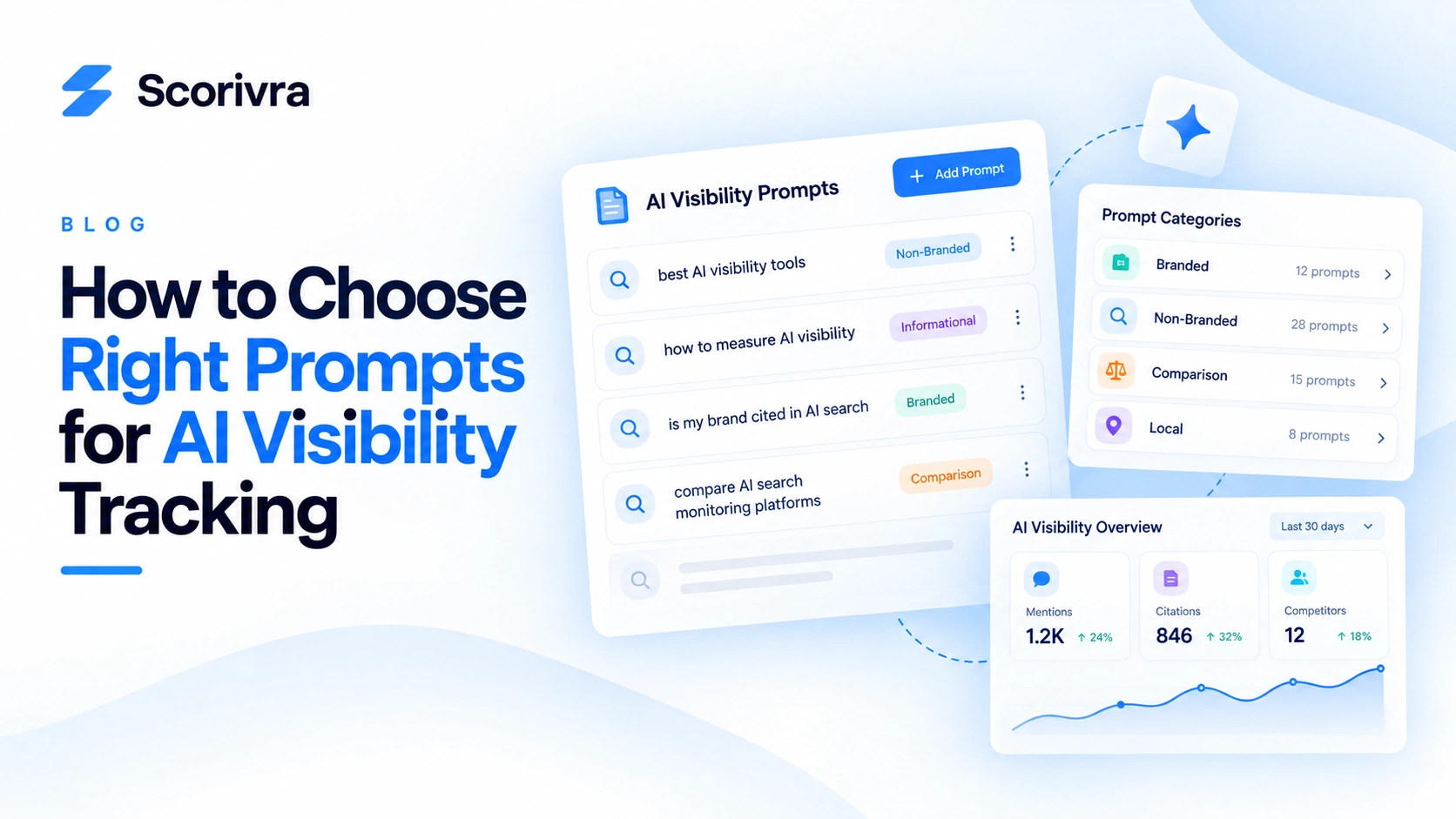
How to Choose the Right Prompts for AI Visibility Tracking
AI search visibility tracking can tell you whether your business appears in answers generated by platforms such as ChatGPT, Gemini, and Google AI Mode. But the usefulness of that data depends on something businesses often overlook: the questions they choose to monitor.
Tracking hundreds of irrelevant prompts can produce impressive-looking dashboards without revealing much about how potential customers discover your business.
A smaller, carefully selected set of questions can provide more actionable insights.
The goal is not simply to track whether AI mentions your brand. It is to understand whether your business appears when people are researching, comparing, and choosing solutions like yours.
This guide explains how to build a meaningful AI visibility tracking prompt list, how to prioritize questions, and how to use the results to identify opportunities.
Why Prompt Selection Matters in AI Search
Traditional SEO often starts with keywords. AI visibility tracking starts with questions.
Someone searching Google might enter:
"best accounting software small business"
The same person using an AI assistant might ask:
"What accounting software would you recommend for a small business with five employees and a limited budget?"
These queries express similar needs, but the second provides more context about the customer's situation.
AI-generated answers can also vary based on wording, context, platform, and other factors.
That makes prompt selection a critical part of measurement.
If you only monitor broad questions, you may miss the situations where your business is genuinely competitive.
If you only monitor questions that mention your brand, you may overestimate how easily new customers can discover you.
A useful prompt strategy needs to cover both.
1. Start With Questions Customers Actually Ask
The first step is to identify realistic customer questions rather than inventing phrases designed to make your business appear.
Think about the conversations that happen before someone makes a purchase.
What problem are they trying to solve? What alternatives are they considering? What information would help them make a decision?
For example, a dental clinic might track:
- "What should I look for when choosing a cosmetic dentist?"
- "Which dental clinics offer Invisalign consultations in Manchester?"
- "How do I compare Invisalign providers near me?"
- "What questions should I ask before booking cosmetic dental treatment?"
These prompts represent different stages of the decision process.
They also reveal different types of visibility opportunities.
A clinic might appear in answers about local Invisalign providers but remain absent from broader recommendations about cosmetic dental treatment.
That difference is worth understanding.
Where to Find Relevant Customer Questions
Useful sources include:
- Customer enquiries and support conversations
- Sales calls and frequently asked questions
- Product or service comparison requests
- Google Search Console queries
- Relevant customer reviews
- Common objections raised before purchasing
Google Search Console is particularly useful for identifying the language people use when searching for your business or services.
However, its search query data does not directly tell you which prompts people enter into AI assistants.
Treat those queries as research inputs, not verified AI prompt-volume data.
2. Separate Branded and Non-Branded Prompts
One of the most important distinctions in AI visibility tracking is whether a question already includes your brand name.
Branded Prompts
Branded prompts explicitly mention your business.
Examples:
- "Is Acme Accounting suitable for small businesses?"
- "How does Acme Accounting compare with QuickBooks?"
- "What services does Acme Accounting provide?"
These questions help you understand how AI systems represent your business when someone already knows its name.
They may reveal missing information, inaccurate descriptions, or unfavorable comparisons.
But branded visibility alone does not demonstrate that AI assistants recommend your business to unfamiliar customers.
Non-Branded Prompts
Non-branded prompts describe a need without identifying a particular company.
Examples:
- "What is the best accounting software for a small business?"
- "Which accounting tools support international invoicing?"
- "What accounting platforms are suitable for freelancers?"
These questions are especially valuable for measuring discovery.
If your brand appears in relevant non-branded answers, it suggests your business is present in recommendations where the user did not explicitly ask about you.
The practical rule: Monitor both types, but report their results separately.
Otherwise, strong branded visibility can disguise poor performance in competitive discovery questions.
3. Group Prompts by Customer Intent
Not every question has equal commercial importance.
A person asking for a definition may be learning about a subject. Someone comparing providers may be much closer to making a purchase.
A practical prompt list should include several intent categories.
| Intent | Example Prompt | What It Reveals |
|---|---|---|
| Educational | "What is AI search visibility?" | Presence during early research |
| Problem-aware | "Why is my business missing from AI recommendations?" | Visibility around customer problems |
| Comparison | "Which AI visibility tracking tools should I compare?" | Competitive consideration |
| Purchase-oriented | "What AI visibility platform should a small agency use?" | Presence near a buying decision |
| Branded | "What does Scorivra measure?" | How AI describes a known brand |
For most businesses, commercial and comparison-oriented questions deserve particular attention because they are more directly connected to purchase decisions.
That does not mean educational questions have no value.
They can help identify topics where your business lacks relevant content or authority.
The important distinction is to avoid treating every prompt as equally valuable.
4. Include Competitor Comparison Questions
Competitor-oriented prompts can reveal opportunities that general brand tracking misses.
For example:
- "Which tools are alternatives to [Competitor]?"
- "What is the difference between [Brand A] and [Brand B]?"
- "Which platforms offer similar features to [Competitor]?"
- "What are the best alternatives for small businesses?"
These questions help you investigate whether your business enters the conversation when buyers evaluate competing products.
However, competitor prompts should not dominate your tracking list.
A prompt set focused entirely on competitors may fail to represent the wider market.
Use competitor questions as one category within a balanced monitoring strategy.
Also avoid changing the prompt wording solely to produce favorable results. That can undermine the reliability of your measurement.
5. Add Geographic Context When Location Matters
For local businesses, geographic context can substantially change what a useful prompt looks like.
Compare:
"Which cosmetic dentists are recommended?"
With:
"Which cosmetic dentists in Manchester offer Invisalign consultations?"
The second question is more specific about the market and service.
A restaurant, dental clinic, estate agency, or local service provider should generally prioritize questions that reflect its actual service area.
Examples include:
- "Best emergency plumbers in Bristol"
- "Which estate agents help first-time buyers in Leeds?"
- "Where can I book a dental implant consultation in Birmingham?"
You may also want to distinguish between city-wide searches and neighborhood-specific searches.
But avoid adding dozens of locations without a business reason.
If your company only serves one city, tracking nationwide recommendations may generate data that is difficult to act on.
For geographic ranking analysis, it can also be useful to compare AI recommendations with Google Maps visibility. These are different discovery surfaces and should not be treated as identical measurements.
6. Prioritize Prompts Before Tracking Them
Once you have collected candidate prompts, you need a way to choose which ones deserve ongoing monitoring.
A simple prioritization model uses four criteria:
- Customer relevance: How closely does the question match a genuine customer need?
- Commercial intent: How likely is the question to arise during a buying decision?
- Business fit: Can your company realistically satisfy the underlying request?
- Competitive opportunity: Would appearing in the answer help you compete for a relevant customer?
You can score each category from 1 to 5 and use the combined total to organize your initial list.
For example:
| Prompt | Relevance | Intent | Business Fit | Opportunity | Total |
|---|---|---|---|---|---|
| Best CRM for small agencies | 5 | 5 | 5 | 4 | 19 |
| What is CRM software? | 3 | 1 | 5 | 2 | 11 |
| Alternatives to a competing CRM | 5 | 4 | 5 | 5 | 19 |
Illustrative scores only. These are planning judgments, not measured search volumes or conversion probabilities.
This model is not a scientific ranking formula.
Its purpose is to make prompt selection more consistent and prevent arbitrary choices.
Once tracking begins, you can revisit priorities based on the visibility gaps you discover.
7. Build a Balanced Initial Prompt List
You do not need hundreds of questions to begin learning from AI visibility data.
A practical starting point is a focused set of 20 to 30 prompts covering your most important customer scenarios.
For example, a 25-prompt list might contain:
| Prompt Category | Number |
|---|---|
| Non-branded service discovery | 8 |
| Comparison and alternatives | 5 |
| Problem-aware questions | 5 |
| Branded questions | 4 |
| Educational questions | 3 |
| Total | 25 |
This is an illustrative allocation, not a universal benchmark.
Local businesses may need more location-specific questions. Software companies may need more feature-comparison prompts.
The best distribution depends on how customers evaluate your product or service.
Once you have enough baseline data, expand the set to cover overlooked services, customer segments, and competitive opportunities.
8. Keep Your Core Prompts Consistent Over Time
A frequent mistake is changing tracked questions every time a result looks disappointing.
AI answers can vary between runs. Changing the question adds another source of variation.
For example, these prompts are not necessarily equivalent:
- "Best CRM for small businesses"
- "Best affordable CRM for small marketing agencies"
The second question introduces budget and industry constraints.
If you replace the first with the second, changes in brand visibility cannot be attributed solely to changes in AI recommendations.
Keep a stable core set of prompts for longitudinal comparisons.
When adding or replacing questions, record:
- The original question
- The updated question
- The reason for the change
- The date it changed
- The customer-intent category
Where possible, compare trends using a consistent set of completed measurements.
New prompts can be tracked separately until they have enough history to support meaningful comparisons.
9. Measure Mentions, Citations, and Competitive Presence Separately
Selecting the right prompts is only part of the process.
You also need to interpret what happens when those questions are tested.
Three useful measurements are:
Brand mentions: Whether an AI-generated answer names your business.
Citations: Whether an answer links to or cites your website as a source.
Competitive presence: Whether your business appears alongside, instead of, or less frequently than relevant competitors.
These signals answer different questions.
Your business might be mentioned frequently while its own website is rarely cited.
Or competitors might dominate the most commercially valuable questions even when your overall mention rate appears reasonable.
A citation is also not the same as a website visit.
To understand whether AI visibility contributes to traffic or business outcomes, analyze referral and on-site performance separately where reliable data is available.
10. Turn Missing Prompts Into Actionable Opportunities
After monitoring your questions, the next step is to identify patterns.
Suppose your business is missing from five important comparison prompts.
Rather than immediately creating five similar blog posts, examine what those questions have in common.
Perhaps your website lacks a clear comparison page.
Maybe your service pages do not answer the questions customers ask before choosing a provider.
Or competing businesses provide more detailed information about specific use cases.
The appropriate response depends on the evidence.
Potential actions include:
- Improving existing service pages
- Publishing useful comparison content
- Clarifying product features and limitations
- Adding specific customer-use-case explanations
- Strengthening relevant internal links
- Reviewing whether important pages can be accessed and understood
None of these changes guarantees an AI mention or citation.
The objective is to improve the information available to customers and then measure whether your visibility changes.
How Scorivra Helps You Monitor the Questions That Matter
Scorivra's AI Visibility tracking focuses on how businesses appear in answers across ChatGPT, Gemini, and Google AI Mode.
Instead of relying on occasional manual searches, you can monitor selected customer-style questions and examine whether your brand is mentioned, whether your site is cited, and where competitors appear.
This helps distinguish between several important situations:
- Your brand appears in relevant answers.
- Competitors appear, but your business does not.
- Your brand is mentioned without a citation to your website.
- Your visibility changes across repeated measurements.
The goal is not simply to collect more data.
It is to identify which customer questions matter, understand where your business is missing, and prioritize improvements based on those gaps.
You can explore Scorivra's features to see how AI visibility, local search, site audits, and performance analysis fit together.
Frequently Asked Questions
How many prompts should I track for AI visibility?
For a small business, 20 to 30 carefully selected questions can be a useful starting point. The appropriate number depends on your services, locations, and customer segments. Coverage and relevance matter more than maximizing the prompt count.
Should I include my brand name in AI tracking prompts?
Yes, but keep branded and non-branded prompts in separate categories. Branded questions help evaluate how AI describes your business, while non-branded questions are more useful for assessing potential discovery by new customers.
How do I know which AI prompts customers actually use?
Exact prompt frequency is generally not available through standard website analytics. You can develop realistic candidates from customer conversations, sales enquiries, frequently asked questions, and Google Search Console data. These are informed estimates of customer intent rather than verified AI search volumes.
Should I track the same prompts in ChatGPT and Gemini?
Using a consistent core set across platforms helps compare the visibility of your business for equivalent questions. However, each platform may generate different answers, and results should be interpreted within that context.
Can I change my AI visibility prompts later?
Yes. Add new prompts as your business or market changes, but preserve a stable core for historical comparison. When you significantly rewrite a question, treat it as a new measurement scenario rather than assuming its results are directly comparable.
Final Thoughts
Effective AI visibility tracking begins before you run your first measurement.
The questions you choose determine which customer needs, competitive situations, and discovery opportunities your reports can reveal.
Start with realistic customer questions. Separate branded and non-branded prompts, prioritize commercial relevance, and keep a consistent core set over time.
Most importantly, use visibility data to identify specific business opportunities rather than treating every AI mention as a success.
The right question is not simply whether AI mentions your brand. It is whether your business appears when a potential customer needs a solution you can actually provide.