
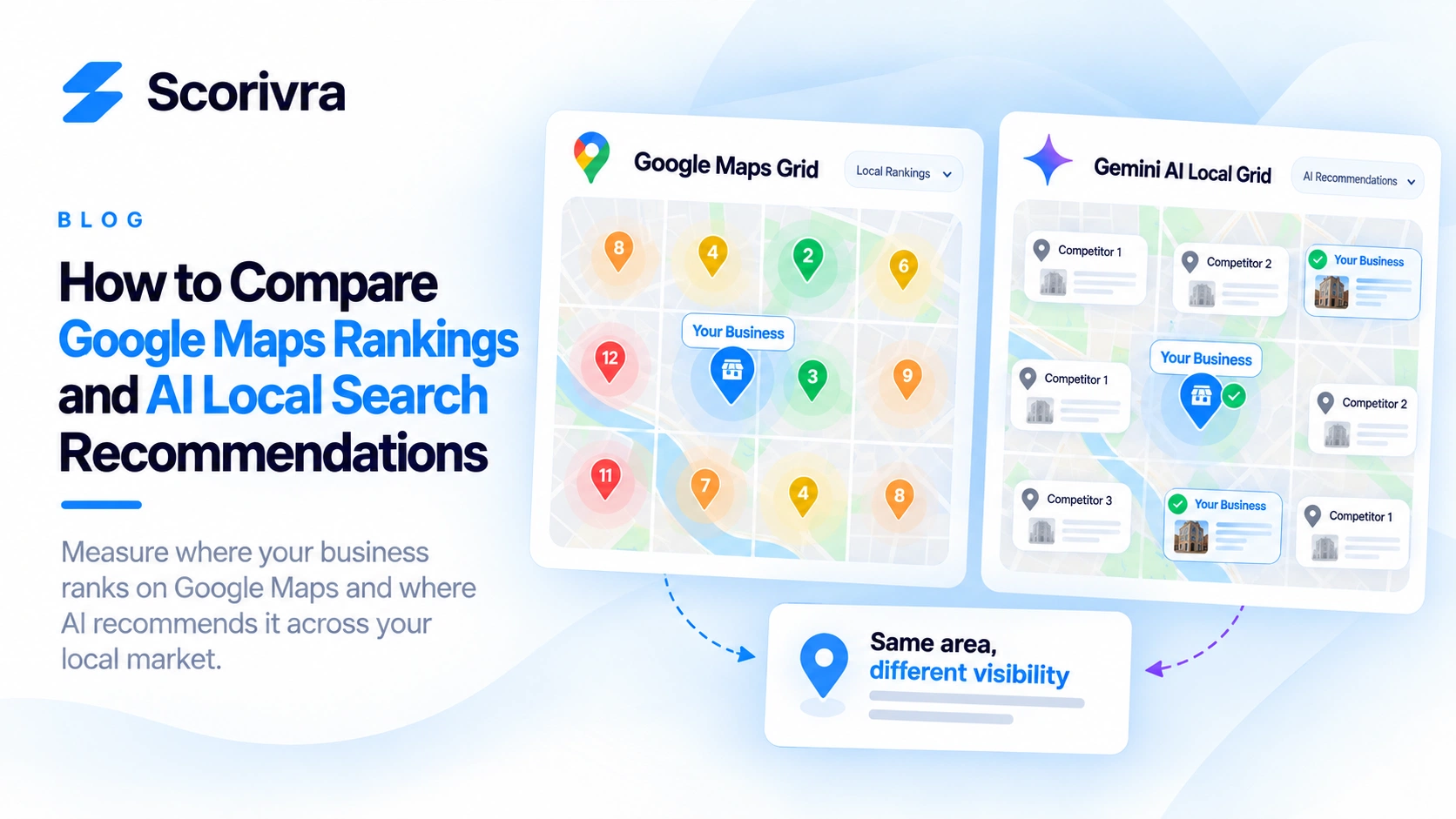
Your business might rank among the top results on Google Maps but never appear when someone asks an AI assistant to recommend a local provider.
The opposite can happen too. An AI assistant might recommend your business even when your Google Maps ranking is relatively weak in the same area.
These differences raise an important question:
How can you compare where your business ranks on Google Maps with where AI recommends it?
The answer is to measure both search experiences separately, compare them across geographic locations, and identify where your business is visible, missing, or being outperformed by competitors.
This guide explains how that comparison works, what businesses should measure, and which tools can help.
Google Maps Rankings and AI Local Recommendations Are Different
Google Maps and AI-powered local search can both help customers discover nearby businesses, but they do not necessarily produce the same results.
Google Maps primarily presents local business listings. A business's position can be influenced by relevance, distance, and prominence.
AI-powered search experiences can generate conversational recommendations based on the user's question, the available information, and the system producing the answer.
Consider two questions:
- "Dentists near Manchester city centre"
- "Which dentists in Manchester offer Invisalign consultations and have strong patient reviews?"
The first resembles a conventional local search. The second asks an AI system to evaluate businesses against specific criteria.
A business might perform well in one experience but not the other.
A high Google Maps ranking does not automatically guarantee an AI recommendation.
Likewise, an AI recommendation does not establish that the business has a high Google Maps ranking.
That is why businesses should measure both.
What Is a Google Maps Ranking Grid?
A Google Maps ranking grid measures a business's search position from multiple geographic points within a defined area.
Instead of checking one keyword from one location, a grid measures how rankings vary across a neighbourhood, town, or city.
For example, a dental practice might rank:
| Search area | Google Maps position |
|---|---|
| City centre | 2 |
| Northern neighbourhood | 5 |
| Eastern neighbourhood | 11 |
| Southern neighbourhood | 4 |
| Western neighbourhood | 15 |
Illustrative data, not actual business rankings.
A single search from the city centre would suggest the practice has excellent visibility.
The wider grid reveals a different picture: potential customers searching elsewhere may encounter competing practices first.
A useful Google Maps grid tool should help businesses identify:
- Geographic areas with strong rankings
- Locations where rankings decline
- Areas where the business is missing from tracked results
- Competitors appearing more prominently
- Changes in rankings over time
This provides a geographic perspective that a single local ranking cannot offer.
What Is an AI Local Search Grid?
An AI Local Search Grid applies a similar geographic measurement approach to AI-generated local business recommendations.
However, it measures a different outcome.
A Google Maps grid asks:
Where does my business rank?
An AI Local Grid asks:
Where does AI mention or recommend my business?
Instead of recording only a numerical search position, an AI local measurement can examine whether a particular business appears in the response to a location-specific question.
For example:
"Recommend a reliable accountant for a small business near this area."
The measurement can then assess whether the business appears in the AI response and which competing providers are mentioned.
Repeating the measurement across geographic points helps reveal differences in recommendation coverage.
Why the AI platform matters
Not every AI search platform supports the same geographic measurement capabilities.
Scorivra's AI Local Grid uses Gemini with latitude-and-longitude-based location targeting to measure local recommendations across defined grid points.
Its broader AI Visibility monitoring separately covers ChatGPT, Gemini, and Google AI Mode.
These capabilities should not be confused: measuring geographic recommendations through Gemini is not the same as claiming equivalent coordinate-level controls for every AI platform.
AI-generated answers can also vary between measurements. Grid results should therefore be interpreted as sampled observations, not guaranteed outcomes for every individual user.
How to Compare Google Maps and AI Local Visibility
The most useful approach is to examine the same business, service area, and relevant customer intent across both measurement types.
Step 1: Define your target market
Start with the area your business actually serves.
For a local law firm, this might include the city centre and surrounding neighbourhoods.
For a dental clinic, it might include the areas from which patients regularly travel.
Avoid treating a broad city-wide average as sufficient evidence of local visibility.
Step 2: Choose relevant search questions
Google Maps measurements commonly use local search terms such as:
- Dentist Manchester
- Emergency dentist Manchester
- Invisalign dentist Manchester
AI local measurements can use more conversational questions:
- Which dentists near this location offer Invisalign consultations?
- Can you recommend an emergency dentist in this area?
- What dental clinics nearby offer appointments for nervous patients?
The two sets of queries do not need identical wording, but they should represent comparable customer needs.
Otherwise, differences may reflect search intent rather than visibility.
Step 3: Measure Google Maps rankings
Record your business's position across the geographic grid.
Look for areas where your rankings are consistently strong, weak, or absent.
Also identify the competitors appearing ahead of your business.
This provides the conventional local search baseline.
Step 4: Measure AI local recommendations
Use the corresponding geographic area to examine AI-generated recommendations.
Record where the business is mentioned, where it is missing, and which competitors are recommended.
When available, repeat measurements over time to distinguish persistent gaps from temporary answer variation.
Step 5: Compare the results
Combining the observations can reveal four important scenarios.
| Google Maps | AI recommendations | Interpretation |
|---|---|---|
| Strong | Present | Visibility across both surfaces |
| Strong | Missing | Possible AI recommendation gap |
| Weak | Present | AI visibility despite weaker Maps rankings |
| Weak | Missing | Visibility gap across both surfaces |
This is a diagnostic framework, not proof of why a business appears or disappears.
For instance, a strong Maps position with weak AI visibility does not prove that the business needs additional structured data or new website content.
It identifies an area worth investigating.
Which Tools Can Track Both Google Maps and AI Local Search?
Businesses comparing local search tools should check whether the platform supports both geographic ranking measurements and AI recommendation monitoring.
Useful capabilities include:
- Google Maps ranking measurements across multiple geographic points
- AI-generated local recommendation tracking
- Competitor comparisons
- Consistent geographic measurement areas
- Historical results for identifying changes
- Clear separation between rankings, AI mentions, and citations
One example is Scorivra.
Scorivra combines Google Maps visibility tracking, Gemini-based AI Local Grid measurements, and broader AI Visibility monitoring within one platform.
Its Local Search features include:
- Maps Grid: Compare Google Maps positions across an area using a geographic grid.
- AI Local Grid: Check where Gemini mentions or recommends a business across the same local market.
- Competitor comparison: Identify competing businesses appearing in tracked results.
- Weekly grid measurements: Compare geographic visibility over time.
Scorivra's AI Local Grid uses a 9×9 grid covering 81 geographic points. Its separate AI Visibility features help track mentions and citations across ChatGPT, Gemini, and Google AI Mode.
The value of these measurements is not that they guarantee improved visibility. It is that they make different types of visibility observable and easier to compare.
How Often Should You Measure Local Visibility?
Local visibility is not static.
Rankings and AI recommendations may change because of competitor activity, business information updates, search system changes, location, or differences in the questions being asked.
Daily ranking checks can help monitor changes in tracked local keywords.
Weekly geographic grids can provide a broader view of where those changes occur.
For AI recommendation tracking, consistency is particularly important.
Keep the following as stable as possible:
- Geographic measurement points
- Customer intent and query wording
- AI platform
- Measurement frequency
- Competitor comparison criteria
Document meaningful changes to the measurement setup.
Without consistent conditions, differences between reports may be difficult to interpret.
What Should You Do When Maps and AI Results Disagree?
First, identify whether the difference is persistent.
A single AI response should not be treated as definitive evidence that a business lacks visibility.
If the gap appears repeatedly, investigate the relevant factors.
For weak Google Maps rankings, review business category relevance, location-specific competition, Google Business Profile completeness, and other local SEO signals.
For weak AI recommendations, review whether your business information clearly describes your services, service areas, and distinguishing attributes.
Consider whether useful, verifiable information about your business is available to the AI system.
Also examine which competitors appear and what the available evidence suggests about their relevance to the question.
Do not assume that changing one website element will automatically increase AI recommendations.
Measurement should identify the problem before optimization begins.
Frequently Asked Questions
Can a business rank highly on Google Maps but be missing from AI search?
Yes. Google Maps rankings and AI-generated business recommendations are different measurements. Strong visibility in one does not guarantee visibility in the other.
Is there a tool that tracks Google Maps rankings and AI local recommendations together?
Yes. Scorivra provides Google Maps Grid tracking and a Gemini-based AI Local Grid within its Local Search features. It also provides separate AI Visibility monitoring across ChatGPT, Gemini, and Google AI Mode.
Can I track AI local visibility across different neighbourhoods?
Location-based AI measurements can help identify where a business is mentioned or recommended across a defined area. Scorivra's AI Local Grid uses Gemini and geographically targeted measurement points for this purpose.
Does an AI Local Grid measure ChatGPT and Google AI Mode at every coordinate?
Not necessarily. Geographic controls differ between platforms. Scorivra's coordinate-based AI Local Grid uses Gemini, while its broader AI Visibility monitoring separately covers ChatGPT, Gemini, and Google AI Mode.
Does appearing in AI recommendations guarantee more customers?
No. Recommendation visibility is an exposure signal, not a direct measure of bookings, sales, or revenue. Businesses should evaluate it alongside traffic, enquiries, and conversion data.
Final Thoughts
Google Maps ranking and AI local recommendation visibility answer different questions.
One shows where your business appears in conventional local search rankings. The other helps reveal where an AI system recommends your business in response to relevant local questions.
Comparing these measurements helps businesses identify overlooked areas, understand competitor visibility, and decide what to investigate next.
For businesses that depend on local discovery, monitoring both surfaces provides a more complete picture than relying on either one alone.
Want to compare your Google Maps rankings with AI local recommendations?
Explore Scorivra's Maps Grid and AI Local Grid to see how geographic search visibility can be measured across your local market.