
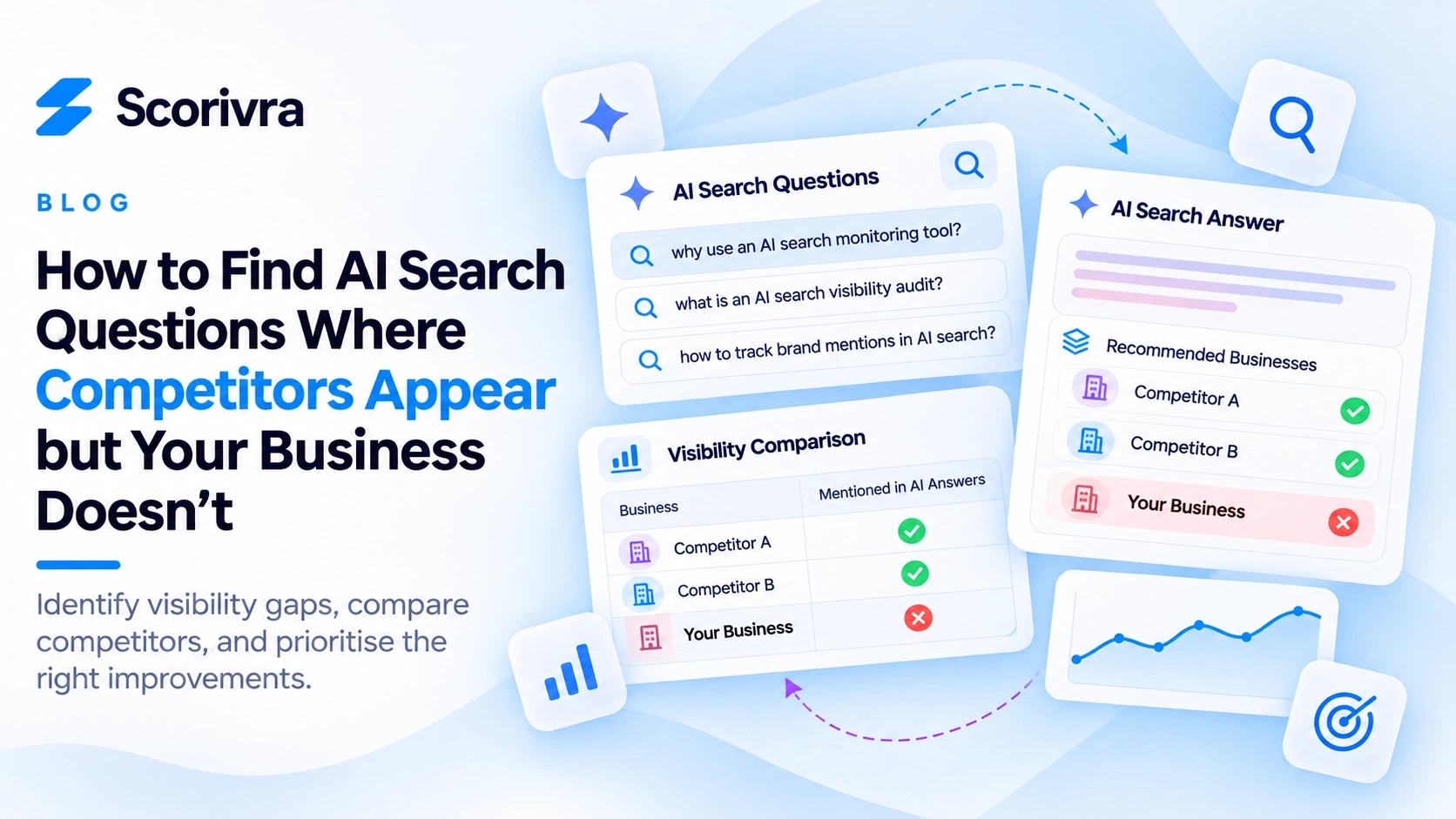
Imagine a potential customer asking AI to recommend a business that offers exactly what yours provides.
The answer includes three competitors. Your business is nowhere to be found.
That result does not necessarily mean your website has a technical problem or that competitors are better. But it raises an important question: which customer questions consistently lead AI to recommend competitors instead of your business?
Finding those questions is the first step towards understanding your AI search visibility gaps.
This guide explains how to identify those gaps, compare competing businesses, and decide which improvements deserve attention.
What Is an AI Search Competitor Gap?
An AI search competitor gap occurs when an AI-generated answer mentions one or more competing businesses but does not mention yours for a question relevant to your products or services.
For example, a customer might ask:
"Which accounting firms in Manchester help small limited companies?"
If the answer recommends several local accounting firms but excludes yours, that is a potential visibility gap worth investigating.
However, one missing mention is not enough to establish a persistent problem.
AI responses may vary between repeated requests, platforms, locations, and conversational contexts.
The important distinction is between an isolated result and a pattern that appears across relevant questions or repeated checks.
You should also establish whether your business genuinely meets the customer's requirements. Being absent from a recommendation for a service you do not offer is not a meaningful competitive gap.
Step 1: Identify Questions Where Customers Compare Providers
Begin with questions that represent realistic customer decisions.
Focus on situations where someone is choosing a provider, comparing alternatives, or looking for a specific service.
For an accounting firm, those questions might include:
- "Which accountants in Manchester specialise in small businesses?"
- "Can you recommend an accountant for a new limited company?"
- "Which local accounting firms offer bookkeeping and tax services?"
Choose questions that match your actual services and customer base.
Avoid relying only on questions containing your business name. Those measure how AI describes a known company rather than whether it recommends you to someone unfamiliar with your brand.
You do not need hundreds of questions to begin. A focused set covering your commercially important services is sufficient for an initial investigation.
Keep the wording consistent when repeating checks. Changing a question can change the type of recommendation you receive.
Step 2: Record Which Competitors Appear Instead
Test each question and document the answer.
At minimum, record:
- The exact customer question
- The date and AI search experience
- Whether your business is mentioned
- Which competing businesses are mentioned
- Whether your website is cited
- Any relevant location or context
A simple spreadsheet can help you organise the results.
For example, consider this illustrative comparison:
| Customer question | Your business | Competitor A | Competitor B |
|---|---|---|---|
| Accountants for small businesses | Not mentioned | Mentioned | Mentioned |
| Limited company tax advice | Mentioned | Mentioned | Not mentioned |
| Bookkeeping services in Manchester | Not mentioned | Mentioned | Mentioned |
Illustrative results only; these are not actual AI search measurements.
In this example, the first and third questions deserve further investigation because competing firms appear while your business does not.
The second question represents a different situation: your business is already included.
This question-by-question approach is more useful than treating all AI recommendations as one overall visibility score.
Step 3: Check Whether the Gap Is Consistent
Before deciding that a competitor is outperforming your business, repeat the checks using a consistent method.
Keep the question wording and relevant location context unchanged. Record each new result rather than replacing the previous one.
A business may appear in one response and disappear in another. Results may also differ between AI search experiences.
Look for patterns such as:
- The same competitor appearing repeatedly for one service
- Your business remaining absent across several checks
- Your business being mentioned but your website rarely being cited
- Different competitors appearing for different customer needs
A repeated gap is usually more useful for prioritising investigation than a single missing mention.
Even repeated observations are not proof that every potential customer receives the same answer. The results describe the questions, contexts, and checks you have measured.
Step 4: Investigate Why Competitors May Be Appearing
Once you identify a recurring gap, compare the information available about your business with the information available about the competitors.
Start with the pages that should answer the customer's question.
Suppose competitors appear for "accountants for small limited companies" while your business does not.
Review whether your website clearly explains:
- That you provide accounting services for limited companies.
- Which relevant services you offer.
- Which customers and locations you serve.
- How potential customers can evaluate your suitability.
Then examine competitor websites for relevant information you may be missing.
For example, a competitor might have a dedicated page explaining limited company accounting, while your website only mentions the service briefly on a general homepage.
That difference suggests a possible content improvement.
It does not prove that the competitor's page caused the AI recommendation. AI systems can draw on multiple sources, and the exact reasons for a recommendation may not be visible.
Treat competitor gaps as evidence for investigation, not automatic proof of an SEO or website failure.
Step 5: Prioritise the Most Valuable Gaps
Not every missing recommendation deserves the same attention.
A business might be absent from a broad educational answer but also missing from a question that directly relates to a valuable service.
The second gap may deserve priority.
Use three criteria to organise your findings:
| Criterion | Question to ask |
|---|---|
| Customer relevance | Does this question reflect a genuine customer need? |
| Competitive gap | Do competitors appear repeatedly while your business is absent? |
| Business fit | Can your business genuinely provide the requested service? |
Give greater attention to questions that score strongly across all three areas.
For example, a dental practice offering emergency appointments might prioritise a gap involving "emergency dentist near me" over a general question about dental health.
Commercial importance still needs to be assessed using your own business knowledge. AI mention data alone cannot reveal the number of customers searching a question or its conversion rate.
Step 6: Improve the Relevant Content and Measure Again
After prioritising the gaps, decide what information would genuinely help a customer make a better decision.
Possible improvements include:
- Expanding an existing service page with specific details
- Clarifying which customers or locations you serve
- Answering important questions directly
- Correcting outdated or inconsistent business information
- Adding useful comparisons or evidence where appropriate
- Reviewing relevant technical issues affecting access to your pages
Do not create a separate article for every missing AI question.
If several questions concern the same service, improving one strong, comprehensive page may be more appropriate than publishing multiple overlapping posts.
After making changes, continue checking the original questions using the same measurement approach.
Compare your recorded results over time to see whether your business begins appearing more consistently.
Remember that content changes do not guarantee AI mentions, citations, rankings, or customer enquiries.
When Manual Competitor Checking Becomes Difficult
Manual investigation works well for a small number of questions.
However, the process becomes harder to maintain when you need to compare several competitors, record changes over time, or monitor multiple services.
For example, tracking 30 questions across three AI search experiences creates 90 question-and-platform combinations for each measurement cycle.
Repeating those checks and keeping accurate historical records can become a substantial task.
This is where continuous AI visibility monitoring becomes useful.
Instead of manually reviewing each answer, a monitoring platform can help organise question-level results, competitor mentions, and historical visibility changes.
The purpose is not simply to automate searches. It is to make recurring competitive gaps easier to identify and investigate.
Find Your Competitor Gaps with Scorivra
Scorivra's AI Visibility feature includes Prompt Gap, which helps identify tracked questions where competitors appear but your business does not.
It also provides brand mentions, website citations, competitor comparisons, and historical tracking so you can investigate whether a gap continues over time.
This directly supports the process described above: find missing recommendations, examine the competing businesses, and identify the customer questions that deserve attention.
If you want to move beyond occasional manual checks, you can explore the monitoring features and decide whether ongoing tracking fits your needs.
Explore Scorivra AI Visibility
You can also compare Scorivra's monitoring plans if you need to evaluate the available tracking capacity.
Frequently Asked Questions
Why does AI recommend competitors instead of my business?
There is no single explanation. AI recommendations can reflect the wording and context of the question, available information, and other factors specific to the AI system. Compare repeated results and the relevant business information before deciding what to improve.
How can I check whether competitors appear more often than my business?
Use the same relevant questions across a consistent set of measurements. Record your business mentions and competitor mentions separately, then compare the results at the question level. Avoid drawing conclusions from one response.
Will improving my website make AI recommend my business?
Improving useful and accurate website information may help customers and search systems understand your services, but it does not guarantee AI recommendations. Continue measuring the same questions to evaluate any changes.
Is an AI search competitor gap the same as a Google ranking gap?
No. A Google ranking gap concerns visibility within traditional search results. An AI search competitor gap concerns which businesses appear in generated answers to tracked questions. Both can be relevant to discovery, but they are different measurements.
Final Thoughts
When competitors appear in AI-generated recommendations and your business does not, the most useful response is not to assume that something is wrong with your entire website.
Start by finding the specific customer questions where the gap occurs. Check whether the pattern repeats, investigate the relevant information, and prioritise improvements that match real customer needs.
This approach turns isolated AI answers into a more structured method for understanding competitive visibility.
And when manual checks are no longer sufficient, consistent monitoring can help you follow those gaps over time.