
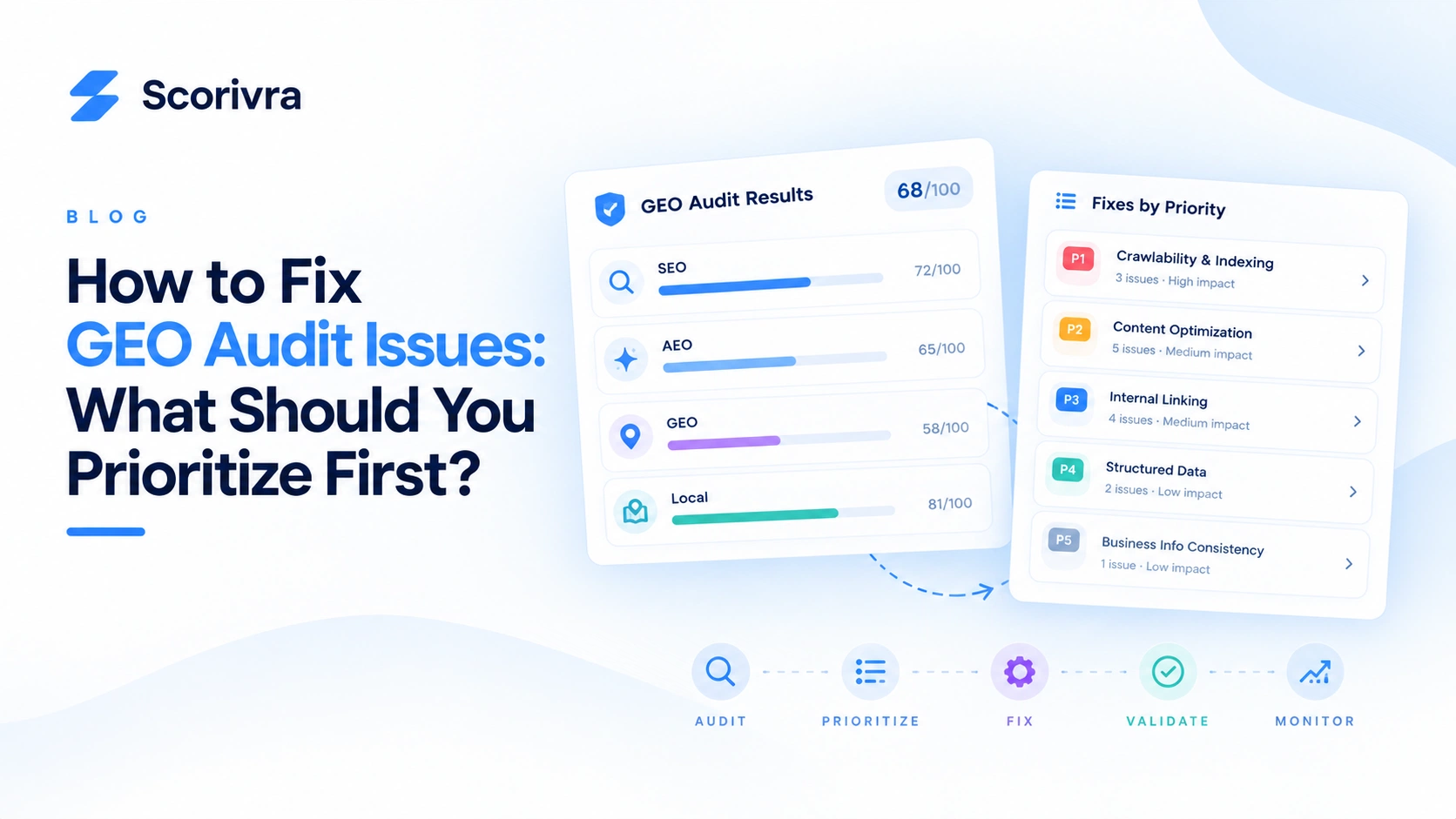
Running a GEO audit is a useful first step toward understanding how prepared your website is for AI-powered search.
But what happens after the audit?
You might discover pages that are difficult to crawl, content that lacks clear answers, missing structured data, weak internal links, or inconsistent information about your business.
Fixing everything at once is rarely practical.
Some issues can prevent important pages from being discovered. Others affect how clearly your content communicates its purpose. Some are minor improvements that may have little immediate impact.
The real challenge is deciding what to fix first.
This guide explains how to turn GEO audit findings into a prioritized action plan, which issues deserve immediate attention, and how to evaluate progress without assuming that every technical improvement will produce an AI citation.
1. Why GEO Audit Issues Shouldn't All Have the Same Priority
A GEO audit evaluates signals that may influence how accessible, understandable, and useful your website is in AI-powered search environments.
However, an audit finding is not automatically a ranking factor, and not every failed check has the same business impact.
Consider three examples:
- An important service page is accidentally blocked from crawling.
- A product page has an unclear heading and limited supporting information.
- An informational article is missing optional structured data.
All three may deserve attention, but they should not receive equal priority.
The first problem could prevent a crawler from accessing the page at all. The second could make it harder for readers and search systems to understand the page. The third might be a useful enhancement, depending on the content and the markup involved.
A practical prioritization process considers four questions:
- Impact: How much could the issue affect discovery, understanding, or user experience?
- Scope: Does it affect one page or an entire section of the website?
- Business relevance: Does it affect a page important to customers or conversions?
- Effort: How difficult and risky is the fix?
These questions help businesses focus on meaningful improvements instead of simply trying to eliminate every warning.
2. First Priority: Fix Crawlability and Indexing Problems
Before improving a page for AI search, make sure relevant search systems can access it.
A page with excellent content has limited discovery opportunities if it is unintentionally inaccessible.
Check Robots.txt Restrictions
Your robots.txt file can tell compliant crawlers which areas of your website they should not access.
For example:
User-agent: *
Disallow: /services/
This rule asks compliant crawlers not to access URLs under /services/.
If your important service pages are located there, the restriction could interfere with crawling.
However, robots.txt is not an access-control system, and crawler behavior differs across services.
What to fix:
- Identify rules affecting important public pages.
- Determine whether the restrictions are intentional.
- Remove unintended restrictions.
- Keep private or sensitive content protected through appropriate access controls rather than relying on robots.txt.
Do not automatically allow every AI-related crawler. Different crawlers serve different purposes, and your decision should reflect your content and access policies.
For additional context, read Can Robots.txt Block Your Website From AI Search?.
Review Noindex Directives
A page can be crawlable but excluded from indexing through a noindex directive.
For example:
<meta name="robots" content="noindex">
If this directive appears on a page you want indexed by Google, review whether it is intentional.
Remove an unintended noindex directive only after confirming that the page should be publicly discoverable.
Remember that removing noindex does not guarantee indexing or inclusion in AI-generated answers.
Check Canonical URLs
Canonical tags help indicate a preferred URL when similar or duplicate pages exist.
An incorrect canonical URL can cause search systems to associate a page with an unintended alternative.
Review whether important pages point to the correct canonical destination.
For a self-referencing canonical, the markup might look like:
<link rel="canonical" href="https://example.com/services/">
The URL above is illustrative.
Canonical tags are signals, not absolute commands, and they do not guarantee which page Google will select.
Verify Important Pages in Google Search Console
Use Google Search Console to investigate indexing and discovery issues.
For important URLs, review:
- Whether the page is indexed
- Whether crawling is permitted
- Whether the selected canonical URL is appropriate
- Whether Google encountered a technical error
- Whether the page can be rendered and understood
Priority rule: Address unintended access and indexing problems affecting important pages before spending time on cosmetic content improvements.
3. Second Priority: Improve Pages That Don't Clearly Answer User Questions
Once important pages are accessible, focus on whether their content is genuinely useful.
A page can be technically healthy but still provide a weak answer to the questions potential customers ask.
Identify the Main Question Behind Each Page
Every important page should have a clear purpose.
For example, a page about GEO audits should help readers understand what a GEO audit evaluates.
A page about fixing GEO audit issues should explain how to resolve those findings.
These are related topics, but they represent different user needs.
Before rewriting a page, ask:
- What question is this page supposed to answer?
- Can readers find the main answer quickly?
- Does the page explain important terms?
- Are recommendations supported by useful details?
- Is the content more helpful than a short generic summary?
Avoid expanding articles solely to increase word count.
Make Answers Specific and Actionable
Compare these examples.
Vague answer:
Improve your website structure to increase AI search visibility.
More useful answer:
Check whether important service pages have descriptive headings, accessible internal links, and content that directly explains the services offered. Fix missing information before adding optional markup.
The second answer provides specific actions that readers can evaluate.
It does not promise improved AI rankings, but it helps users understand what to change.
Add Supporting Evidence Where Appropriate
Claims are more useful when readers can understand their basis.
Depending on the topic, supporting material might include:
- Original examples
- Documented methods
- Product specifications
- Clear comparisons
- Relevant primary sources
- Publication and update information
Do not invent research findings, customer outcomes, or performance metrics to make a page appear more authoritative.
For commercial pages, accurate service descriptions and transparent product information are often more valuable than generic promotional language.
4. Third Priority: Repair Weak Internal Linking and Page Structure
Internal links help visitors discover related information and help search engines understand relationships between pages.
A website might have useful content but fail to connect it logically.
For example, imagine a website with separate articles about:
- AI search visibility
- AI mentions and citations
- GEO audits
- GEO audit fixes
- AI search performance measurement
These articles should not exist as isolated pages.
A reader learning about GEO audits may naturally want to know what to fix afterward.
Likewise, a reader investigating AI citations may want to understand how to monitor citation changes over time.
How to Fix Internal Linking Issues
Start by identifying important pages that receive few relevant internal links.
Then:
- Link from related articles where the connection helps readers.
- Use descriptive anchor text that explains the destination.
- Avoid adding repetitive links to every paragraph.
- Make important service and product pages reasonably easy to reach.
- Check that links do not point to deleted pages or unnecessary redirects.
For example:
After reviewing your website's readiness,
learn how to [prioritize GEO audit fixes](https://example.com/geo-audit-fixes).
Internal linking should support a logical content journey.
It should not be treated as a guaranteed mechanism for earning AI citations.
Improve Heading Structure
Descriptive headings make long pages easier to navigate.
A practical article might use sections such as:
- What the problem means
- Why it matters
- How to check it
- How to fix it
- How to verify the result
Headings should describe the actual content rather than repeat the target keyword unnecessarily.
5. Fourth Priority: Correct Structured Data Errors
Structured data can help eligible search systems interpret certain types of page information.
However, structured data is not a universal requirement for AI search visibility.
Adding schema markup does not guarantee that ChatGPT, Gemini, or Google AI search experiences will cite a page.
The first priority is ensuring that any structured data you already use is accurate.
What to Check
Review whether:
- The schema type matches the actual content.
- Required properties are present for the intended supported feature.
- Marked-up information matches visible page content.
- Business names, URLs, and other details are accurate.
- The markup contains invalid syntax or unsupported claims.
For example, an organization might use Organization structured data to describe its identity.
A product page might use appropriate product-related markup when applicable.
But adding unrelated schema types simply to increase markup coverage can create confusion rather than value.
When Should Schema Fixes Come First?
Move structured data fixes higher in the queue when they affect important pages and a specific supported search feature.
Otherwise, correcting broken access, inaccurate content, or missing information may be more valuable.
For background, see Does Schema Markup Help AI Search Visibility?.
6. Fifth Priority: Improve Business and Brand Information Consistency
AI search can involve questions about businesses, services, products, and locations.
Inconsistent public information can make it harder for customers to understand which details are current.
For a local business, check:
- Business name
- Address and service area
- Phone number
- Opening hours
- Primary services
- Location-specific pages
For a SaaS business, check:
- Product name and description
- Feature availability
- Pricing information
- Supported platforms
- Intended customer segments
- Documentation and contact information
Why This Matters
Imagine a software company whose homepage describes four supported platforms while an older comparison page describes only two.
A potential customer may encounter contradictory information.
Fixing that inconsistency improves the quality of the information available to readers.
It does not guarantee that an AI system will prefer the newer information, but it reduces unnecessary ambiguity.
Priority rule: Correct factual inconsistencies on high-value pages before publishing more pages that repeat outdated information.
7. How to Prioritize GEO Audit Fixes With an Impact-Effort Matrix
A simple impact-effort matrix can turn a long list of findings into a manageable plan.
Classify each issue using two dimensions:
Impact
- High: Affects accessibility, important content, or major customer journeys.
- Medium: Affects clarity, navigation, or useful supporting information.
- Low: Limited effect on important pages or user tasks.
Effort
- Low: Can be fixed quickly with limited risk.
- Medium: Requires editing, testing, or coordination.
- High: Requires development work, significant restructuring, or careful validation.
Here is an illustrative prioritization table.
| GEO audit issue | Impact | Effort | Suggested priority |
|---|---|---|---|
| Important service page unintentionally blocked | High | Low–Medium | Critical |
| Important page accidentally marked noindex | High | Low | Critical |
| Incorrect canonical on a key page | High | Low–Medium | High |
| Core service page missing essential information | High | Medium | High |
| Broken internal links to important pages | Medium–High | Low | High |
| Inaccurate business information | Medium–High | Low | High |
| Invalid structured data on a key eligible page | Medium | Low–Medium | Medium |
| Minor heading improvements on a low-traffic article | Low | Low | Low |
| Optional schema enhancement without a clear use case | Low | Medium | Low |
These classifications are illustrative. Actual priority depends on the affected pages, the issue's severity, and the business context.
A Simple Priority Formula
If you need a repeatable internal process, you can create a basic scoring model.
For example:
Priority score = (Impact × Business relevance × Scope) ÷ Effort
Assign each factor a value from 1 to 5.
Suppose an issue has:
- Impact: 5
- Business relevance: 5
- Scope: 3
- Effort: 2
Its illustrative priority score would be:
(5 × 5 × 3) ÷ 2 = 37.5
Compare that with a minor issue:
- Impact: 2
- Business relevance: 2
- Scope: 1
- Effort: 3
Its score would be:
(2 × 2 × 1) ÷ 3 ≈ 1.3
This formula is a suggested planning method, not Scorivra's proprietary audit scoring system or a Google ranking formula.
It is useful for organizing work, but human judgment should override the score when security, compliance, accessibility, or major technical failures are involved.
8. A Practical 30-Day GEO Audit Fix Plan
You don't need to resolve every issue in a single day.
A structured 30-day plan can help small teams make progress without losing track of changes.
Week 1: Resolve Critical Technical Problems
Focus on issues that could prevent important pages from being accessed or indexed.
Tasks:
- Review robots.txt restrictions.
- Investigate unintended noindex directives.
- Check important canonical URLs.
- Identify major server and crawl errors.
- Confirm that critical pages are reachable through internal navigation.
Document what changed and when.
Week 2: Improve High-Value Content
Choose a small number of important pages rather than rewriting the entire website.
Tasks:
- Clarify the main question each page answers.
- Improve incomplete service or product descriptions.
- Add useful examples and supporting evidence.
- Correct outdated information.
- Make headings and sections easier to understand.
Prioritize pages that support real customer decisions.
Week 3: Strengthen Internal Links and Supporting Information
Connect related pages and review structured data where appropriate.
Tasks:
- Add relevant links between related articles.
- Repair broken links.
- Review important navigation paths.
- Correct inaccurate structured data.
- Check consistency across key business pages.
Avoid creating new pages when an existing page can satisfy the same search intent.
Week 4: Validate and Establish a Baseline
Review the completed changes and collect performance data.
Tasks:
- Recheck affected URLs.
- Review Google Search Console indexing and search performance.
- Compare relevant AI search monitoring results.
- Examine landing-page engagement and conversions.
- Record unresolved issues for the next improvement cycle.
A 30-day plan is an organizational framework, not a promise that search performance will improve within 30 days.
Some changes take longer to be crawled, indexed, reflected in search systems, or measured reliably.
9. How to Measure Whether GEO Audit Fixes Worked
A completed task is not the same as a successful outcome.
For example, correcting an unintended noindex directive is a technical fix.
Whether the page is subsequently indexed, receives impressions, or earns citations is a separate question.
Evaluate changes at several levels.
Technical Validation
Confirm that the original issue has been resolved.
Examples include:
- The intended page is accessible.
- An unintended noindex directive has been removed.
- Canonical markup points to the correct destination.
- Broken internal links now work.
- Structured data errors have been corrected.
These checks provide relatively direct evidence that a technical task was completed.
Google Search Performance
Use Google Search Console to examine relevant pages and queries over time.
Look for:
- Indexing status changes
- Search impressions
- Clicks
- Query coverage
- Performance of important landing pages
Avoid attributing every change to a single fix.
Search performance can also change because of competition, seasonality, algorithm updates, and changing search behavior.
AI Search Visibility
Monitor a consistent set of relevant questions across the AI search platforms you are evaluating.
Useful observations include:
- Brand mentions
- Website citations
- Recommendation positions
- Competitor appearances
- Changes across repeated monitoring periods
Because AI-generated responses can vary, one successful citation is not enough to establish a lasting improvement.
Use comparable prompt sets and observation periods whenever possible.
Business Outcomes
Finally, review whether relevant pages contribute to meaningful actions.
These might include:
- Qualified website visits
- Demo requests
- Contact submissions
- Trial or account registrations
- Purchases or subscriptions
A technical improvement can be worthwhile even when it does not immediately produce measurable revenue.
But long-term optimization should consider both website quality and business outcomes.
10. Common Mistakes When Fixing GEO Audit Issues
Mistake 1: Trying to Reach a Perfect Audit Score
A higher audit score can indicate that more checks are passing, but it does not automatically mean your business will receive more AI citations or customers.
Focus on meaningful issues rather than treating 100/100 as the only objective.
Mistake 2: Adding Schema Before Fixing the Content
Structured data should accurately describe the page.
If the underlying content is incomplete or misleading, markup alone does not solve the problem.
Improve the information first.
Mistake 3: Publishing New Articles for Every Related Keyword
Creating separate pages for nearly identical questions can lead to unnecessary overlap.
For example:
- What is a GEO audit?
- What does a GEO audit check?
- How does a GEO audit work?
These questions may sometimes fit within one comprehensive article.
A separate article about how to fix GEO audit findings, however, serves a more action-oriented purpose.
Build new pages around distinct user needs, not minor keyword variations.
Mistake 4: Assuming Every AI Crawler Behaves the Same Way
Search crawlers, AI search systems, and model-training crawlers do not all have identical roles or policies.
Review the documentation for the specific services that matter to your business.
Avoid making universal claims about how every AI platform discovers or uses content.
Mistake 5: Expecting Immediate Results
Technical corrections may be verifiable quickly, but visibility changes can take time.
An AI-generated answer may also change without any modification to your website.
Measure results across comparable periods rather than drawing conclusions from a single prompt or a single day.
11. How Scorivra Fits Into the GEO Improvement Process
Scorivra provides a Site Audit that evaluates website checks across SEO, AEO, GEO, and Local categories.
This can help businesses identify issues that deserve investigation.
The important next step is translating those findings into practical work.
A useful process is:
- Run a site audit to identify potential issues.
- Review which findings affect important pages.
- Prioritize fixes using impact, scope, business relevance, and effort.
- Implement and validate the changes.
- Use search and AI visibility data to observe what happens afterward.
Scorivra also offers AI Visibility monitoring for tracked questions across supported AI search platforms, as well as Performance reporting using connected Google Search Console and Google Analytics 4 data.
These capabilities can help businesses examine different aspects of search performance.
However, audit findings, AI visibility observations, and analytics results should not be treated as proof of direct causation.
You can start with Scorivra's free site audit to review your website's initial findings.
For a broader introduction to what an audit evaluates, read What Is a GEO Audit? How to Evaluate Your Website for AI Search.
Frequently Asked Questions
What should I fix first after a GEO audit?
Start with critical access and indexing issues affecting important pages. Then address missing or inaccurate content, broken internal links, business information inconsistencies, and relevant structured data errors.
Should I fix every GEO audit warning?
Not necessarily. Prioritize findings based on their actual impact, the pages affected, business relevance, and implementation effort. Some warnings may require investigation rather than immediate changes.
Will fixing GEO audit issues improve my ChatGPT visibility?
There is no guarantee. Improving accessibility and content quality may support discoverability and usefulness, but AI recommendations and citations depend on factors outside your direct control.
Is structured data the most important GEO fix?
No. Structured data can be useful in appropriate contexts, but important crawlability problems, inaccurate information, and weak content may deserve attention first.
How long does it take to see results after GEO fixes?
There is no universal timeline. Technical changes can often be checked after implementation, while indexing, search visibility, and AI citation changes may take longer or may not occur.
Can I use a traditional SEO audit to fix GEO problems?
Many foundational SEO checks are relevant, including crawlability, indexing, internal links, and content quality. GEO-focused evaluation can add attention to how content serves questions in AI-powered search, but it does not replace technical SEO.
Should I create new content or update existing pages?
Update an existing page when the new material serves the same search intent. Create a separate page when the user needs a meaningfully different answer, such as moving from understanding an audit to implementing its findings.
Final Thoughts
A GEO audit is most valuable when it leads to a clear improvement plan.
Fix the issues that prevent important pages from being accessed or understood before spending time on optional enhancements.
Then strengthen high-value content, repair internal navigation, correct factual inconsistencies, and validate the changes.
You don't need to resolve every warning immediately, and you shouldn't expect every improvement to produce an AI citation.
The goal is to build a website that is accessible, accurate, useful, and easier for customers to navigate.
Audit → Prioritize → Fix → Validate → Monitor
That process provides a more sustainable foundation for GEO improvements than chasing a perfect score.