
Your business might appear in an AI recommendation when someone searches from one part of a city but be missing when the same question is asked from another location.
For businesses serving local customers, this difference matters. A single AI search result cannot show how consistently a business is recommended across its service area.
Measuring AI search visibility across different locations helps reveal where your business appears, where it is missing, and which competitors are recommended instead.
1. Why AI Recommendations Can Vary by Location
Location can influence the businesses recommended in AI-generated answers, particularly when a question has local intent.
Consider someone asking AI to recommend a plumber nearby. The results may depend on the location associated with the request, the relevance of available business information, and other signals used by the AI system.
A plumbing company might be recommended near its premises but appear less consistently across the wider area it serves.
This creates an important distinction between two questions:
- Does AI recommend your business?
- Where does AI recommend your business?
Checking one location answers only part of the second question.
It is also important to recognise that location is not the only factor affecting AI-generated answers. Results can vary between measurements, platforms, and question wording.
Therefore, a change in recommendation should not automatically be attributed to geography alone.
2. How to Measure AI Recommendation Coverage Across Locations
A practical approach is to measure the same local-intent question from multiple geographic points within a defined market.
For example, a business could examine recommendations across its city rather than relying on one search near its premises.
To make the comparison meaningful, keep the following conditions consistent:
- Search question: Use the same relevant local-intent question.
- Geographic coverage: Define the locations included in the measurement.
- AI platform: Compare results from the same AI search environment.
- Measurement period: Record when each result was collected.
For every location, identify whether your business was mentioned or recommended and which competitors appeared.
One useful metric is AI recommendation coverage: the proportion of measured locations where your business appears.
Illustrative example:
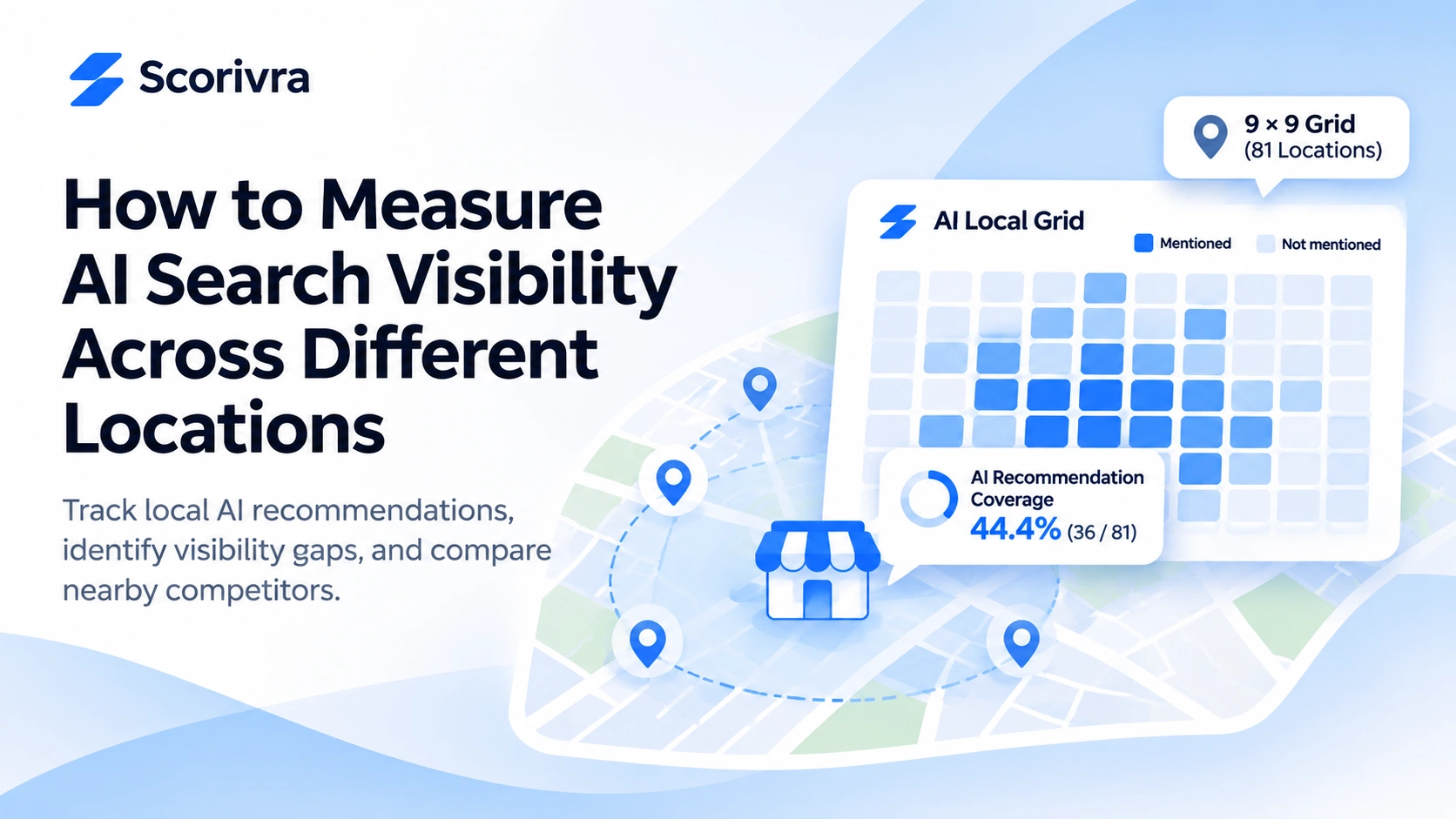
Suppose a business is mentioned at 36 out of 81 measured locations.
Its measured coverage would be:
36 ÷ 81 × 100 = 44.4%
This means the business appeared at approximately 44.4% of the sampled locations.
It does not mean that 44.4% of people in the city will see the business, or that the business holds 44.4% of local AI search traffic.
The figure describes the specific locations, questions, platform, and measurement period included in the analysis.
3. How to Interpret Local AI Visibility Gaps
Once you have location-based results, look for patterns rather than focusing on a single missing recommendation.
For example, your business might appear frequently around its premises but less often in neighbouring areas.
Another business might be recommended consistently across locations where yours is absent.
These observations can help identify areas worth investigating.
However, a missing recommendation does not prove that your website, business profile, or local SEO is defective.
Before deciding what to change, consider whether:
- The monitored question reflects a service your business actually provides.
- The locations fall within your intended service area.
- Competitors offer services relevant to those locations.
- The pattern remains visible across subsequent measurements.
Comparing results over time is especially important because individual AI-generated answers can vary.
A location that produces no mention during one measurement should not immediately be treated as a permanent visibility gap.
Likewise, improved recommendation coverage does not automatically establish an increase in enquiries or customers.
The goal is to identify meaningful geographic patterns and determine which areas deserve closer investigation.
4. How Scorivra's AI Local Grid Helps
Scorivra's AI Local Grid measures location-based business recommendations using Gemini.
It applies a geographic grid across a local market, allowing businesses to examine whether AI mentions or recommends them at different measurement points.
The feature provides a 9×9 grid covering 81 locations and supports weekly geographic measurements.
Businesses can use these results to:
- Identify locations where their business is recommended.
- Find geographic areas where their business is missing.
- See which competitors appear in local AI recommendations.
- Compare recommendation coverage across measurement periods.
For example, a business may discover that its AI recommendation coverage is concentrated in one part of its market while competitors appear more consistently elsewhere.
This provides a more detailed geographic picture than checking a single AI answer.
AI Local Grid and Google Maps Grid measure different things.
Google Maps Grid tracks map rankings by location, while AI Local Grid measures Gemini-based business mentions and recommendations.
Scorivra's broader AI Visibility feature separately tracks selected questions across supported AI search environments.
AI Local Grid should not be interpreted as measuring location-specific recommendations across every AI platform or as directly measuring Google AI Overviews.
Explore Scorivra's Local Search features to see how AI Local Grid measures geographic recommendation coverage and compares local competitors.
Frequently Asked Questions
Can AI recommend my business in one location but not another?
Yes. Location can influence local-intent AI recommendations. However, other factors can also affect generated answers, so results should be compared under consistent measurement conditions.
Does AI Local Grid measure Google AI Overviews?
No. Scorivra's AI Local Grid uses Gemini for geographic recommendation measurements. Its results should not be presented as direct measurements of Google AI Overviews.
Does better AI recommendation coverage guarantee more customers?
No. Recommendation coverage measures visibility across defined geographic points. Website visits, enquiries, and customer conversions are separate business outcomes.
Conclusion
AI search visibility is not always consistent across a local market. Measuring recommendations from multiple locations can help businesses understand where they appear, where competitors are more visible, and which geographic areas deserve attention.
By using consistent questions, defined measurement locations, and repeated observations, businesses can build a more reliable picture of their local AI presence. Scorivra's AI Local Grid provides a geographic view of these recommendations, helping businesses make better-informed decisions about their local visibility.