
Your client asks a straightforward question:
"Are more people finding our business through AI search?"
You have data showing brand mentions, website citations, and competitor appearances. But sending those numbers alone doesn't explain whether the client is making progress.
An effective AI search visibility report should show where a business appears in AI-generated answers, how it compares with competitors, what has changed, and what to investigate next.
The goal is to turn visibility measurements into useful business decisions without confusing AI recommendations with website traffic or sales.
Here's a practical way to do it.
What Should You Measure in an AI Search Visibility Report?
Start with four core metrics.
| Metric | What it measures |
|---|---|
| Brand mention rate | How often the business is named in monitored AI answers |
| Website citation rate | How often its website is cited as a source |
| Competitor presence | Which competing businesses appear in the same answers |
| Share of Voice | The brand's relative presence within a defined competitor set |
These metrics answer different questions.
A company might appear frequently in AI recommendations but rarely receive website citations. Another might have a lower overall mention rate but appear consistently for questions about its most valuable services.
That is why a single visibility score rarely tells the entire story.
Keep the Measurement Scope Consistent
Before comparing results, record the questions, AI search experiences, competitors, locations, and reporting dates.
If the monitored questions change significantly between months, differences in the results may reflect the measurement setup rather than changes in brand visibility.
Mention rates and citation rates should also have clearly defined denominators. For example, 20 mentions across 50 completed question checks produces a 40% mention rate for that measured sample.
It does not mean 40% of all AI search users encounter the brand.
How to Create a Monthly AI Search Visibility Report
A practical client report can be organised into four sections.
1. Performance Summary
Begin with the most important changes.
Consider this fictional monthly report for a professional services company.
| Metric | Previous month | Current month |
|---|---|---|
| Brand mention rate | 32% | 40% |
| Website citation rate | 14% | 18% |
| Share of Voice | 22% | 27% |
| Questions where only competitors appeared | 12 | 9 |
Illustrative data only. These are not actual Scorivra customer results.
The report should explain the changes in plain language.
For example:
"Brand mentions increased by 8 percentage points, while website citations increased by 4 percentage points across the monitored questions. Competitor-only appearances declined from 12 questions to 9."
This gives the client a useful summary without claiming the business has gained more customers.
2. Questions Where Competitors Still Appear
Overall improvement does not mean every important customer question is performing well.
Suppose the company provides accounting services and remains absent from AI recommendations for:
- "Which accountants help new limited companies in Manchester?"
- "Who provides bookkeeping services for small businesses?"
- "Which accounting firms specialise in contractor tax returns?"
If relevant competitors appear repeatedly for these questions, the report should identify them as areas for further investigation.
Before recommending improvements, check whether the company actually offers the requested services.
This prevents teams from treating every missing recommendation as a problem.
3. Interpretation and Recommended Actions
Clients need to understand what the results mean.
Instead of simply saying "AI visibility improved", explain which opportunities remain.
For example:
"Overall brand visibility improved, but competitors continue to appear more consistently for questions about limited company accounting. We recommend reviewing the relevant service page to ensure it clearly addresses these customer needs."
A good report separates three elements:
- Observation: What the measurements show
- Interpretation: What those findings might indicate
- Action: What should be investigated or improved next
This distinction matters because a competitor appearing more often does not prove that its website content is the cause.
AI-generated answers can vary, and the underlying reasons for a recommendation may not be fully visible.
4. Next Reporting Period
Finish with specific follow-up actions.
For example:
- Review the limited company accounting service page.
- Check whether relevant business information is accurate and consistent.
- Repeat the same customer questions during the next reporting period.
- Compare brand mentions, citations, and competitor presence again.
This turns the report into a repeatable improvement process rather than a collection of disconnected figures.
Should AI Search Reports Include Website Traffic and Conversions?
Yes, when reliable data is available. However, it should be presented separately from AI visibility measurements.
An AI brand mention does not necessarily produce a website visit. A website citation does not guarantee a click.
Google Search Console can show Google search impressions and clicks, while Google Analytics 4 provides information about website sessions, traffic sources, and configured key actions.
These are different measurements.
For example, a monthly report might show increased AI brand mentions alongside stable website traffic.
That doesn't necessarily mean the monitoring data is incorrect. It means the available evidence does not establish a corresponding increase in visits.
Where identifiable AI referral traffic and conversion data exist, include them as additional context.
Avoid claiming that changes in AI visibility directly caused revenue growth without supporting evidence.
How to Prepare Reports Without a Dedicated Reporting Tool
You can build a useful report using a spreadsheet.
Start by recording question-level measurements, then calculate the relevant rates and compare reporting periods.
Next, create a short summary explaining the changes and identifying questions that require attention.
For a small number of questions, this can be manageable.
However, reporting becomes more time-consuming when you need to monitor multiple competitors, repeat checks regularly, or maintain historical records across several clients.
The challenge is not just creating the final document. It is collecting comparable measurements consistently.
How Scorivra Helps with AI Search Reporting
Scorivra helps teams collect and review the measurements needed for ongoing AI search reporting.
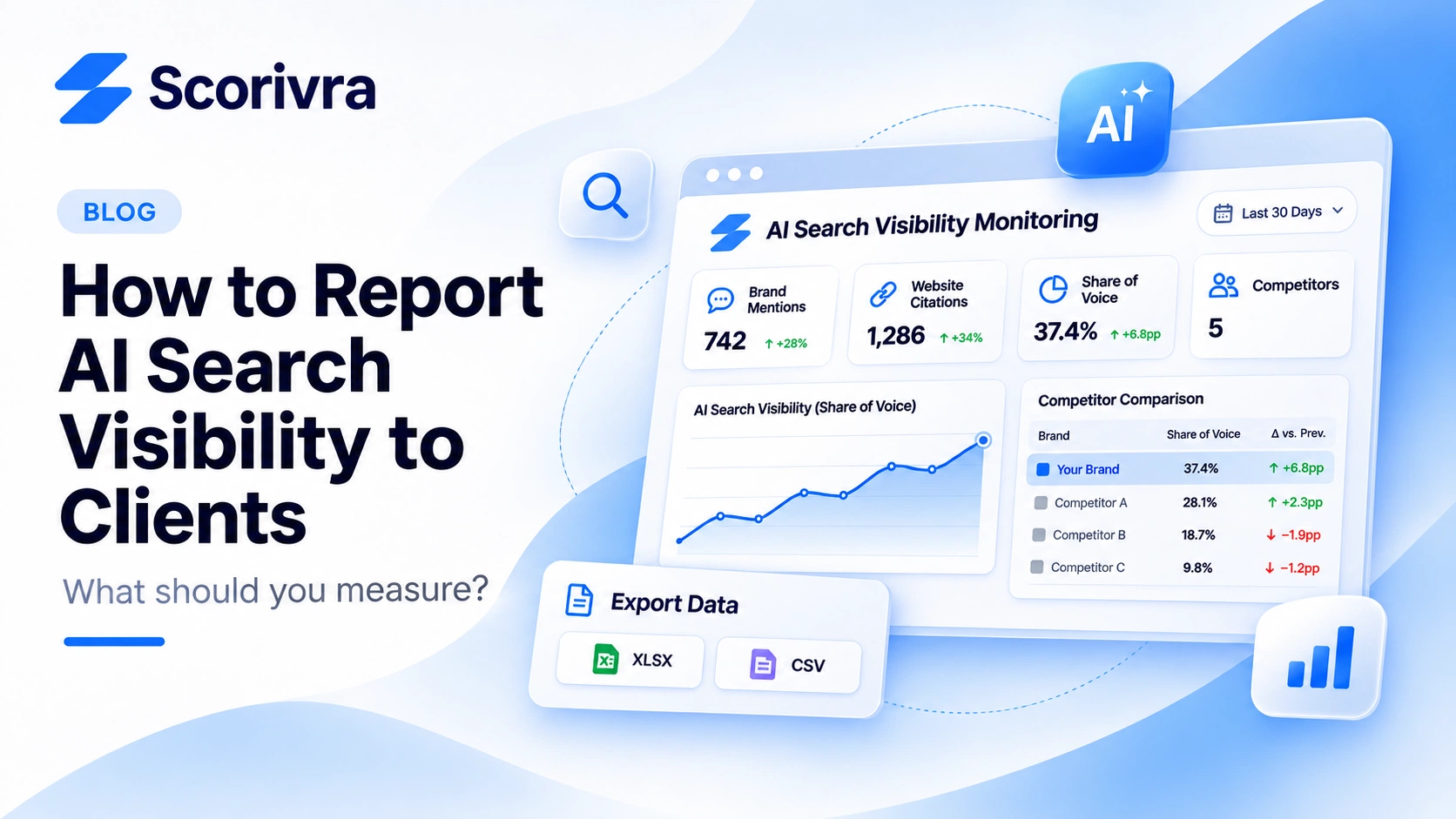
Its AI Visibility feature tracks brand mentions, website citations, Share of Voice, competitor appearances, and question-level results over time.
These measurements can help identify which customer questions deserve attention and whether observed patterns are changing.
Scorivra also supports exporting stored data to Excel or CSV, allowing teams to work with the information in their own spreadsheets and reporting documents.
The export provides data, not a finished client presentation. Teams still need to select relevant metrics, interpret results, and prepare their own report.
For businesses with connected Google Analytics 4 and Search Console accounts, Scorivra's Performance section can provide additional website and search performance context. These measurements should remain distinct from AI mentions and citations.
Make AI Search Performance Easier to Monitor
If your team regularly checks AI answers and compares competitors, consistent historical data can make reporting more manageable.
Scorivra helps you monitor brand visibility and question-level changes so you can focus on explaining what the results mean and what to investigate next.
Explore Scorivra AI Visibility
Frequently Asked Questions
How often should agencies report AI search visibility?
Monthly reporting is a practical starting point for many teams. The underlying monitoring can occur more frequently, depending on the client's needs and the tracking service.
Does higher AI Share of Voice mean more sales?
Not necessarily. Share of Voice describes relative visibility within a defined monitoring set. Website traffic, enquiries, and conversions must be measured separately.
Can AI search monitoring data be exported to Excel?
Yes, some monitoring platforms provide spreadsheet exports. Scorivra supports XLSX and CSV data exports on paid plans, which teams can use to prepare their own reports.
Final Thoughts
AI search reporting should answer more than whether a brand appeared in an AI-generated response.
A useful report explains how often the business was mentioned, whether its website was cited, where competitors appeared, and which findings deserve attention.
Present the measurements clearly, acknowledge their limitations, and recommend practical next steps.
For teams that need consistent AI visibility data across reporting periods, explore Scorivra's monitoring features.