
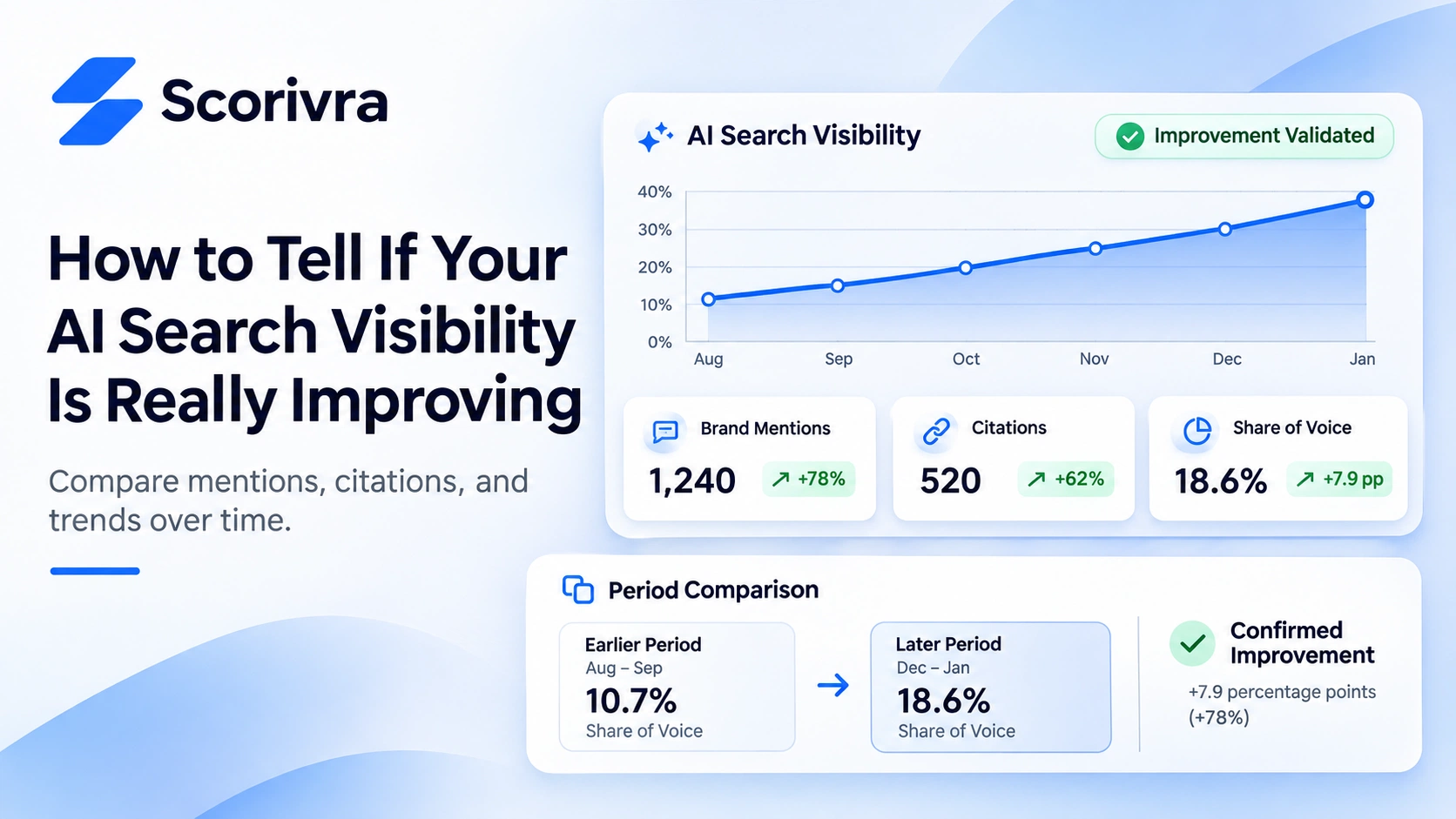
Your brand appeared in more AI-generated answers this week than last week. Does that mean your AI search visibility is improving?
Not necessarily.
AI-generated answers can change even when your website and business information remain the same. A higher mention rate during one measurement period may reflect a genuine improvement, temporary variation, or changes in how the data was collected.
To understand whether your visibility is improving, you need to look beyond individual results and examine consistent patterns over time.
1. Why AI Search Visibility Results Fluctuate
AI search results are not always identical when the same question is asked repeatedly.
A business might appear in one answer but be absent from another. The competitors mentioned, sources cited, and order of recommendations can also change.
Several factors may contribute to these differences:
- Answer variability: AI systems can generate different responses to the same question.
- Platform differences: Different AI search platforms may recommend different businesses.
- Measurement conditions: Changes in questions, locations, or measurement periods can affect results.
- Information changes: Updated website content and external sources may influence what AI systems use.
This makes it risky to judge performance from a single result.
For example, if your business appears in five AI answers today but only three tomorrow, that does not necessarily indicate a decline.
The difference could reflect normal variation rather than a meaningful change in your brand's visibility.
The key is to compare results consistently enough to distinguish short-term fluctuations from broader trends.
2. Establish a Reliable Visibility Baseline
Before deciding whether visibility has improved, establish a baseline that represents your starting position.
A useful baseline should reflect a defined set of customer questions, consistent measurement conditions, and a clear observation period.
Focus on three core measurements:
Brand Mention Rate
How often your business appears in AI-generated answers to the questions being tracked.
Citation Rate
How often your website is cited as a source in those answers.
Share of Voice
Your brand's relative visibility compared with competing businesses within the measured question set.
These metrics describe different aspects of AI search visibility and should not be treated as interchangeable.
For example, your brand might appear more frequently without receiving additional website citations.
Similarly, your Share of Voice might increase because competitors appear less frequently, even if your own mention count remains unchanged.
When establishing a baseline, record the measurement period, tracked questions, platforms, and number of completed measurements.
If the questions or measurement conditions change substantially, treat the new results as a separate comparison rather than assuming they represent a direct improvement.
3. How to Identify Meaningful Visibility Improvements
A positive trend becomes more convincing when it appears consistently across comparable measurements.
Consider this hypothetical example:
| Metric | Earlier period | Later period |
|---|---|---|
| Brand Mention Rate | 30% | 42% |
| Citation Rate | 12% | 18% |
| Share of Voice | 20% | 27% |
All three measurements have increased.
This could indicate stronger AI search visibility, provided the same questions, platforms, and measurement methodology were used.
However, the percentages alone do not establish how reliable the improvement is.
A change based on ten measurements provides less evidence than a similar change observed across hundreds of comparable measurements.
You should also check whether improvements are concentrated in just one or two questions or appear across a broader portion of your monitored searches.
When reviewing trends, ask:
- Are mention and citation rates improving across multiple measurement periods?
- Is the number of completed measurements sufficient to interpret the change?
- Are the same customer questions and platforms being compared?
- Are competitors becoming more or less visible during the same period?
A sustained increase across comparable measurements provides stronger evidence than an isolated spike.
Even then, a visibility improvement does not prove that a specific website update caused the change.
It also does not automatically mean that website traffic, enquiries, or sales have increased. Those business outcomes require separate measurement.
4. How Scorivra Helps Track AI Visibility Trends
Scorivra's AI Visibility feature helps businesses monitor their presence in AI-generated answers over time.
Instead of relying on occasional manual searches, businesses can track selected questions and review changes in several visibility metrics.
Scorivra provides:
- Brand Mentions: See whether your business appears in tracked AI answers.
- Website Citations: Check whether your website is referenced as a source.
- Share of Voice: Compare your visibility with competitors.
- Question-Level Results: Identify which questions include your business and which do not.
- Historical Trends: Review how measured visibility changes across reporting periods.
These measurements help businesses investigate whether improvements are becoming more consistent or whether recent results may reflect temporary fluctuations.
For example, a business could compare its latest mention and citation rates with previous measurements while reviewing which questions contributed to the change.
Scorivra provides the monitoring data needed for that comparison. Interpreting whether a trend is meaningful still requires attention to measurement consistency, sample size, and the broader context.
Explore Scorivra's AI Visibility features to learn how brand mentions, citations, and competitor visibility can be monitored over time.
Frequently Asked Questions
How long should I monitor AI search visibility before judging improvement?
There is no universal minimum period. The appropriate timeframe depends on measurement frequency, the number of tracked questions, and how variable the results are. Comparing several consistent measurement periods is generally more informative than relying on a single day.
Can AI visibility improve even if my website has not changed?
Yes. AI-generated answers may change because of platform behaviour, updated external information, or normal response variation. An improvement should not automatically be attributed to changes made by your business.
Does a higher AI mention rate mean more customers?
Not necessarily. Mention rates measure visibility within tracked AI answers, not website visits or conversions. Actual traffic and business outcomes should be analysed separately.
Conclusion
Improving AI search visibility is not simply about recording a higher number of brand mentions. Meaningful progress requires consistent measurements, reliable comparisons, and an understanding of how AI-generated answers can vary over time.
By reviewing mentions, citations, and competitive visibility across comparable periods, businesses can distinguish temporary fluctuations from more persistent trends. This provides a stronger foundation for evaluating their AI search presence without assuming that every increase represents a lasting improvement.