
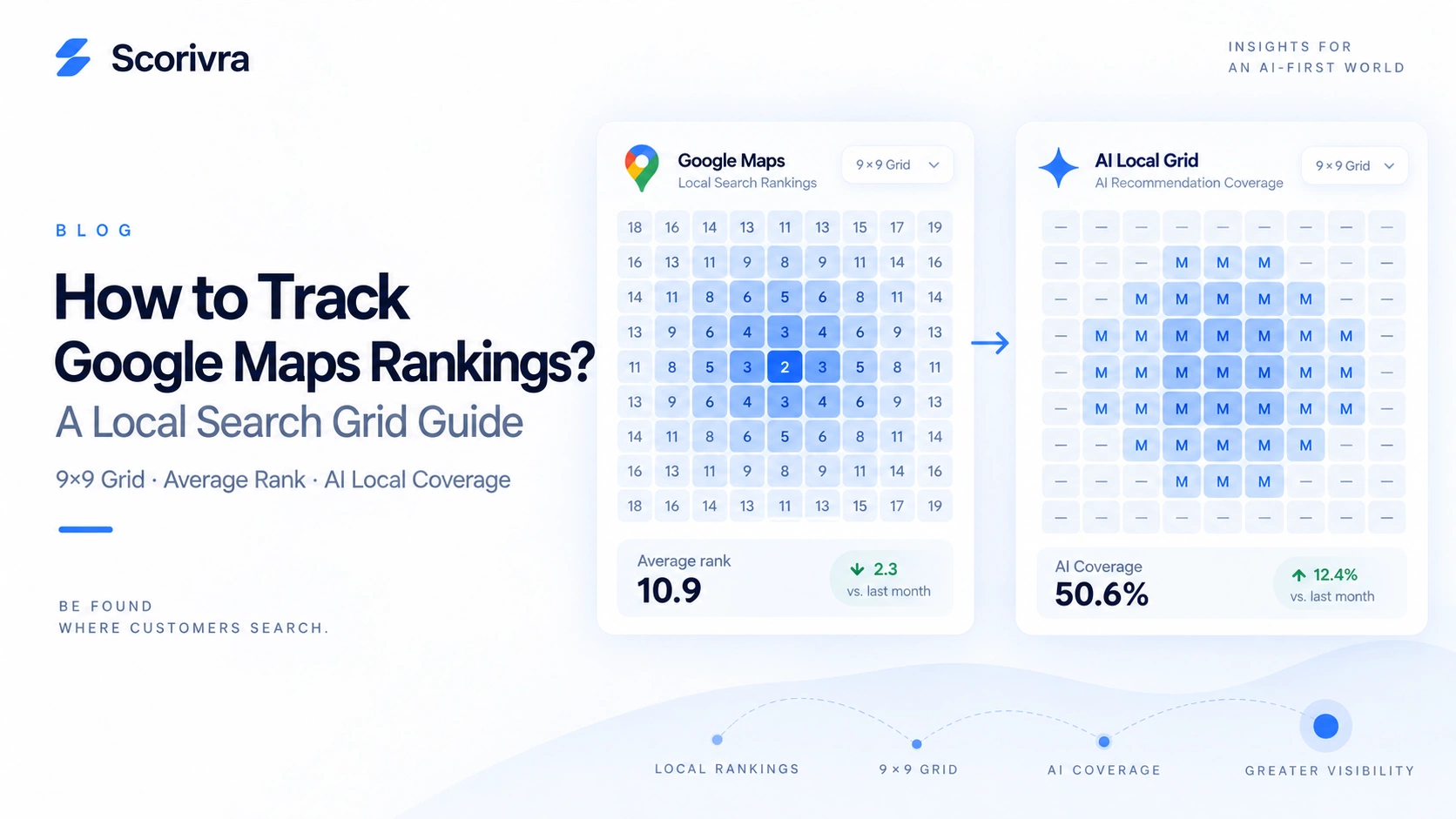
Google Maps rankings are not the same everywhere in a city.
A business may appear near the top when someone searches a few blocks away, rank much lower from another neighborhood, and disappear from the visible results farther across town.
That does not necessarily mean something is wrong.
Google states that local search results are mainly influenced by relevance, distance, and prominence. Because distance is part of the ranking system, the location of the person searching can directly affect which businesses appear and in what order.
That is why checking your Google Maps ranking from one location is not enough.
A local search grid helps you measure how your business actually appears across an entire target area.
Why Google Maps Rankings Change by Location
Traditional rank tracking usually gives you one number.
For example:
Your business ranks #3 for “med spa near me.”
That sounds useful, but it leaves out an important question:
From where?
Imagine a med spa located in the center of a city.
A customer searching one block away may see the business in position 2.
Someone searching two miles away may see it in position 6.
Another person searching from the opposite side of the city may not see the business in the top results at all.
All three results can exist at the same time.
Google explains that local rankings are primarily based on:
- Relevance — how closely the business matches the search.
- Distance — how far the business is from the searcher or the location used in the query.
- Prominence — how well known and established the business appears to be.
Because distance changes from one neighborhood to another, local rankings can also change.
So instead of asking:
What is my Google Maps ranking?
a more useful question is:
Where across my target area is my business visible?
What Is a Local Search Grid?
A local search grid measures the same keyword from multiple geographic points around a business.
For example, a 9 × 9 grid contains:
81 search locations.
If a dental clinic wants to track:
dental implants
the same search can be measured from all 81 locations around the business.
The result is a geographic view of local visibility.
Near the clinic, rankings may look like:
- #1
- #2
- #3
Farther away, they may become:
- #6
- #9
- #14
And in some areas, the business may not appear within the tracked ranking range at all.
This gives you something a single ranking number cannot provide:
a map of where your business is strong and where its visibility becomes weaker.
Why One Google Maps Ranking Can Be Misleading
Suppose you check your Google Maps ranking from your own office.
Your business appears in position 2.
It would be easy to conclude:
We rank #2 on Google Maps.
But your customers are not all searching from inside your office.
They may be searching from:
- their homes
- nearby neighborhoods
- offices
- shopping districts
- surrounding suburbs
If your business ranks #2 close to your location but #10 or lower across most of the city, the #2 result does not represent your overall local visibility.
A single location gives you a point measurement.
A local search grid gives you a coverage measurement.
For a local business, coverage is often much more useful.
Two Metrics That Make Local Grid Data Easier to Understand
Looking at 81 individual ranking positions every time you run a scan is not practical.
Two summary metrics make the data easier to interpret:
- Discovery Rate
- Average Rank
Discovery Rate
Discovery Rate measures how often your business appears across the tracked grid.
For example:
- Total locations: 81
- Business found at: 61
The Discovery Rate would be approximately:
61 ÷ 81 = 75%
This means the business appeared at roughly 75% of the monitored search locations.
Discovery Rate answers:
How much of my target area can actually find my business?
A higher Discovery Rate means your business is visible across a larger part of the area being measured.
Average Rank
Average Rank measures the average ranking position across locations where your business was found.
For example, your business may rank:
2, 3, 4, 5, 6, 7, 8
across several search points.
The Average Rank summarizes the overall strength of those visible positions.
Average Rank answers:
When my business appears, how strongly does it usually rank?
A lower Average Rank generally means stronger visibility.
But Average Rank should not be viewed alone.
Consider two businesses.
Business A
- Average Rank: 2.5
- Discovery Rate: 30%
Business B
- Average Rank: 6.0
- Discovery Rate: 90%
Business A ranks extremely well where it appears, but its geographic reach is narrow.
Business B ranks lower on average, but it appears across almost the entire monitored area.
These are two very different local visibility profiles.
That is why Discovery Rate and Average Rank should be analyzed together.
How to Read a Local Search Grid
The goal of a local search grid is not simply to look at dozens of ranking numbers.
The goal is to identify geographic patterns.
Strong Near the Business, Weak Farther Away
This is one of the most common patterns.
Your business ranks well close to its physical location but gradually loses visibility as the search points move farther away.
Because distance is one of Google's local ranking factors, some decline can be expected.
The more useful question is:
Do your competitors lose visibility at the same rate?
If competitors remain visible much farther away, there may be additional differences in:
- relevance
- prominence
- reviews
- website authority
- local content
- business category
- competitive strength
One Area Is Much Weaker Than the Rest
Sometimes visibility is relatively strong in most directions but significantly weaker in one part of the city.
For example, the business may perform well everywhere except the northwest area.
Possible reasons include:
- stronger competitors in that neighborhood
- greater distance from your location
- competitors with stronger local relevance
- greater concentration of competing businesses
- weaker brand prominence in that area
Instead of saying:
Our Google Maps rankings are bad.
you can say:
Our visibility is specifically weak in the northwest part of the city.
That is a much more actionable problem.
High Discovery Rate but Weak Average Rank
Your business appears across most of the grid, but usually in lower positions.
That means Google recognizes the business across a broad geographic area, but competitors frequently rank above it.
Your geographic coverage is strong.
Your competitive position is weaker.
Low Discovery Rate but Strong Average Rank
The opposite can also happen.
Your business ranks extremely well near its physical location but disappears quickly as searches move outward.
Your rankings are strong, but your geographic visibility is narrow.
Again, this is why one metric alone does not tell the full story.
Compare Competitors on the Same Grid
Your own ranking data becomes much more useful when you compare it with competitors.
Suppose your average ranking changes from #4 to #6.
That looks negative.
But if several major competitors also declined during the same period, the movement may reflect broader changes in local search results.
Now consider the opposite situation.
Your business remains at #5.
At first glance, nothing changed.
But a competitor that previously ranked #9 now appears at #2 across a large part of the city.
Your own ranking stayed the same.
Your competitive position did not.
That is why local visibility should not be analyzed in isolation.
You need to understand:
- who appears above you
- where they appear
- how much of the city they cover
- where their visibility is increasing
- where your visibility is weaker than theirs
Track Changes Over Time
A local search grid becomes much more valuable when the measurements are repeated consistently.
One scan is only a snapshot.
Repeated scans help you understand whether your visibility is expanding, shrinking, or remaining stable.
Track the same:
- keyword
- business location
- grid center
- grid dimensions
- geographic coverage
over time.
Then compare:
- Discovery Rate
- Average Rank
- weak regions
- competitor visibility
- changes between measurement dates
A single scan tells you:
Where am I visible today?
Historical tracking tells you:
Is my local visibility actually improving?
Keep Measurement Conditions Consistent
Consistency matters when comparing local search performance.
If you change your tracking setup every time, the results can become misleading.
For example, imagine you measure a three-mile area this week and a ten-mile area next week.
Your Average Rank may suddenly become worse.
That does not necessarily mean your local SEO declined.
You simply measured a larger and more competitive geographic area.
For reliable comparisons, keep the following consistent:
- keyword
- grid center
- grid dimensions
- measurement radius
- tracking method
Otherwise, it becomes difficult to separate real ranking changes from changes in the measurement setup.
What Should You Do When You Find a Weak Area?
Finding a weak area is only the first step.
The next step is to investigate why competitors are stronger there.
Compare:
- Google Business Profile categories
- services
- business descriptions
- review volume
- review quality
- website content
- local landing pages
- internal links
- local citations
- business location
- competitor concentration
You may discover that a competitor describes an important service much more clearly.
You may find that your Google Business Profile category does not accurately reflect your primary service.
You may discover that another business has significantly stronger reviews in that area.
Or you may simply be trying to rank much farther away than your physical location naturally supports.
The grid tells you where the weakness exists.
Further analysis helps determine why.
Which Businesses Benefit Most From Local Search Grid Tracking?
Local search grids are especially useful for businesses that depend heavily on nearby customers.
Examples include:
- Med spas
- Medical aesthetics clinics
- Cosmetic dentists
- Dental implant clinics
- Orthodontists
- Dermatologists
- Plastic surgeons
- Hair restoration clinics
- LASIK and eye clinics
- Physical therapy clinics
- Chiropractors
- Roofing companies
- HVAC companies
- Remodeling companies
- Landscaping companies
- Premium auto detailing businesses
For these businesses, appearing prominently in Google Maps can directly affect how often potential customers discover them.
That makes geographic ranking data commercially important.
Stop Asking Only “What Is My Ranking?”
Google Maps visibility is geographic.
Your business can rank extremely well in one area and poorly only a few miles away.
That means a single ranking number cannot tell the full story.
A local search grid helps answer more useful questions:
- Where does my business appear?
- How much of my target area can find me?
- What is my average ranking when I appear?
- Which parts of the city are weak?
- Which competitors are stronger there?
- Is my visibility expanding over time?
That gives you a more realistic view of your local search performance.
Track Google Maps Visibility with Scorivra
Scorivra measures Google Maps rankings across a 9 × 9 Local Search Grid, covering 81 geographic points around your target area.
Instead of relying on one ranking position, you can monitor:
- Discovery Rate
- Average Rank
- competitor comparison
- regional weaknesses
- keyword opportunities
- historical changes
Scorivra also combines Local Search visibility with AI Search visibility, Site Audit data, and organic performance data.
That gives you a broader view of where your business appears across modern search.
See where your business is actually visible — not just where it ranks from one location.
Source
Google Business Profile Help — Tips to improve your local ranking on Google https://support.google.com/business/answer/7091