
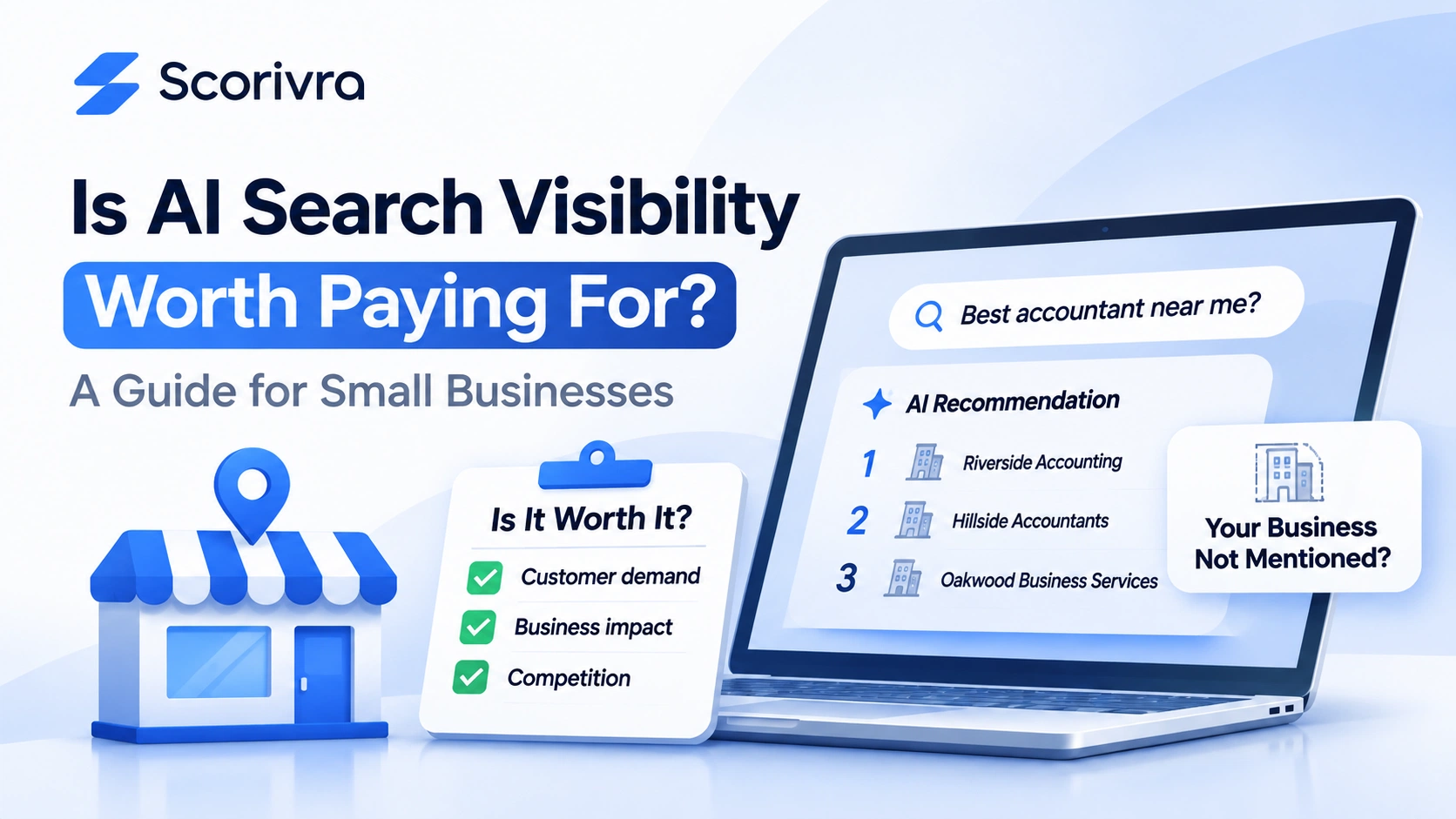
AI search is becoming another way for customers to discover and compare businesses. Instead of browsing several websites, a potential customer might ask AI to recommend a local service provider, compare products, or suggest a company for a particular need.
For a small business, this creates a new question: is it worth paying to monitor whether your company appears in those recommendations?
The answer depends on how customers find your business, how valuable those enquiries are, and whether you can act on the information. Paid AI search monitoring can be worthwhile, but not every business needs it.
1. When AI Search Visibility Becomes a Business Priority
Imagine two independent accounting firms serving the same city. A potential customer asks AI to recommend an accountant for a growing small business.
If one firm is mentioned and the other is absent, the recommended firm may receive consideration that the other never gets.
That does not prove the missing firm has lost a customer. The person might use other sources, already know the business, or choose a different provider entirely.
However, when AI recommendations form part of a customer's buying process, visibility can influence which businesses enter their shortlist.
The commercial importance of that visibility depends on three factors:
- Customer behaviour: Are potential customers likely to use AI when researching providers?
- Customer value: Would a small number of additional qualified enquiries materially affect the business?
- Competition: Are customers comparing several providers before making a decision?
A business that relies heavily on recommendations and comparison-based searches may have more reason to monitor AI visibility than one whose customers come almost entirely through existing relationships.
2. Which Small Businesses May Benefit from Paid Monitoring?
Not all businesses face the same level of exposure to AI-assisted discovery.
Businesses offering high-value services
Accountants, specialist contractors, consultants and other service providers often depend on a relatively small number of valuable customer relationships.
For these businesses, understanding whether they appear in relevant recommendations may support marketing decisions, particularly when potential clients actively compare providers.
Businesses competing in crowded markets
When multiple companies offer similar services, it can be useful to identify which competitors appear repeatedly in answers to customer questions.
The objective is not simply to collect mentions. It is to understand where a business is represented, where it is absent, and whether there is a realistic opportunity to improve its presence.
Businesses actively investing in marketing
A company already spending time or money on content, website improvements or brand visibility may benefit from additional measurement.
AI search monitoring provides another source of evidence when reviewing those activities. It does not establish that a particular change caused an improvement, but it can help identify patterns worth investigating.
3. When Paying for AI Search Monitoring May Not Make Sense
A monitoring subscription is not automatically a sensible investment.
For a business that receives most of its customers through referrals, repeat purchases or direct relationships, AI search may currently play a minor role in customer acquisition.
Paying for detailed monitoring without a clear purpose could add another expense without improving decisions.
There are also situations where a business has more immediate priorities. If its website has major technical problems, its service information is outdated, or it cannot respond effectively to existing enquiries, those issues may deserve attention first.
Before subscribing, a small business should be able to answer:
- Which customer questions do we need to appear in?
- What decisions would we make if competitors appeared more frequently than us?
- Do we have the resources to improve our website, content or business information?
- How would we evaluate whether monitoring is worth continuing?
If those questions have no practical answers, it may be better to postpone paid monitoring rather than purchase it simply because AI search is receiving attention.
4. How to Decide Whether the Cost Is Justified
The value of AI search monitoring should be assessed against the decisions it enables, not against the number of reports it produces.
Consider a hypothetical business paying $99 per month for monitoring.
Its annual subscription cost would be $1,188, excluding any additional work required to investigate findings or improve visibility.
If the business earns $400 in contribution profit from a typical new customer, it would need roughly three additional customers per year to cover that subscription cost alone.
This is only a financial illustration. Monitoring does not guarantee additional customers, and it may be difficult to attribute a sale directly to improved AI visibility.
The more practical evaluation is whether the information supports decisions that the business otherwise would not make.
For example, monitoring may reveal that competitors consistently appear in questions about a service the business provides. That finding could justify reviewing the relevant service page, improving the clarity of business information, or examining which sources are being cited.
Businesses should then look for supporting evidence in website traffic, enquiries and customer acquisition data rather than treating visibility improvements as proof of revenue growth.
A simple decision rule: paid monitoring is easier to justify when relevant customer searches, meaningful commercial value and the ability to act on findings are all present.
5. What Scorivra Can Help Businesses Measure
For businesses that decide ongoing measurement is worthwhile, Scorivra provides tools to monitor AI search visibility.
Instead of assuming that a business is visible, users can examine whether it appears in answers to selected customer-style questions.
Scorivra supports several relevant measurements:
- Brand mentions: Whether a business appears in tracked AI answers.
- Competitor comparisons: Which competing businesses are mentioned for the same questions.
- Prompt gaps: Questions where competitors appear but the monitored business does not.
- Visibility trends: How mentions and citations change across repeated measurements.
These measurements can help businesses prioritise questions and opportunities for further investigation.
They should not be confused with actual customer enquiries or sales. AI answer visibility is one measurement, while website traffic and customer actions require separate performance data.
Scorivra also offers a free Site Audit for businesses that want to review their website's technical search readiness before committing to paid ongoing monitoring.
Frequently Asked Questions
Is AI search monitoring necessary for every small business?
No. Its value depends on whether AI-assisted discovery is relevant to the business, the importance of potential customers using those searches, and whether the company can act on the results.
Can AI search monitoring guarantee more customers?
No. Monitoring identifies visibility patterns and competitive differences. It does not guarantee recommendations, traffic, enquiries or sales.
Should a small business invest in AI monitoring or traditional SEO first?
The decision depends on its current situation. Businesses with significant website or search visibility problems may benefit more from addressing those issues first. AI monitoring can complement existing search marketing rather than replace it.
Final Thoughts
Paying for AI search visibility monitoring is not a requirement for every small business. It becomes more relevant when customers use AI to compare providers, competitors appear in important recommendations, and the business has a practical reason to investigate or improve its visibility.
The objective is not to purchase another marketing dashboard. It is to make better-informed decisions about how customers discover the business. If those decisions matter to your growth strategy, explore Scorivra's AI Visibility features to see what ongoing monitoring can reveal.