
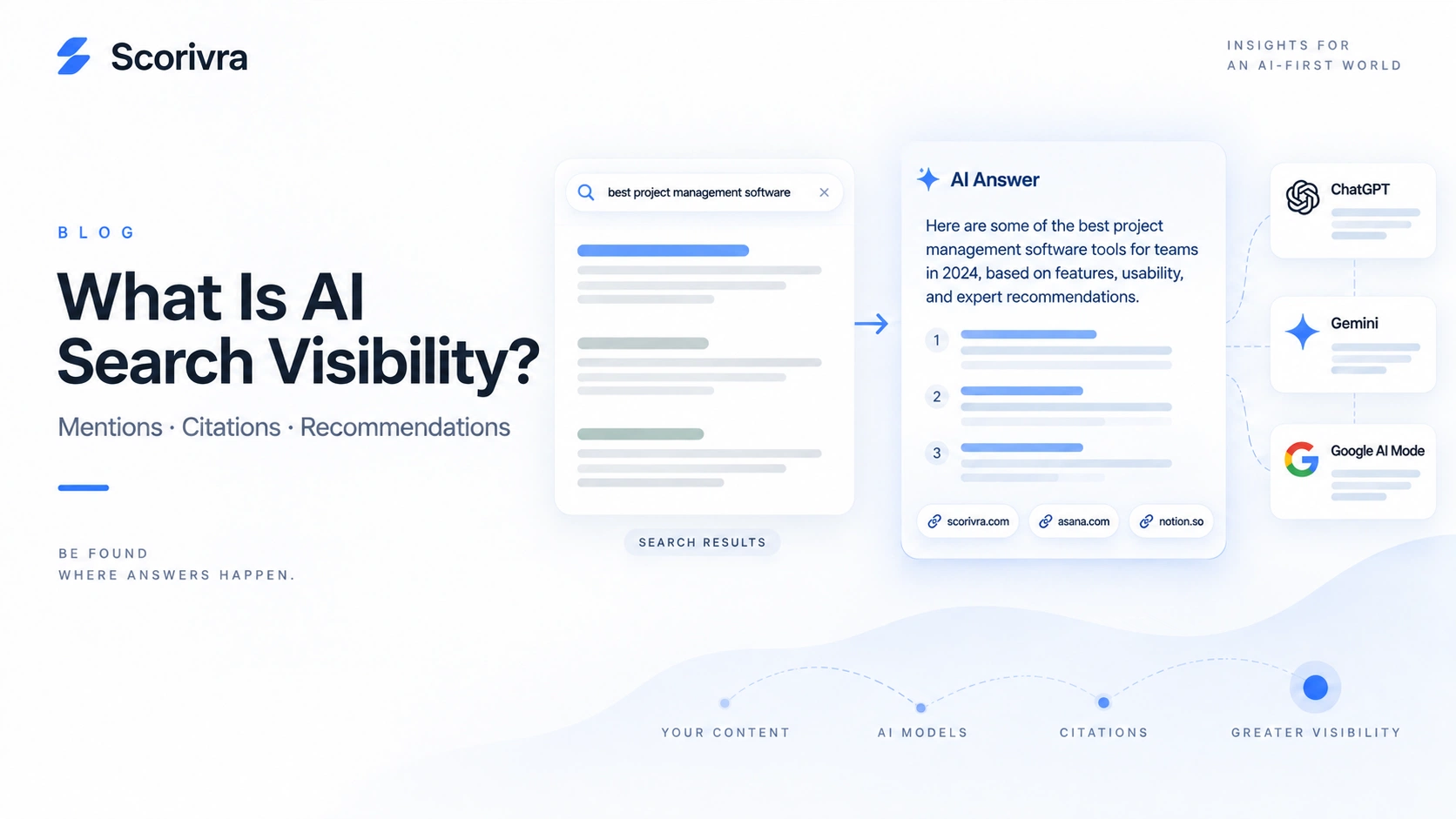
For years, businesses measured search visibility mainly by one question:
Where do we rank on Google?
That still matters.
But people are increasingly using AI-powered search experiences to research products, compare services, find local businesses, and make decisions.
This creates another question:
When someone asks an AI system about your market, does your brand appear in the answer?
That is the basic idea behind AI search visibility.
What does AI search visibility mean?
AI search visibility describes how often and in what way a brand, website, product, or business appears in AI-generated search answers.
Traditional search tracking usually focuses on things like:
- keyword rankings
- impressions
- clicks
- organic traffic
AI search visibility looks at a different set of signals:
- Is your brand mentioned?
- Is your website cited?
- Is your business recommended?
- Which competitors appear instead?
- Which pages are being used as sources?
- Does your visibility change depending on the question?
These signals do not replace traditional SEO metrics.
They add another layer to them.
Mention, citation, and recommendation are not the same thing
One of the easiest mistakes to make when measuring AI visibility is treating every appearance as the same.
They are not.
Brand mention
A brand mention happens when the AI answer names your company or business.
For example:
Bryant Park Hotel is located near Bryant Park in Manhattan.
The brand appears in the answer, even if the official website is not linked.
Citation
A citation happens when the AI answer uses your website as a supporting source or links to one of your pages.
This can be especially important for publishers, SaaS companies, research sites, and businesses producing useful informational content.
Recommendation
A recommendation is stronger.
The AI system actively includes the business or product as an option.
For example:
If you're looking for a boutique hotel near Bryant Park, consider Hotel A, Hotel B, and Hotel C.
A business may be mentioned without being recommended.
It may also be cited without being mentioned prominently.
That is why a single "AI visibility score" cannot always explain what is actually happening.
Why Google rankings alone are no longer enough
Imagine a business ranks well for an important keyword.
A hotel might rank near the top of Google for:
boutique hotel near Bryant Park
That sounds like strong visibility.
But then someone asks an AI system:
What are the best boutique hotels near Bryant Park for a weekend stay?
The answer may recommend several competitors and completely exclude that hotel.
Traditional rank tracking would still show a strong position.
AI visibility tracking would show something different:
the brand was not part of the generated answer.
Neither measurement is wrong.
They are simply measuring different search experiences.
Does this mean SEO is becoming irrelevant?
No.
Google continues to state that established SEO practices remain relevant to its generative AI search features.
Google's guidance for AI features emphasizes many of the same fundamentals that have mattered in search for years:
- pages should be crawlable
- important content should be indexable
- information should be clear and useful
- internal navigation should make sense
- structured data should match visible page content
- business information should be accurate
Google also says that site owners do not need a special AI-only file or a completely separate optimization system to appear in its generative search experiences.
In other words:
AI visibility is not a replacement for SEO.
It is another part of search visibility.
Google's current documentation on generative AI features can be found here:
https://developers.google.com/search/docs/appearance/ai-features
What about ChatGPT Search?
ChatGPT can also search the web and provide links to sources used in its answers.
OpenAI states that public websites can appear in ChatGPT search results, and that websites that want their content included in search summaries and previews should allow access to OAI-SearchBot.
That does not mean allowing the crawler guarantees a citation.
It simply removes one possible technical barrier to discovery.
OpenAI's guidance for publishers and developers is available here:
https://help.openai.com/en/articles/12627856-publishers-and-developers-faq
This distinction is important.
Technical accessibility can help a system discover your content.
It does not guarantee that the system will mention, cite, or recommend your brand.
AI visibility depends on the question
AI visibility is highly query-dependent.
A company may appear for one question and disappear for another.
For example:
What are the best tools for tracking AI search visibility?
and
How can I check whether ChatGPT mentions my company?
are related questions.
But they can produce different answers, different sources, and different competitors.
That is why measuring only one prompt is usually not enough.
A more useful approach is to track a group of realistic questions that potential customers might actually ask.
Over time, this can reveal:
- which topics your brand is associated with
- where competitors appear more often
- which questions generate citations to your site
- which questions never mention your brand
- whether visibility is improving or declining
Competitors matter just as much as your own visibility
A missing brand mention does not tell the whole story.
The next question should be:
Who appeared instead?
Suppose your business is not recommended for a particular query.
If the same three competitors repeatedly appear across multiple AI systems and prompts, that pattern matters.
It may indicate that those competitors have:
- stronger brand recognition
- more useful supporting content
- better third-party coverage
- clearer business information
- stronger topical relevance
- more authoritative sources discussing them
AI competitor tracking helps turn a simple "we were not mentioned" result into something more useful.
You can start asking:
What are the systems consistently finding about competitors that they are not finding about us?
Local businesses have another visibility layer
For local businesses, visibility becomes even more complicated.
A restaurant, hotel, clinic, or service business may rank differently depending on where the search is performed.
This is already common in Google Maps.
A business might rank highly near its physical location but disappear several kilometers away.
AI-powered local recommendations can also vary depending on location and query context.
That means local businesses may need to understand at least three different visibility layers:
- traditional search visibility
- Google Maps visibility
- AI-generated local recommendations
A single ranking number cannot fully describe all three.
What should businesses actually track?
You do not need dozens of metrics to start.
A practical AI visibility measurement system can begin with a few questions.
AI search
Track:
- brand mentions
- website citations
- recommendations
- competitors
- cited URLs
- changes over time
Local search
Track:
- daily Google Maps position
- geographic ranking coverage
- areas where the business disappears
- local competitors
- AI-generated local recommendations
Website performance
Track:
- organic impressions
- search clicks
- website sessions
- traffic sources
- conversions or meaningful actions
The goal is not to collect as many numbers as possible.
The goal is to understand the path from:
visibility → discovery → website visit → business outcome
One measurement is not enough
AI-generated answers can change.
The same question may produce a different result later.
That makes a single screenshot useful as evidence of one moment, but weak as a long-term measurement strategy.
Repeated tracking is more useful.
For example, instead of asking:
Did ChatGPT mention us today?
you can ask:
Across the last 30 days, how often were we mentioned for the questions that matter to our customers?
That is a much stronger business question.
The same principle applies to competitors, citations, recommendations, and local visibility.
Good content still has to be useful
There is no reliable shortcut that guarantees inclusion in AI-generated answers.
Publishing large amounts of repetitive content simply to target AI systems is not a strong strategy.
Useful content still needs to do something valuable.
It might:
- explain a difficult concept clearly
- provide original data
- compare approaches
- answer a real customer question
- document a process
- publish research
- show evidence
- provide information that is difficult to find elsewhere
This becomes even more important as more companies begin publishing AI-generated content at scale.
If everyone can produce generic explanations, generic explanations become less valuable.
Original information becomes more important.
This is where AI visibility becomes useful
AI search visibility is not about chasing a new ranking number.
It is about understanding a new discovery surface.
Traditional SEO tells you how your pages perform in search.
AI visibility tells you whether your brand becomes part of generated answers.
Local visibility tells you where your business appears geographically.
Performance data tells you whether any of that visibility leads to real visits and actions.
Together, these measurements provide a more complete view of how people can discover a business online.
The question businesses should start asking
The old question was:
Where do we rank?
That question still matters.
But businesses now have another one to ask:
When people ask AI about our category, are we part of the answer?
That is what AI search visibility is designed to measure.
And as AI-powered search becomes a larger part of how people discover information, products, and local businesses, that question is likely to become increasingly important.