
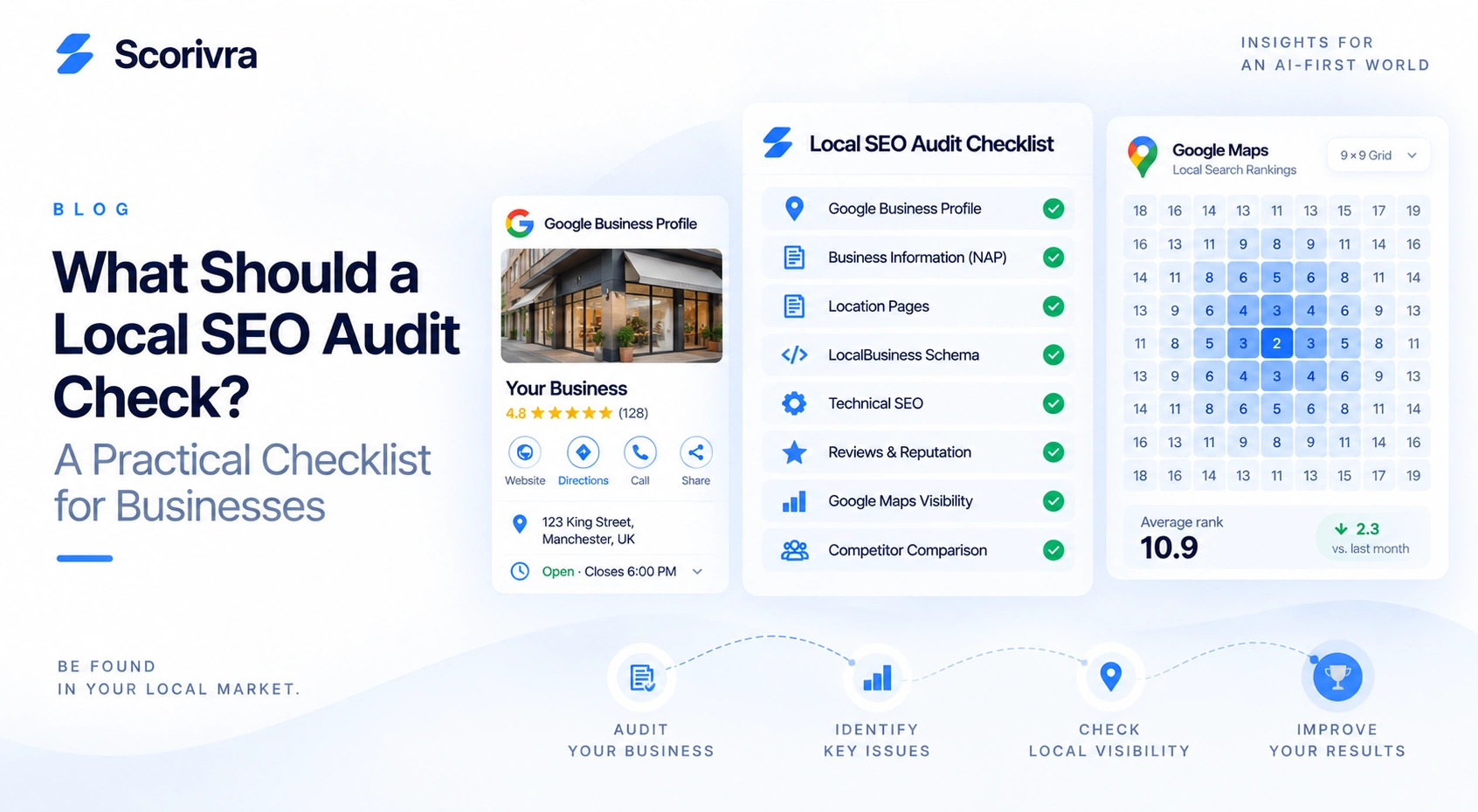
What Should a Local SEO Audit Check? A Practical Checklist for Businesses
Your business has a website.
Your Google Business Profile is live.
Your address is correct.
But you still struggle to appear when potential customers search for your services nearby.
What should you actually check?
A local SEO audit should examine whether search engines can understand your business, whether your local information is accurate, whether your website supports the locations and services you want to be found for, and where your business actually appears across your market.
It should not simply produce a generic SEO score.
This guide walks through the main areas a business should review.
What Is a Local SEO Audit?
A local SEO audit is a structured review of the factors that can affect how a local business is understood and discovered in Google Search and Google Maps.
A useful audit should answer questions such as:
- Is the business information accurate?
- Can Google clearly understand what the business does?
- Is the location clearly represented on the website?
- Are important local pages crawlable and indexable?
- Is LocalBusiness structured data implemented correctly?
- Does the Google Business Profile accurately represent the business?
- How visible is the business in Google Maps?
- Does visibility change across the city?
- Which competitors appear where the business does not?
These questions cover different parts of local visibility.
That distinction matters because finding a technical issue is not the same as measuring an actual ranking.
What Does Google Say Affects Local Rankings?
Google says local results are mainly based on three factors:
| Factor | What it means | |---|---| | Relevance | How well the business matches what someone is searching for | | Distance | How far the business is from the searcher or location used for the search | | Prominence | How well known the business is |
Google also recommends keeping Business Profile information complete and accurate so it can better understand the business and match it with relevant searches.
This means a local SEO audit should not look for one secret ranking factor.
It should examine whether the business provides clear, accurate information and then measure how that business performs in the real local search environment.
1. Is Your Google Business Profile Accurate?
Start with the basic representation of the business.
Check:
- Business name
- Address
- Phone number
- Website URL
- Primary category
- Additional categories
- Opening hours
- Special hours
- Business attributes
- Services where applicable
The goal is accuracy.
Do not add keywords to the business name simply because you want to rank for them.
Do not choose categories that do not genuinely represent the business.
Google states that complete and accurate information makes businesses more likely to appear in relevant local search results.
What should you prioritize?
Fix factual problems before cosmetic ones.
For example:
High priority:
- Wrong address
- Old phone number
- Incorrect website
- Wrong primary category
- Outdated opening hours
Lower priority:
- Minor formatting differences
- Cosmetic wording differences that do not change the underlying business information
A local audit should distinguish between genuine business-information errors and harmless formatting differences.
2. Is Your Business Identity Clear on the Website?
Now move from the Business Profile to the website.
A visitor — and a search system — should be able to determine:
- Who the business is
- What it offers
- Where it operates
- How customers can contact it
Check the:
- Homepage
- Contact page
- About page
- Footer
- Service pages
- Location pages
Look for contradictions.
For example:
Google Business Profile: 25 King Street, Manchester
Contact page: 25 King Street, Manchester
Footer: 87 King Street, Manchester
That deserves investigation.
The objective is not to make every occurrence character-for-character identical.
The objective is to avoid conflicting business information.
3. Do You Have a Useful Location Page?
A physical business should make its location understandable.
A useful location page may include:
- Business name
- Address
- Phone number
- Opening hours
- Services available at that location
- Directions or useful location information
- Relevant contact information
But a location page should not exist merely to repeat a city name dozens of times.
Ask a more useful question:
“If a potential customer lands directly on this page, does it give them enough information to understand and visit or contact this location?”
If the answer is no, the page may need improvement.
4. Are Multi-Location Businesses Separating Their Locations Clearly?
If a business operates multiple locations, each legitimate location should be distinguishable.
Imagine a dental group with clinics in:
- Manchester
- Liverpool
- Leeds
Each location may have different:
- Addresses
- Phone numbers
- Opening hours
- Services
- Local information
Using one generic location page for all three can make the site less useful.
Google's LocalBusiness structured-data documentation recommends defining each local business location as a LocalBusiness where appropriate.
For multi-location businesses, audit each location individually.
5. Is LocalBusiness Structured Data Implemented Correctly?
Structured data provides machine-readable information about a business.
Google supports LocalBusiness properties including:
- name
- address
- telephone
- URL
- geographic coordinates
- opening hours
The structured data should accurately describe the business represented on the page.
For example:
Visible page: 25 King Street
Structured data: 87 King Street
That is a real inconsistency.
Likewise, structured data for one location should not accidentally describe another location.
Does LocalBusiness schema guarantee better rankings?
No.
Structured data can help search engines understand information on a page, but it should not be treated as a guaranteed Maps ranking boost.
Use it to represent accurate business information.
Do not treat it as a ranking switch.
For more detail, see:
Does Schema Markup Help AI Search Visibility? What Businesses Should Know
6. Can Google Crawl and Index the Important Pages?
A perfectly written location page provides little search value if Google cannot access or index it properly.
Check important local pages for:
- robots.txt restrictions
- noindex directives
- incorrect canonical URLs
- broken internal links
- unexpected redirects
- server errors
- duplicate pages
You should also check whether important pages are actually indexed in Google.
Technical SEO and local SEO overlap here.
The local information needs to exist, but search engines also need to be able to reach and understand it.
7. Are Your Service Pages Specific Enough?
A local business often wants visibility for multiple services.
For example, a cosmetic dental clinic may offer:
- Dental implants
- Veneers
- Teeth whitening
- Invisalign
- Cosmetic dentistry
A homepage that simply says:
“We provide high-quality dental services.”
does not explain much.
Review whether important services have enough useful information for customers to understand:
- What the service is
- Who it is for
- What the business offers
- Where the service is available
- How to take the next step
Do not create hundreds of thin pages by combining every service with every nearby city.
Create pages when there is a genuine user need and enough useful information to justify them.
8. Are Your Internal Links Supporting Important Local Pages?
Important pages should not be isolated.
Check whether users and crawlers can naturally reach:
- Location pages
- Important service pages
- Contact information
- Relevant supporting content
For example:
Homepage → Locations → Manchester Clinic → Dental Implants
is much clearer than leaving the Manchester page accessible only through a sitemap.
Internal links help establish relationships between the site's pages.
They also make navigation easier for users.
9. Are Your Reviews Competitive?
Reviews are another part of the local picture.
Google says review count and positive ratings can contribute to local prominence.
But avoid reducing the audit to:
“Competitor has 500 reviews and we have 200, so we need 300 reviews.”
Local ranking is not determined by review count alone.
Compare:
- Total reviews
- Average rating
- Recent review activity
- Competitors
- Geographic rankings
Use reviews as one signal among several.
10. Where Does Your Business Actually Rank on Google Maps?
This is where many local SEO audits stop too early.
A website can pass technical checks while the business still has weak Maps visibility.
Likewise, an audit may identify several imperfections even though the business already performs strongly.
That is why audit data and visibility data should be separated.
An audit asks:
“Is something potentially wrong?”
Rank tracking asks:
“Where are we actually visible?”
Both are useful.
They answer different questions.
11. Why Isn't One Google Maps Ranking Enough?
Because local rankings can change depending on where the search occurs.
Suppose you search:
“cosmetic dentist”
while standing inside the clinic.
You rank #2.
That does not mean everyone across the city sees you at #2.
A customer three miles away may see:
#6
Another customer may see:
#12
And in another part of the city, the business may not appear prominently at all.
Google explicitly includes distance as one of the primary factors in local ranking.
So instead of asking:
“What is our Google Maps rank?”
ask:
“Where do we rank across the market?”
For more detail, see:
Why Does My Google Maps Ranking Change Depending on Where I Search?
12. Should You Use a Local Search Grid?
A local search grid can reveal geographic ranking patterns that a single search cannot.
For example:
| Area | Maps Rank | |---|---:| | Near business | 2 | | North | 4 | | South | 9 | | East | 13 | | West | 6 |
Now you have a geographic visibility pattern.
You can identify:
- Strong areas
- Weak areas
- Top-three coverage
- Competitor-heavy areas
- Changes over time
Scorivra's Google Maps Grid measures rankings across a 9×9 grid of 81 geographic points rather than treating one search location as representative of the entire market.
For a deeper explanation, see:
How to Track Google Maps Rankings Across a City: A Local Search Grid Guide
13. Should a Local SEO Audit Include Competitors?
Yes.
An issue only becomes meaningful in context.
Suppose your business has:
- 180 reviews
- 4.8 average rating
- Complete Business Profile
- Relevant service pages
Is that strong?
You cannot answer without context.
If the businesses consistently outranking you have:
- 30 reviews
- weaker websites
- similar categories
you may investigate one set of factors.
If they have:
- 2,000 reviews
- strong local authority
- highly relevant websites
- closer locations
the competitive situation is different.
A useful local audit should therefore identify who actually competes with you in the search results.
14. Should a Local SEO Audit Include AI Search?
Treat AI visibility as a separate layer rather than mixing it into a Google Maps ranking score.
A local business can have:
Strong Google Maps visibility + weak AI visibility
or:
Weak Google Maps visibility + stronger AI visibility for certain questions.
Those outcomes are not inherently contradictory.
Google Maps rankings and AI-generated recommendations are different discovery surfaces.
Scorivra therefore separates traditional Local Search measurement from broader AI Search Visibility.
AI Search Visibility measures selected customer questions across supported AI search experiences.
AI Local Grid is a separate geographic feature for measuring location-based AI recommendation visibility.
AI Local Grid does not use ChatGPT.
Keeping these measurements separate makes it easier to identify what is actually changing.
What Should a Free Local SEO Audit Include?
If you are using a free local SEO audit tool, do not judge it only by the size of the score.
Ask what it actually checks.
At minimum, a useful website-focused local audit should investigate areas such as:
- Business identity
- Contact information
- Location information
- LocalBusiness structured data
- Location pages
- Crawlability
- Indexability
- Important technical signals
- Maps-related website signals
Then combine that audit with actual visibility measurement.
A score of 90/100 does not mean:
“You should rank #1 on Google Maps.”
And a score of 50/100 does not prove:
“Your local rankings are bad.”
Audit scores describe the checks included in the audit.
Rankings describe actual search visibility.
Do not confuse the two.
Local SEO Audit Checklist
Use this checklist when reviewing a local business.
Google Business Profile
- [ ] Business is verified
- [ ] Business name is accurate
- [ ] Address is correct
- [ ] Phone number is current
- [ ] Website URL is correct
- [ ] Primary category is appropriate
- [ ] Additional categories are relevant
- [ ] Opening hours are accurate
- [ ] Business information is complete
Website
- [ ] Business identity is clear
- [ ] Contact information is accurate
- [ ] Location information is easy to find
- [ ] Important services are explained
- [ ] Location pages are useful
- [ ] Multi-location pages are clearly separated
- [ ] Internal links reach important local pages
Technical
- [ ] Important pages are crawlable
- [ ] Important pages are indexable
- [ ] Canonical URLs are correct
- [ ] Important internal links work
- [ ] Redirects behave correctly
- [ ] LocalBusiness structured data is accurate
- [ ] Structured data matches visible content
Reputation
- [ ] Review count has been checked
- [ ] Average rating has been checked
- [ ] Relevant competitors have been compared
Visibility
- [ ] Important local queries are defined
- [ ] Google Maps rankings are measured
- [ ] Multiple geographic points are checked
- [ ] Strong and weak areas are identified
- [ ] Competitors in weak areas are identified
- [ ] Visibility is tracked over time
This gives you a much more useful picture than one generic local SEO score.
What Does Scorivra's Local Site Audit Check?
Scorivra's Site Audit separates website checks into SEO, AEO, GEO, and Local categories.
The Local category checks supported local website signals such as business identity, NAP-related information, location pages, Maps-related signals, and LocalBusiness structured data.
The audit is designed to identify issues worth investigating.
It does not claim that fixing one failed check will move a business a specific number of positions in Google Maps.
Actual local visibility is measured separately.
This distinction is important:
Site Audit: “What should we investigate or fix?”
Google Maps tracking: “Where are we actually ranking?”
Google Maps Grid: “Where across the market are we strong or weak?”
AI visibility: “Where are we appearing in AI-generated discovery experiences?”
Different measurements answer different questions.
FAQ
What is a local SEO audit?
A local SEO audit is a structured review of the business information, website pages, technical setup, structured data, Google Business Profile, reputation, and visibility signals relevant to local search.
Can I do a local SEO audit for free?
Yes. Many important checks can be performed without paying for an audit, including reviewing your Business Profile, website information, indexing, structured data, location pages, and basic Maps visibility. Tools can make the process faster and more systematic.
What should a free local SEO audit tool check?
Look for meaningful checks rather than just a score. Useful areas include business identity, location information, NAP-related information, LocalBusiness structured data, crawlability, indexability, location pages, and Maps-related website signals.
Does a high local SEO audit score mean I will rank higher on Google Maps?
No. An audit score reflects the checks included in that particular audit. Google says local rankings are primarily based on relevance, distance, and prominence. A high audit score does not guarantee a specific Maps position.
Why does my Google Maps ranking change by location?
Distance is one of Google's primary local-ranking factors. Customers searching from different parts of a city can therefore receive different local results.
Should a local SEO audit check schema markup?
Yes, when structured data is appropriate for the business. Google supports LocalBusiness structured data containing information such as the business name, address, telephone, URL, geographic coordinates, and opening hours.
Should I audit competitors too?
Yes. Competitor comparison provides context. A review count, ranking, or website signal is much more useful when compared with the businesses actually appearing for the same local searches.
Is Google Maps visibility the same as AI local visibility?
No. They are different discovery surfaces and should be measured separately.
Does Scorivra AI Local Grid measure ChatGPT?
No. AI Local Grid is a separate geographic local AI measurement and does not use ChatGPT.
Final Takeaway
A useful local SEO audit should not end with:
“Your score is 82/100.”
It should help you answer:
Is our business information accurate?
Can search engines understand our locations and services?
Are important pages technically accessible?
Is our structured data correct?
Where do we actually appear on Google Maps?
Where are competitors stronger?
And which problems are worth fixing first?
Start with accuracy and technical foundations.
Then measure actual visibility.
Because an audit tells you what may need attention.
Your search visibility tells you what customers can actually find.