
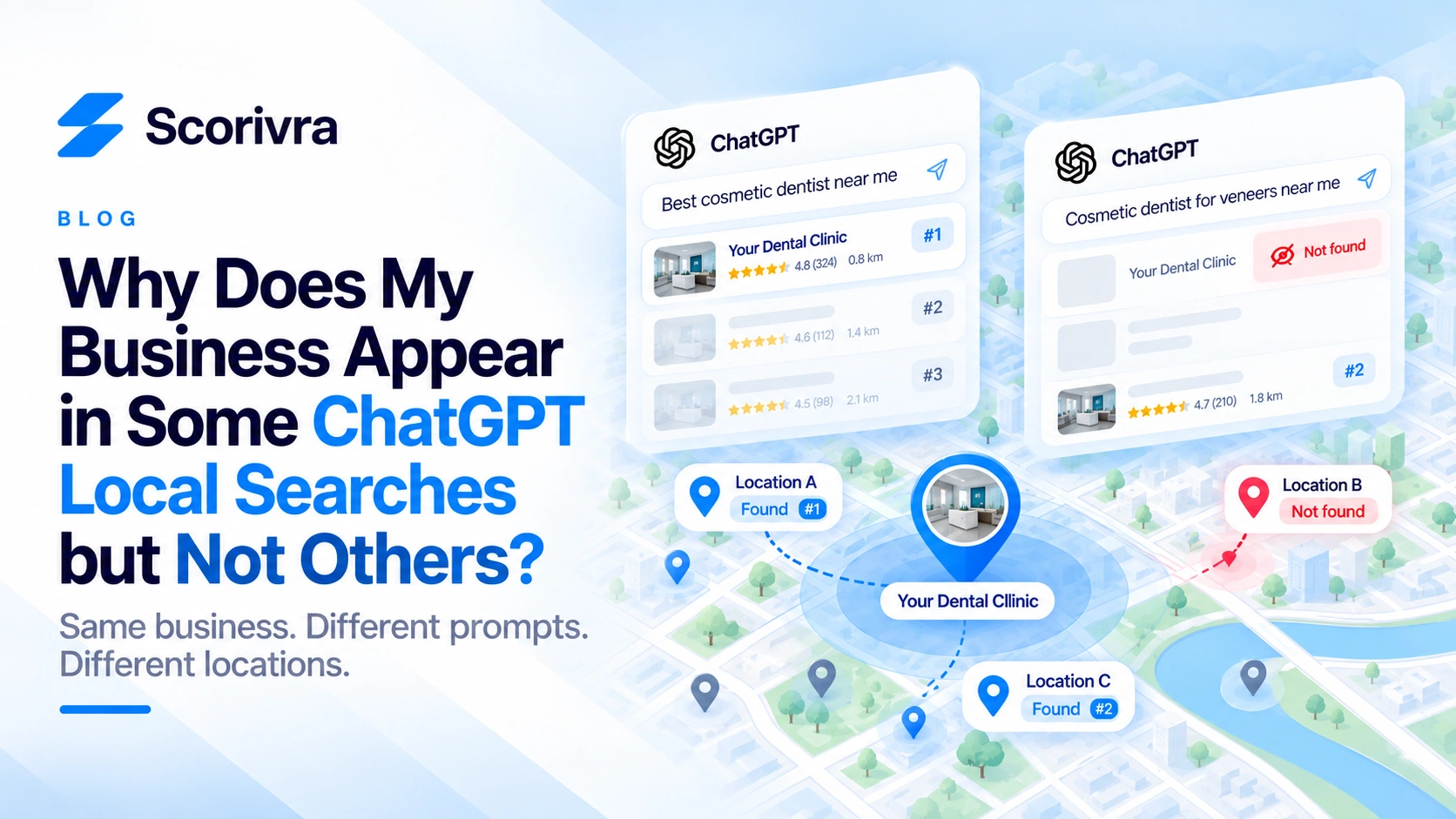
Why Does My Business Appear in Some ChatGPT Searches but Not Others?
You search for your business in ChatGPT and it appears.
Then you change the question slightly — and it disappears.
Or a competitor shows up instead.
For businesses starting to monitor AI search visibility, this can feel inconsistent. But the problem is often not that ChatGPT "removed" your business. The more important point is that AI search does not behave like a traditional keyword ranking system.
A business can be visible for one prompt, invisible for another, and recommended differently depending on location, search intent, available sources, and how the question is interpreted.
That means the right question is not:
"Do I rank in ChatGPT?"
It is:
"How consistently does my business appear across the AI searches that matter to my customers?"
Let's look at why.
1. ChatGPT Search Is Not a Single Fixed Ranking
Traditional search has trained businesses to think in rankings.
You search a keyword such as:
cosmetic dentist Manchester
and check whether your website ranks #3, #8, or #25.
AI search works differently.
A user might ask:
Who are the best cosmetic dentists in Manchester?
Another might ask:
Which cosmetic dentist in Manchester is good for veneers?
Another could ask:
Find a highly rated cosmetic dentist near me that offers Invisalign and veneers.
These questions overlap, but they do not express exactly the same intent.
ChatGPT can also rewrite a user's question into one or more targeted web searches when looking for current information. OpenAI explains that ChatGPT Search may transform a user's prompt into more specific queries before sending them to search providers.
Source: OpenAI — Searching the web with ChatGPT
As a result, changing a few words can change:
- what information ChatGPT looks for,
- which sources it retrieves,
- which businesses appear relevant,
- and which businesses are ultimately mentioned.
This is one reason your business can appear for one query but not another.
2. Search Intent Changes Which Businesses Are Relevant
Consider these prompts:
best dentist near me
affordable dental implants near me
cosmetic dentist for veneers
dentist with strong patient reviews
They are all related to dentistry, but each prompt asks for something different.
A business may have strong signals for cosmetic dentistry but weaker information about implants.
Another practice might have extensive third-party coverage for veneers but little content about general dentistry.
AI systems have to determine which businesses best match the user's specific request.
This means broad visibility does not automatically translate into visibility for every service.
For businesses, this creates an important measurement problem.
You cannot accurately evaluate AI visibility using only one generic prompt.
You need to test multiple prompts that represent the different ways customers actually describe their needs.
3. Location Can Change ChatGPT Local Search Results
Location adds another layer.
OpenAI says ChatGPT may use an approximate location based on a user's IP address to improve local results.
Users can also optionally share their device location. When location sharing is enabled, ChatGPT can use more specific location information when answering questions about nearby businesses, restaurants, local news, and other location-sensitive topics.
Source: OpenAI — Searching the web with ChatGPT
So imagine two users asking:
What are the best coffee shops near me?
One user is in the north of a city.
Another is several kilometres south.
There is no reason to assume they should receive exactly the same recommendations.
This becomes even more important for businesses that depend heavily on local discovery, including:
- dentists,
- medical aesthetics clinics,
- chiropractors,
- physical therapists,
- restaurants,
- roofers,
- HVAC companies,
- auto detailing businesses,
- and other location-based services.
A business may therefore have strong AI visibility in one part of a city and weak visibility in another.
That is similar to a problem local SEO professionals already know from Google Maps: local visibility is not always uniform across an entire city.
4. ChatGPT May Use Different Sources for Different Questions
Another reason visibility changes is source selection.
ChatGPT Search can search the web and provide links to sources used in an answer.
But different questions can trigger different searches.
A question about:
the best dental implant clinic
may surface different sources from:
highly rated cosmetic dentists
or:
cosmetic dentists that offer payment plans
The websites, directories, articles, reviews, and business information available for each topic may differ.
This creates an important distinction between mentions and citations.
Mention
Your business or brand appears in the AI-generated answer.
Citation
A webpage is used or linked as a supporting source.
These are not the same thing.
Your business can be mentioned without your own website being cited.
Your website can also be used as a source without your brand becoming one of the primary recommendations.
That is why businesses monitoring AI search should not track citations alone.
They should also monitor whether the business itself is actually being mentioned or recommended.
5. Why Does My Competitor Appear in ChatGPT but My Business Does Not?
This is one of the most important questions in AI search visibility.
There usually is not one simple answer.
And there is currently no publicly documented formula that tells businesses exactly how ChatGPT ranks local businesses.
Instead, it is more useful to investigate the information available to the system.
For example, compare whether your competitor has:
- clearer service pages,
- stronger location information,
- more detailed business descriptions,
- relevant third-party mentions,
- more consistent business information across the web,
- stronger pages for the specific service being requested,
- accessible pages that search systems can crawl,
- and content that directly answers the user's search intent.
OpenAI specifically states that sites that want to appear in ChatGPT Search should allow OAI-SearchBot to crawl their content and ensure that their hosting provider or CDN is not blocking OpenAI's published crawler IP addresses.
Source: OpenAI — Searching the web with ChatGPT
That does not guarantee that your business will appear.
But preventing search systems from accessing your content creates an obvious visibility problem.
6. Your Website May Explain Your Business Differently Than Customers Search
This is easy to overlook.
Suppose your homepage says:
Advanced aesthetic solutions tailored to your individual needs.
But potential customers ask:
Where can I get Botox near me?
Best medical aesthetics clinic for lip fillers
Aesthetic clinic with good reviews in Manchester
The website may technically describe the correct business, but the relationship between the page and the customer's intent may not be very explicit.
For both traditional search and AI search, clarity matters.
A business website should make it easy to understand:
- what the business does,
- where it operates,
- what services it provides,
- who those services are for,
- and how each important service differs.
This does not mean repeating keywords everywhere.
It means reducing ambiguity.
An AI system should not have to guess what your business actually offers.
7. One ChatGPT Search Is Not Enough to Measure AI Visibility
This is probably the biggest mistake businesses can make.
Imagine searching:
best med spa in Birmingham
and seeing your business.
It is tempting to conclude:
"We rank in ChatGPT."
But what happens when you test:
Botox clinic Birmingham
lip filler clinic Birmingham
highly rated medical aesthetics clinic Birmingham
best aesthetic clinic near me
aesthetic clinic for first-time Botox patients
Your business might appear in two of those five prompts.
A competitor might appear in all five.
Those two businesses clearly do not have the same level of AI search visibility.
This is why AI visibility needs to be measured across a set of relevant prompts rather than through a single manual search.
8. Consistency Matters More Than a Single Appearance
A more useful way to think about AI visibility is consistency.
For example:
| Prompt | Your Business | Competitor A | | --- | --- | --- | | Best cosmetic dentist | Mentioned | Mentioned | | Dentist for veneers | Not mentioned | Mentioned | | Invisalign dentist | Mentioned | Mentioned | | Highly rated cosmetic dentist | Not mentioned | Mentioned | | Cosmetic dentist near me | Mentioned | Mentioned |
A single search would hide this difference.
A broader sample reveals it immediately.
This is why useful AI visibility measurement should examine metrics such as:
- Mention Rate
- Citation Rate
- Position
- Share of Voice
- Competitor Visibility
- Prompt Gaps
- Visibility Changes Over Time
The goal is not to find one magical "ChatGPT ranking."
The goal is to understand where your business is consistently visible — and where competitors are being selected instead.
9. Local AI Visibility Makes This Even More Complicated
Local search adds geographic variation to prompt variation.
In theory, the same business could have:
- strong visibility for one prompt,
- weak visibility for another,
- strong visibility in one area,
- and weak visibility several kilometres away.
That creates a combination of:
Prompt × Location × Time
rather than a single static rank.
This is also why traditional Google Maps rankings and AI-generated local recommendations should not automatically be treated as the same metric.
A business may rank well in Google Maps while appearing inconsistently in AI recommendations.
The opposite may also eventually occur.
These are related visibility channels, but they are not identical measurement systems.
10. Can ChatGPT Local Visibility Be Measured Today?
Parts of it can.
Businesses can already monitor whether they appear across different ChatGPT prompts, which sources are cited, which competitors appear, and how those results change over time.
Regional location context can also affect ChatGPT Search.
However, precise coordinate-by-coordinate AI grid measurement is a separate technical problem.
Traditional local rank grids work because a system can simulate searches from many exact geographic coordinates.
For AI search, that level of location control depends on what the underlying platform or data provider exposes.
So businesses should be careful when a tool claims to provide an exact local AI ranking.
The measurement method matters.
A city-level AI visibility test is not automatically equivalent to an exact GPS-based local grid.
11. What Should Businesses Track?
Instead of asking only:
Does my business appear in ChatGPT?
use a broader measurement framework.
Track a representative group of customer questions across your important services.
Then look for patterns.
For example:
Discovery
How often does your business appear at all?
Position
When it appears, where is it presented relative to competitors?
Prompt coverage
Which customer questions trigger your business — and which do not?
Citations
Which pages and external sources are being referenced?
Competitors
Which businesses repeatedly appear when yours does not?
Location
Does visibility change when the geographic context changes?
Trend
Is visibility improving or declining over several weeks or months?
That gives you something much more useful than manually checking ChatGPT once and taking a screenshot.
12. How Scorivra Approaches AI Search Visibility
Scorivra separates different forms of search visibility instead of treating them as one ranking.
AI Search Visibility monitors how businesses appear across AI search experiences, including metrics such as mentions, citations, position, Share of Voice, competitors, and prompt gaps.
Local Visibility separately measures geographic search visibility because location introduces another variable.
This distinction matters.
A traditional search ranking, a Google Maps ranking, an AI citation, and an AI business recommendation are related — but they are not the same thing.
Understanding those differences is increasingly important as search becomes more conversational and location-aware.
Final Takeaway
If your business appears in some ChatGPT searches but not others, that does not necessarily mean something is broken.
The result may have changed because the:
- question changed,
- intent changed,
- location changed,
- available sources changed,
- or competing businesses better matched that particular request.
That is exactly why businesses should stop thinking about AI search visibility as a single rank.
The more useful question is:
Across the prompts and locations that matter to my customers, how consistently does my business get discovered?
That is the metric worth tracking.