
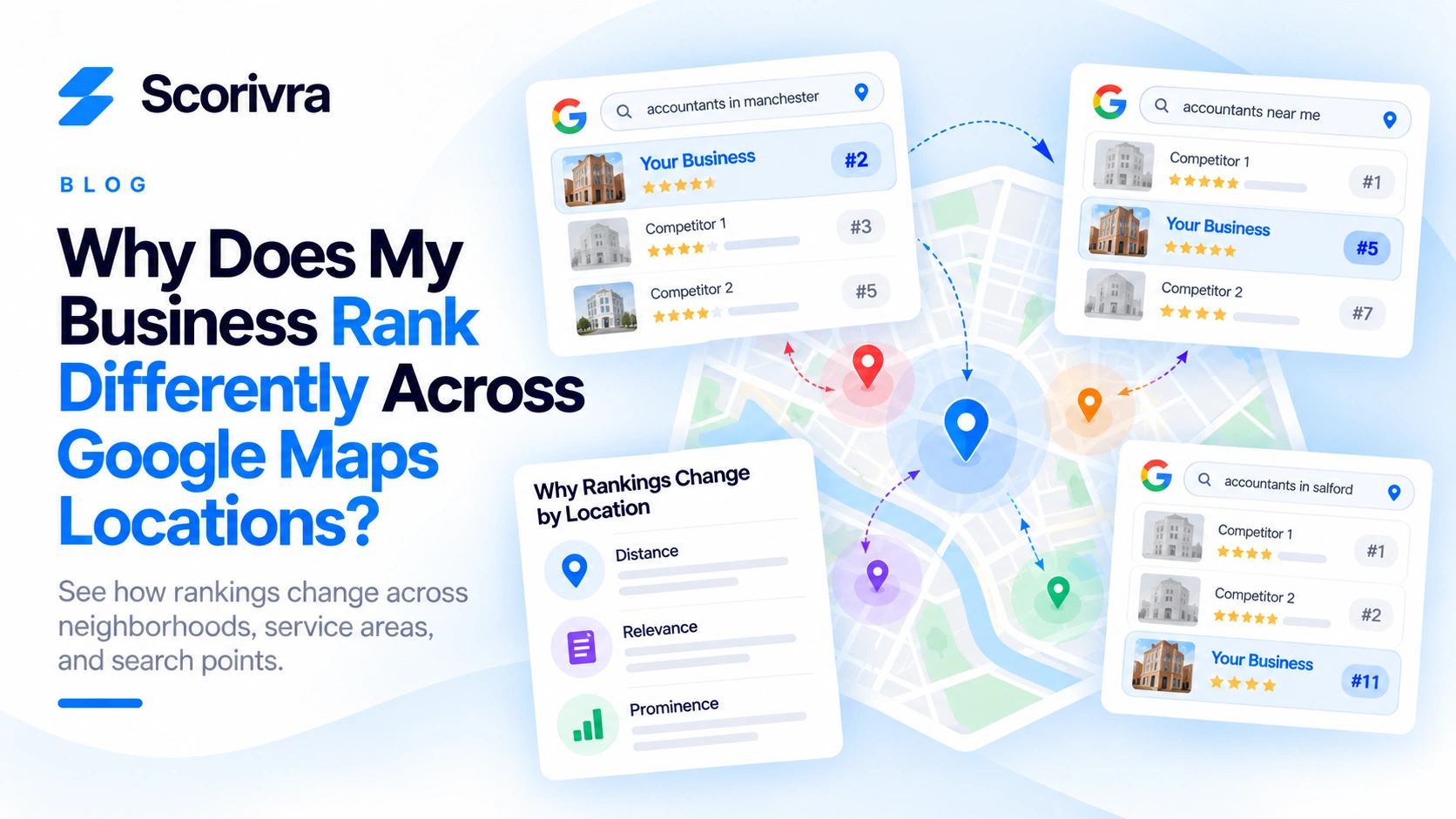
A business can appear near the top of Google Maps results when someone searches from one neighbourhood, yet appear much lower when the same search is performed only a few miles away.
This can happen even when the business name, search keyword, and Google Business Profile remain unchanged.
For local businesses, that difference matters. A strong ranking near your office does not necessarily mean customers across your service area can find you.
Understanding why Google Maps rankings change by location is the first step towards measuring your actual local search visibility.
Why Do Google Maps Rankings Change by Location?
Google Maps does not necessarily show every user the same local search results.
According to Google's official guidance, local rankings are primarily influenced by three factors:
- Relevance: How closely a business matches what someone is searching for.
- Distance: How far a business is from the searcher's location or the location specified in the search.
- Prominence: How well-known or established a business is, based on signals such as reviews, links, and other information.
These factors work together rather than independently.
Consider a dental clinic in central Manchester.
Someone searching for "dentist near me" from the city centre may see that clinic among the leading results. However, a person making the same search from Didsbury or Salford may see different practices first.
The clinic has not necessarily lost authority or experienced a technical problem. Google is evaluating the search in a different geographic context.
This makes local rankings fundamentally different from a single, universal position in traditional search results.
Why Checking Your Ranking From One Location Is Misleading
Many business owners check their Google Maps position by searching for their main service from their office or home.
For example:
- An electrician searches for "electrician Manchester".
- A dental practice searches for "dentist near me".
- An estate agent searches for "estate agents in Bristol".
- A beauty clinic searches for "skin clinic London".
If the business appears in the top three results, the owner may reasonably assume that its local visibility is strong.
But that result only describes one search context.
A customer searching from another neighbourhood could encounter a different ranking order.
There may be areas where your business consistently appears near the top, areas where competitors dominate, and areas where your business is difficult to find.
A single Google Maps ranking cannot reliably represent visibility across an entire local market.
This is particularly important for businesses that serve customers across multiple neighbourhoods rather than relying exclusively on foot traffic near one location.
What Is Google Maps Grid Tracking?
Google Maps grid tracking measures business rankings from multiple geographic points within a defined area.
Instead of checking a keyword from one location, the monitoring system evaluates that keyword across a geographic grid.
For example, a 9×9 grid contains 81 measurement points.
Each point represents a different location within the selected market.
A hypothetical result for a local electrician might look like this:
| Area | Google Maps Rank |
|---|---|
| Near the business | 2 |
| Northern neighbourhood | 4 |
| Eastern neighbourhood | 9 |
| Southern neighbourhood | 15 |
| Western neighbourhood | Not found within the tracked depth |
Illustrative example only. These are not actual search results.
This kind of measurement reveals patterns that a single ranking check cannot.
It can help answer questions such as:
- Where does my business rank strongest?
- Which neighbourhoods have weaker visibility?
- Where are competitors appearing ahead of me?
- Are my local rankings improving across the market?
- Does my visibility decline outside my immediate business location?
The result is a more geographically complete view of Google Maps performance.
However, grid measurements remain sampled observations. They do not guarantee that every customer at a given location will see precisely the same results.
Why Local Ranking Gaps Matter for Businesses
A geographic ranking gap is an area where a business has weaker Google Maps visibility than it has elsewhere.
Not every gap represents a problem that needs fixing.
A business located in one part of a city would naturally expect some variation as searches move further away.
However, certain patterns deserve closer investigation.
1. Strong Rankings Near Your Business, Weak Rankings Elsewhere
This may indicate that distance plays an important role in your current visibility.
For businesses serving a wider geographic area, the question becomes whether their online presence adequately reflects the services and locations they genuinely cover.
2. Competitors Consistently Outrank You in Particular Areas
If several competitors repeatedly appear above your business in certain neighbourhoods, compare their Google Business Profiles, categories, review signals, and local relevance.
The purpose is not to assume that any one competitor signal directly caused the ranking difference.
Instead, competitor comparisons can help identify reasonable areas for further investigation.
3. Rankings Change Significantly Over Time
One measurement is a snapshot.
Repeated measurements can reveal whether geographic ranking patterns are stable, improving, or deteriorating.
A change in one grid point may be temporary. A consistent decline across several measurements may deserve greater attention.
This is why local rank tracking becomes more useful when measurements are repeated under reasonably consistent conditions.
How to Monitor Google Maps Rankings Across Different Locations
A practical local ranking monitoring process can be divided into five steps.
Step 1: Choose Keywords That Reflect Customer Intent
Select phrases that potential customers genuinely use when looking for your services.
Examples include:
- "emergency plumber"
- "dentist near me"
- "commercial electrician"
- "accountant"
- "estate agent"
Avoid measuring only broad keywords that do not clearly match your services.
Different keywords may produce different geographic ranking patterns.
Step 2: Define Your Actual Service Market
Choose a monitoring area that reflects where customers realistically come from.
A city-wide grid may be useful for some businesses, while a smaller area around one branch may be more appropriate for others.
For service-area businesses, focus on locations where you genuinely provide services rather than attempting to measure every nearby town.
Step 3: Measure Rankings Across Multiple Geographic Points
Use geographic grid measurements to identify where your business appears prominently and where it does not.
Keep the keyword, grid configuration, and measurement method consistent when comparing results over time.
Remember that rank tracking tools provide observations of search results, not guaranteed customer impressions.
Step 4: Compare Nearby Competitors
Investigate the businesses appearing above yours in weaker areas.
Relevant questions include:
- Are competitors physically closer to those search locations?
- Do their primary business categories better match the keyword?
- Are their profiles more complete?
- Do they have stronger review or broader prominence signals?
- Does their website clearly explain the relevant services?
These observations can guide an optimisation plan without assuming that correlation proves causation.
Step 5: Track Changes Before Drawing Conclusions
Monitor rankings over multiple measurement periods.
Look for sustained geographic patterns rather than reacting to one isolated change.
If you update your Google Business Profile, improve service pages, or strengthen other local search signals, compare subsequent measurements.
The objective is to determine whether your local visibility is moving in a useful direction.
Google Maps Rankings and AI Local Recommendations Are Not the Same
Google Maps is not the only place where customers discover local businesses.
AI-powered search experiences can also recommend businesses when users ask questions such as:
"Which dental clinics near me offer emergency appointments?"
or
"Can you recommend a reliable electrician in Manchester?"
A business that ranks well in Google Maps is not guaranteed to appear in every AI-generated recommendation.
These are different discovery experiences, and their results should be measured separately.
Google Maps grid tracking examines a business's ranking across geographic search locations.
AI local visibility tracking examines whether an AI system mentions or recommends a business across location-based queries.
Comparing the two can reveal situations where a business has relatively strong Maps visibility but weaker visibility in AI recommendations, or vice versa.
That difference can be useful when deciding where to investigate next.
How Scorivra Helps Measure Local Search Visibility
Scorivra's Local Search tools are designed to make geographic visibility easier to evaluate.
Instead of relying on one Google Maps search, Scorivra provides multiple views of local discovery.
Google Maps Grid
A 9×9 geographic grid measures Google Maps rankings across 81 locations.
It helps businesses identify stronger and weaker ranking areas, compare nearby competitors, and monitor geographic changes over time.
Daily Local Rank Tracking
Selected local search keywords can be monitored daily, providing a more frequent view of ranking movement.
Gemini AI Local Grid
Scorivra also measures location-based business mentions and recommendations through Gemini across geographic grid points.
This provides a separate view of where AI recommends your business within the same local market.
The Google Maps Grid and Gemini AI Local Grid are measured weekly, while daily local rank tracking provides more frequent keyword monitoring.
Together, these views help business owners distinguish geographic ranking performance from AI recommendation coverage.
Importantly, the AI Local Grid uses Gemini for its geographic measurements. It should not be interpreted as equivalent geographic tracking across every AI search platform.
Frequently Asked Questions
Why does my business rank first on Google Maps in one area but lower in another?
Google considers relevance, distance, and prominence when generating local results. As the search location changes, the relative distance and competitive context can also change, resulting in different rankings.
Can I rank in Google Maps outside my immediate neighbourhood?
Yes. Businesses can appear in results beyond their immediate neighbourhood. However, visibility depends on multiple factors, including relevance, distance, prominence, and the businesses competing for each search.
Does having more Google reviews guarantee better Maps rankings?
No. Google identifies reviews as one of several signals that can contribute to prominence, but additional reviews do not guarantee a particular ranking position.
How many locations should I check when monitoring local rankings?
There is no universally correct number. The appropriate grid size depends on the geographic market, business type, and level of detail required. A 9×9 grid provides 81 measurement points, but the selected coverage area and spacing matter as much as the number of points.
How often should I check Google Maps rankings?
Daily keyword tracking can help detect changes, while weekly geographic grid measurements can help identify broader local patterns. Consistent comparisons are generally more useful than repeatedly checking a single isolated result.
Does a high Google Maps ranking guarantee more customers?
No. Strong rankings may increase the opportunity to be discovered, but customer enquiries and conversions also depend on factors such as search demand, business relevance, reputation, availability, and the attractiveness of the offer.
Final Thoughts
Google Maps ranking is not one fixed number that applies across an entire city.
Your business may be highly visible near its physical location while competing much less effectively in surrounding neighbourhoods.
For businesses that depend on local customers, understanding those geographic differences is essential to evaluating local search performance.
Rather than asking only, "What position does my business rank in Google Maps?", a more useful question is:
"Where can potential customers find my business, and where are competitors more visible?"
Geographic ranking measurements provide a clearer starting point for answering that question.
To explore how your Google Maps rankings compare with location-based AI recommendations, visit Scorivra Local Search.