
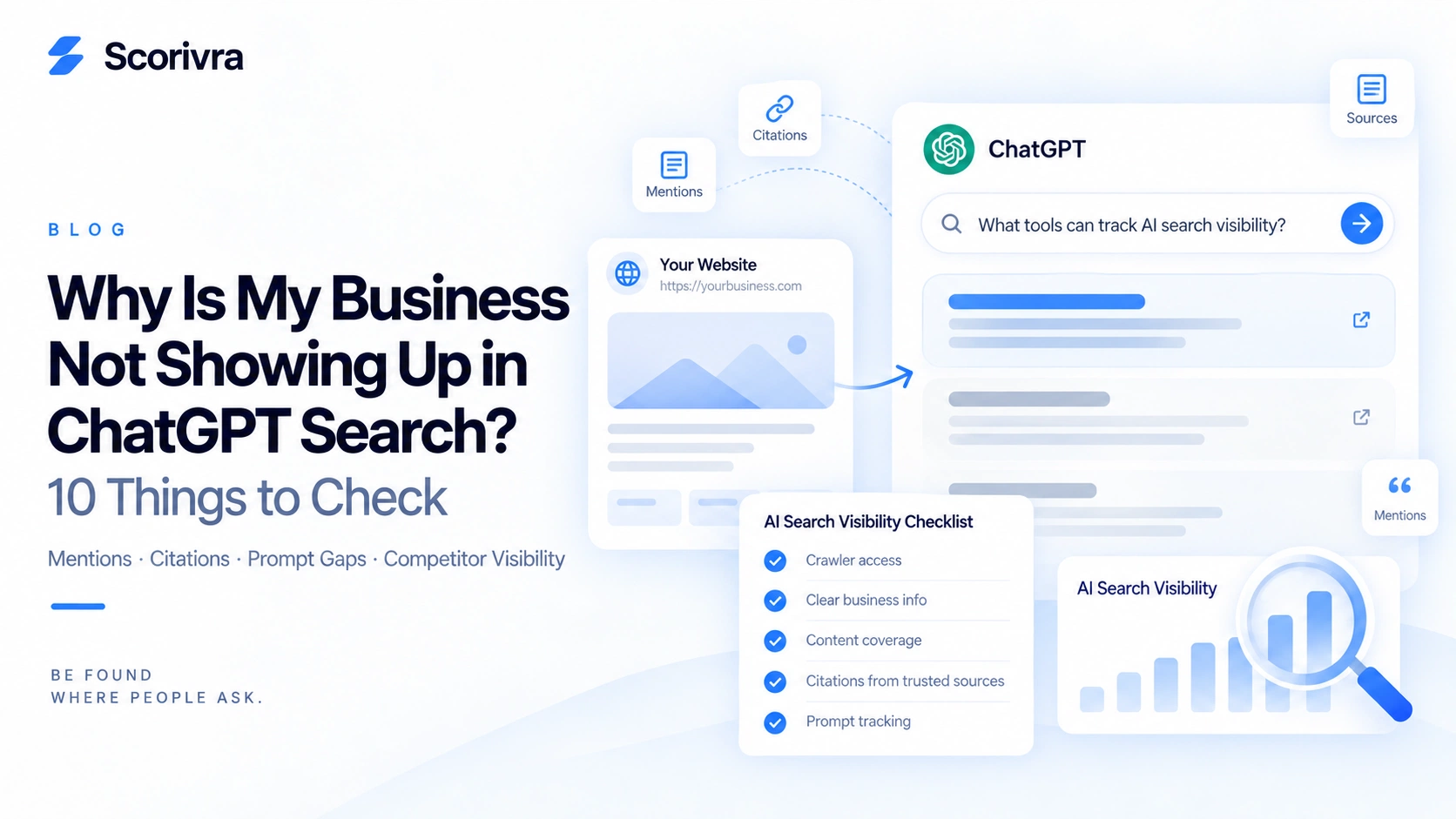
Why can someone find your business on Google but fail to see it mentioned in ChatGPT Search?
The short answer is that traditional search rankings and AI search visibility are not the same thing.
A website can receive organic traffic, rank for important keywords, and still appear inconsistently — or not at all — when users ask ChatGPT questions related to its products, services, or market.
There is also no switch that guarantees inclusion in an AI-generated answer.
Instead of asking only, “How do I rank in ChatGPT?”, a better starting point is:
Can ChatGPT discover my website?
Can it clearly understand what my business does?
Does my website contain information relevant to the questions potential customers ask?
And am I measuring visibility across the right prompts?
Here are 10 things to check.
1. Check Whether OAI-SearchBot Can Access Your Website
The first check is technical.
OpenAI uses OAI-SearchBot to surface websites in ChatGPT Search.
If your website blocks OAI-SearchBot, your content may not be available for inclusion in ChatGPT Search answers.
Check your robots.txt file for rules such as:
User-agent: OAI-SearchBot Disallow: /
If you want your public content to be discoverable through ChatGPT Search, make sure OAI-SearchBot is not being blocked unintentionally.
You should also check whether your hosting provider, firewall, CDN, or bot protection system is rejecting the crawler even when robots.txt allows it.
Allowing OAI-SearchBot does not guarantee that your website will be mentioned or cited.
It simply removes a major technical barrier to discovery.
Is OAI-SearchBot the same as GPTBot?
No.
OAI-SearchBot is used for search.
GPTBot is associated with crawling content that may be used to improve OpenAI's generative AI foundation models.
These controls are independent.
A website can allow OAI-SearchBot for search discovery while separately blocking GPTBot.
That distinction matters because allowing your site to appear in ChatGPT Search does not require you to treat search crawling and model-training crawling as the same thing.
2. Make Sure Your Important Pages Are Publicly Accessible
Crawler access does not help if the useful content itself cannot be reached.
Review the pages that explain your:
- products
- services
- features
- pricing
- comparisons
- use cases
- company information
- FAQs
- research
- documentation
Then check for technical barriers.
Common problems include:
- accidental noindex directives
- authentication requirements
- broken pages
- server errors
- incorrect canonical tags
- broken internal links
- important information hidden behind interactions
- aggressive bot protection
- pages that are difficult to discover internally
Think of this as the foundation.
Before worrying about AI visibility strategies, make sure the pages containing your best information can actually be discovered and accessed.
3. Clearly Explain What Your Business Does
Many websites are written primarily as marketing pages.
That can create a clarity problem.
Consider this homepage statement:
“Build the future of your business.”
It sounds polished.
But it tells a reader almost nothing about the company.
Now compare it with:
“We provide AI search visibility software that helps businesses track brand mentions, citations, competitors, and search visibility across AI search platforms.”
The second statement is much easier to interpret.
A visitor can immediately understand:
- what the product is
- who it is for
- what it measures
- what problem it solves
Your website does not need robotic or keyword-stuffed copy.
But important pages should use explicit language.
Ask yourself:
If someone who has never heard of my company visits the website, can they understand what we sell within 30 seconds?
If the answer is unclear, improving that clarity should come before advanced AI search optimization.
4. Create Content Around Real Customer Questions
Traditional SEO has historically focused heavily on keywords.
AI search often starts with a full question.
For example, a potential customer might ask:
“What tools can track whether my brand appears in AI search results?”
Or:
“How can I compare my AI search visibility with competitors?”
Or:
“What is the difference between an AI mention and an AI citation?”
These queries contain more context than a short keyword.
That means a website with only a homepage and a few short feature descriptions may not cover enough of the user's information need.
Useful supporting content can include:
- practical guides
- comparisons
- definitions
- implementation tutorials
- FAQs
- original research
- benchmark studies
- case studies
- troubleshooting guides
- feature documentation
The goal is not to create hundreds of near-identical pages for every possible question.
The goal is to become a genuinely useful source for the topics your customers care about.
A strong content library should answer both basic and specific questions.
5. Replace Vague Claims With Specific Information
Consider two statements.
“We are the leading AI visibility platform.”
And:
“Our AI visibility tracking measures brand mentions, citations, positions, Share of Voice, prompt gaps, and competitor visibility across supported AI search experiences.”
The second statement provides actual information.
This matters because generic marketing claims contain very little usable context.
Whenever possible, provide concrete details such as:
- what the product does
- what it measures
- who it is designed for
- how the process works
- supported platforms
- limitations
- methodology
- pricing
- examples
- original data
- benchmark results
Useful information is more valuable than repeated superlatives.
You should still market your business.
But your marketing pages should also contain enough factual information for someone to understand and evaluate the product.
6. Build a Clear and Consistent Web Presence
Your website is not the only place where information about your business may exist.
Your brand may also appear on:
- review platforms
- industry directories
- software directories
- partner websites
- professional associations
- media publications
- social profiles
- community websites
- comparison articles
Consistency matters.
Important information such as your company name, product description, website address, and core offering should not contradict itself across major sources.
This does not mean creating hundreds of low-quality directory listings.
It means making sure legitimate sources accurately describe the business.
Independent sources can also provide additional context about your company.
However, there is no published formula that says a specific number of backlinks, mentions, reviews, or directory listings will guarantee inclusion in ChatGPT Search.
Avoid treating AI visibility like a checklist where one backlink or one schema field automatically produces a result.
7. Give Search Systems Something Worth Citing
A useful question is not only:
“How do I get mentioned?”
It is also:
“Why would someone use my page as a source?”
Imagine two pages discussing AI search visibility.
Page A contains:
“AI search is becoming important. Businesses should optimize for AI.”
Page B contains:
- a clear definition
- a measurement framework
- examples
- platform differences
- original screenshots
- benchmark data
- methodology
- limitations
- practical steps
Page B offers much more information that can support an answer.
This is where original information becomes valuable.
Examples include:
- proprietary benchmark data
- original experiments
- product usage data
- industry surveys
- case studies
- first-party research
- detailed technical documentation
This type of content is much harder for competitors to replicate.
For Scorivra, this is particularly important.
Over time, aggregated and appropriately anonymized data can support content such as:
“The Most Common AI Search Visibility Problems We Found Across 1,000 Websites”
or:
“What High-Visibility Business Websites Have in Common”
Those articles provide information rather than simply repeating existing definitions.
8. Test More Than One Prompt
One of the biggest mistakes in AI visibility measurement is testing a single question.
Suppose a business searches:
“What is the best AI visibility tool?”
It does not appear.
That does not prove the business has zero AI visibility.
Change the prompt:
“What tools can track brand citations in AI search?”
Or:
“What software can compare a company's AI search visibility with competitors?”
Or:
“What tools measure Share of Voice across AI search platforms?”
The answer may change.
Different prompts represent different user intents.
A useful AI visibility program should therefore monitor groups of prompts.
Examples include:
Category prompts
“What are AI search visibility platforms?”
Problem prompts
“How can I find out whether AI search engines mention my company?”
Comparison prompts
“What tools can compare AI visibility with competitors?”
Feature prompts
“What software tracks citations from AI search?”
Commercial investigation prompts
“What AI visibility tools are suitable for small marketing teams?”
Branded prompts
“What does Scorivra do?”
Each prompt tests something different.
Do not reduce AI visibility to one manually entered question.
Measure a representative prompt set.
9. Separate Branded Visibility From Discovery Visibility
Branded prompts and discovery prompts should not be treated as the same metric.
Consider:
“What is Scorivra?”
This is a branded prompt.
The user already knows the company exists.
Now consider:
“What tools can help a small business track AI search visibility?”
This is a discovery prompt.
The user may have never heard of Scorivra.
For business growth, discovery visibility can be particularly important because it shows whether the company appears before the user has chosen a brand.
A useful measurement framework should therefore ask two separate questions.
First:
Can an AI search experience correctly understand and describe my company when someone asks about the brand?
Second:
Does my company appear when someone asks about the category, problem, feature, or use case that my product addresses?
These are very different visibility tests.
A brand may perform well in the first and poorly in the second.
10. Measure Mentions, Citations, Positions, and Competitors Separately
“Do we appear in AI search?”
is too broad to be useful.
Visibility has multiple components.
Mention
Does the answer name your brand?
Citation
Does the answer reference your website or a specific page as a source?
Position
Where does your business appear relative to other businesses or sources within the tracked result?
Share of Voice
Across the prompts you track, how much visibility does your brand receive compared with competitors?
Prompt Gap
Which relevant prompts show competitors but not your brand?
Competitor Visibility
Which companies repeatedly appear for the same questions you care about?
These metrics answer different questions.
For example, you may discover that your brand is mentioned frequently but your own website is rarely cited.
Or your business may appear for branded prompts but disappear from discovery prompts.
Or one competitor may repeatedly appear across an entire group of commercial questions.
Those patterns are far more useful than checking ChatGPT manually once and deciding whether your company is “visible.”
Why Does My Competitor Appear but My Business Does Not?
This is often the most actionable question.
Do not immediately assume that your competitor has discovered a secret AI optimization technique.
Compare the underlying information.
Look at:
- how clearly the competitor describes its product
- the depth of its important pages
- the questions its content answers
- original information it publishes
- third-party references
- technical accessibility
- internal linking
- product documentation
- comparison content
- cited pages
Then compare the prompts where the competitor appears.
Imagine a competitor consistently appears when users ask about AI citation tracking.
You might discover that the competitor has:
- a dedicated citation-tracking page
- documentation explaining citations
- several educational articles
- comparison pages
- examples
- external references
Meanwhile, your website may mention citation tracking only once in a feature list.
That difference gives you something concrete to improve.
“Improve GEO” is vague.
“Create a complete resource explaining how AI citations are measured because competitors dominate citation-related prompts” is actionable.
Does Ranking in Google Guarantee Visibility in ChatGPT?
No.
Traditional organic search ranking and AI search visibility measure different outcomes.
Google search measurement commonly focuses on things such as:
- impressions
- clicks
- keyword positions
- landing pages
- organic traffic
AI visibility can focus on:
- mentions
- citations
- positions
- Share of Voice
- prompt coverage
- competitor visibility
Strong SEO is still valuable.
Good technical accessibility, useful content, clear site structure, and authoritative information benefit the website regardless of how users discover it.
But a high Google ranking for one keyword should not be interpreted as a guarantee that the same brand will appear in an AI-generated answer.
Measure both.
Can You Submit a Website Directly to ChatGPT Search?
There is no standard submission button that guarantees your website will appear in ChatGPT Search answers.
OpenAI states that public websites can appear in ChatGPT Search.
The most important technical step is making sure OAI-SearchBot is allowed to access the content you want discoverable.
After changing robots.txt, OpenAI notes that it can take roughly 24 hours for its systems to adjust.
Again, crawler access is not the same as guaranteed visibility.
It simply allows your content to participate in the discovery process.
Can I Track Traffic Coming From ChatGPT?
Yes.
OpenAI states that referral links from ChatGPT Search automatically include a ChatGPT-specific UTM source parameter.
That means analytics tools such as Google Analytics can be used to identify traffic arriving from ChatGPT.
Referral traffic and AI visibility should still be treated as different measurements.
A citation may create visibility without producing a click.
A mention may influence awareness without sending referral traffic.
A click measures traffic.
Each metric tells you something different.
What Should You Check First?
If your business is difficult to find in ChatGPT Search, use this order.
- Confirm OAI-SearchBot is allowed.
- Check whether important pages are publicly accessible.
- Make your business and product descriptions explicit.
- Answer real customer questions.
- Replace vague claims with specific information.
- Keep important business information consistent.
- Publish information worth referencing.
- Track multiple commercially relevant prompts.
- Separate branded and discovery visibility.
- Measure mentions, citations, positions, Share of Voice, prompt gaps, and competitors separately.
The objective is not to find a single “ChatGPT ranking factor.”
The objective is to understand where your visibility breaks down.
Measure AI Search Visibility Instead of Guessing
Manual searches are useful for exploration.
They are not enough for systematic measurement.
Scorivra's AI Search Visibility is designed to measure how brands appear across supported AI search experiences, including:
- ChatGPT
- Google AI Overview
- Google AI Mode
You can track metrics such as:
- brand mentions
- citations
- positions
- Share of Voice
- prompt gaps
- competitor visibility
- visibility changes over time
This is separate from Scorivra's location-based grid features.
AI Search Visibility measures supported AI search experiences such as ChatGPT.
AI Local Grid is a separate local visibility feature and should not be interpreted as ChatGPT grid tracking.
That distinction matters because the two tools answer different questions.
AI Search Visibility asks:
“How visible is my brand across the AI search prompts that matter to my business?”
Local grid measurement asks a different question about visibility across geographic locations.
Keeping those measurements separate makes the data easier to interpret.
The Bottom Line
If your business is not appearing in ChatGPT Search, do not start by looking for shortcuts.
Start with four questions:
Can ChatGPT access my content?
Can it clearly understand my business?
Do I publish information relevant to the questions customers ask?
Am I measuring enough prompts to know whether there is actually a visibility problem?
Then measure the result over time.
AI search visibility becomes much more useful when it changes from:
“Did ChatGPT mention us today?”
to:
“Across the prompts that matter to our business, where are we visible, where are competitors visible instead, and what information gaps can we fix?”
That is a problem you can actually work on.