
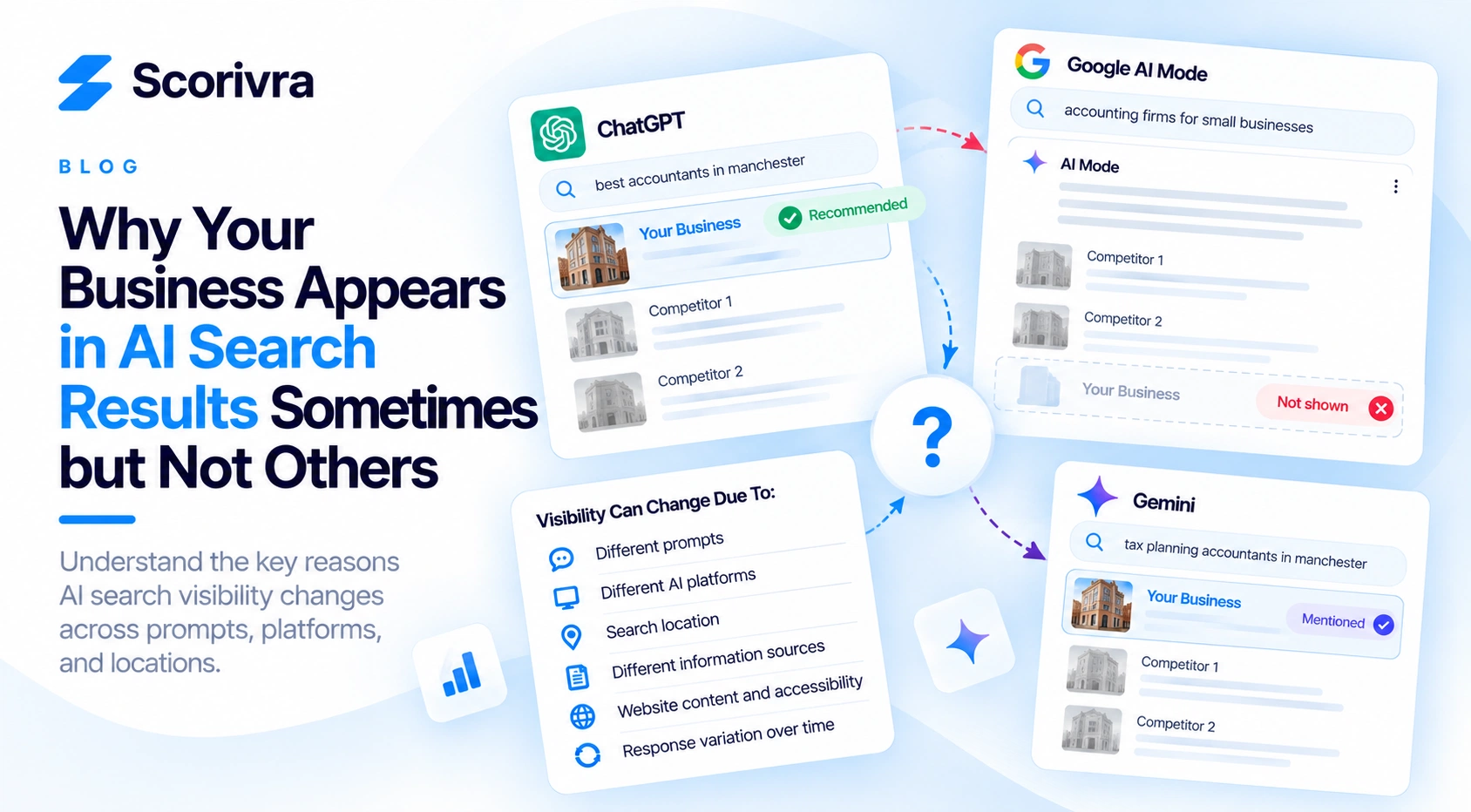
Your business appears when someone asks ChatGPT for recommendations. A colleague tries a similar question an hour later, but your business is missing. Meanwhile, Google AI Overviews mentions a competitor that did not appear in either response.
Which result represents your actual AI search visibility?
The answer is that a single AI-generated response cannot reliably represent your visibility across an entire search platform.
AI search results can differ depending on how a question is phrased, which platform answers it, what information is retrieved, and the context of the search.
For businesses trying to measure their presence in AI-generated recommendations, these differences create an important challenge: appearing once does not mean appearing consistently.
This guide explains why those differences occur, how to investigate them, and what businesses can do to develop a more reliable understanding of their AI search visibility.
1. AI Search Results Are Not Fixed Rankings
Traditional search results typically present a ranked list of webpages. Although those rankings also change based on context, AI-generated answers introduce another layer of variability.
AI search systems interpret questions, retrieve information when appropriate, and construct responses based on the information available to them.
Consequently, two similar questions may produce different recommendations.
Consider these searches:
- "What are the best accounting firms in Manchester?"
- "Which Manchester accountants help small businesses?"
- "Recommend an accounting firm in Manchester for tax planning."
- "Which accountants in Manchester are experienced with startups?"
All four questions concern accounting services in Manchester, but they express different requirements.
An accounting firm specializing in startup taxation may be relevant to the fourth question without being selected for the first.
The important distinction is between being relevant to a particular question and being consistently visible across a broader group of related questions.
This distinction matters when evaluating AI search performance.
2. Six Reasons Your Business Appears in Some AI Answers but Not Others
Reason 1: Small Changes in Prompts Can Change Recommendations
AI search systems interpret the intent behind a question rather than relying only on identical keyword matches.
Adding a service, audience, budget, or location can change which businesses are relevant.
For example:
Prompt A: "Recommend a dental clinic in Birmingham."
Prompt B: "Recommend a dental clinic in Birmingham specializing in dental implants."
Prompt C: "Which Birmingham dental clinics offer dental implants and flexible payment options?"
A practice may appear in Prompt B because its website clearly describes dental implant services.
It may not appear in Prompt C if the system cannot establish that the practice offers the requested payment arrangements.
This does not automatically mean the business has poor AI visibility.
It may simply be less relevant to the additional requirements.
What to check: Test a group of realistic questions that reflect the services and purchasing considerations of your target customers.
Reason 2: Different AI Platforms Use Different Systems
ChatGPT Search, Gemini, Google AI Overviews, and Google AI Mode do not necessarily produce identical answers.
They may differ in how they retrieve information, interpret questions, construct responses, and select supporting sources.
Google also explains that AI Overviews and AI Mode may use different models and techniques, resulting in different answers and links.
Therefore, appearing in one platform does not guarantee appearing in another.
A business could be frequently recommended by one system while receiving few mentions from another.
What to check: Evaluate visibility separately for each platform rather than combining all results into one assumed ranking.
Reason 3: Search Location Can Change the Context
Location can influence which businesses are relevant, especially for local services.
Imagine someone searching for an electrician in Manchester.
A person searching from Didsbury may be interested in different nearby providers than someone searching from Salford.
For a local business, these differences matter because customers do not all search from the same place.
However, geographic behavior depends on the platform and its available location context.
You should not assume that every AI search platform supports precise coordinate-based testing or uses location information in the same way.
What to check: Where supported, compare recommendations across different geographic contexts. Keep location-based AI recommendation analysis separate from traditional Google Maps ranking measurements.
Reason 4: AI Systems May Retrieve Different Sources
An AI-generated answer may draw on information from websites and other accessible sources.
Depending on the platform and query, retrieved information can influence which businesses receive mentions or supporting citations.
A business may have a detailed service page, while a competitor has information that better addresses a particular question.
The retrieved evidence may therefore support different recommendations.
However, a citation does not necessarily mean the cited business was recommended.
For example, an AI answer could cite an informational article from one company's website while recommending several other providers.
This creates two distinct measurements:
- Brand mentions: Whether the business is named in the response.
- Source citations: Whether the business's website is referenced as a supporting source.
Both can be useful, but they measure different types of exposure.
What to check: Record mentions and citations separately. Do not treat every citation as a customer recommendation.
Reason 5: Website Information May Be Incomplete or Difficult to Access
A business may provide an excellent service without clearly explaining that service on its website.
Suppose a roofing company offers emergency roof repairs but mentions this only briefly on its homepage.
Another company maintains a dedicated emergency repairs page explaining its service area, availability, and repair process.
The second website may provide more directly relevant information for an AI system answering an emergency repair question.
Technical accessibility also matters.
For example, OpenAI advises website owners who want their pages to be eligible for ChatGPT Search to allow OAI-Searchbot access.
Google states that pages appearing as supporting links in AI Overviews and AI Mode must satisfy its relevant Search eligibility requirements.
Accessibility and clear content can support discoverability, but neither guarantees inclusion in AI answers.
What to check:
- Are important service pages accessible to relevant search crawlers?
- Do pages clearly describe the services offered?
- Are service areas and business details consistent?
- Can visitors understand the business's specialties without making assumptions?
- Are important pages indexable where required?
These checks help identify potential obstacles without assuming that every missing mention is caused by a technical problem.
Reason 6: AI-Generated Answers Can Vary Between Tests
Even when a question remains unchanged, an AI-generated answer is not necessarily identical on every attempt.
Differences may arise from retrieval behavior, changing source information, system updates, or the generation process.
One test might mention your business. Another might select different companies.
That is why businesses should avoid making major optimization decisions based on a single response.
What to check: Repeat important prompts over time and compare patterns rather than interpreting an isolated answer as a definitive result.
3. How to Measure AI Search Visibility More Reliably
If AI-generated responses can vary, how should a business evaluate its actual visibility?
A practical approach is to measure a defined set of customer questions consistently.
Step 1: Build a Relevant Prompt Set
Start with the questions potential customers are likely to ask when considering your services.
For a dental practice, examples might include:
- "Which dental clinics in Leeds provide dental implants?"
- "Recommend an orthodontist in Leeds."
- "What dental practices in Leeds offer cosmetic dentistry?"
- "Which Leeds dentists provide clear aligners?"
Avoid relying exclusively on broad questions such as "best dentist."
Include service-specific and comparison-oriented queries that reflect genuine customer needs.
Step 2: Measure Each AI Platform Separately
Run the selected questions across the platforms you want to monitor.
Document the platform, prompt, and collection date.
Avoid assuming that a recommendation from ChatGPT represents what users will see in Gemini or Google AI Mode.
Different platforms may require different collection methods.
Step 3: Track Mentions, Recommendations, and Citations
These measurements answer different questions.
| Metric | What It Helps You Understand |
|---|---|
| Brand mention | Whether your business is named |
| Recommendation | Whether your business is suggested as an option |
| Citation | Whether your website is referenced as a source |
| Position | Where your business appears within a measured response |
| Share of Voice | Your relative presence compared with tracked competitors |
These metrics require clear definitions.
For example, an AI answer that discusses a business negatively should not automatically count as a positive recommendation.
Similarly, position within a generated response should not be interpreted as a fixed search engine ranking.
Step 4: Compare Competitors
Monitoring your own business provides only part of the picture.
Suppose your practice appears in 4 out of 20 tracked questions.
Without competitor information, it is difficult to determine whether that represents strong or weak relative visibility.
If a nearby competitor appears in 15 of those questions, the difference may identify an opportunity for further investigation.
This does not prove that the competitor receives more customers from AI search.
It indicates that the competitor appears more frequently within the measured prompt set.
Step 5: Monitor Changes Over Time
A single measurement provides a snapshot.
Repeated measurements help identify patterns.
Suppose a business appears in 6 of 20 tracked prompts during the first measurement and 11 of 20 during a later measurement.
Its measured mention rate changes from 30% to 55%.
That is a meaningful change within the defined prompt set, but it does not establish an equivalent increase in overall market visibility or customer traffic.
Keep your prompt selection, platform coverage, and measurement rules consistent when comparing periods.
4. A Practical Example: Measuring Visibility for a Local Business
Consider a hypothetical accounting firm in Manchester.
The firm wants to understand whether AI search platforms recommend it to potential clients.
Instead of asking one general question, the business selects five different prompts:
- "Recommend an accountant in Manchester."
- "Which accounting firms in Manchester help small businesses?"
- "Who provides tax planning for startups in Manchester?"
- "Which Manchester accountants offer bookkeeping services?"
- "Recommend a Manchester accounting firm for limited companies."
For illustration, suppose the following results are observed:
| Prompt | Business Mentioned? | Website Cited? |
|---|---|---|
| General accountant | Yes | No |
| Small business accounting | Yes | Yes |
| Startup tax planning | No | No |
| Bookkeeping | Yes | No |
| Limited company accounting | No | No |
These are hypothetical results, not actual measurements.
The business appears in three of the five responses, giving it a 60% mention rate within this small example.
But that figure alone does not tell the whole story.
The missing mentions in startup taxation and limited company accounting could reflect differences in relevance, accessible information, competing sources, or response variation.
The business should investigate those possibilities before deciding what to change.
A sensible next step might be reviewing whether its website clearly describes those services and whether the corresponding pages are accessible.
5. What to Do When Your Business Is Missing from AI Recommendations
Once you identify visibility gaps, prioritize the problems you can investigate and potentially address.
Improve Service-Specific Content
Make sure your website accurately explains the services you provide.
For each important service, consider whether your content answers:
- Who is this service for?
- What problem does it solve?
- What does the service include?
- Which geographic areas do you serve?
- What should a potential customer know before contacting you?
Avoid creating repetitive pages solely to target minor prompt variations.
Instead, make existing pages more useful and specific.
Review Technical Accessibility
Check whether relevant search crawlers can access your important pages.
Review indexing, robots.txt directives, and other technical barriers where applicable.
Remember that different AI search platforms have different retrieval and indexing arrangements.
There is no universal technical change that guarantees inclusion across every AI platform.
Investigate Competitor Differences
When competitors appear more often, look for observable differences.
For example:
- Do their websites answer specific customer questions more completely?
- Do they provide clearer information about relevant services?
- Are their service areas easier to identify?
- Do they provide useful original information that yours does not?
These observations can guide improvements.
They do not prove why an AI system selected a competitor.
Measure Again Before Drawing Conclusions
After making changes, continue monitoring the same relevant questions.
Look for sustained improvements across multiple measurements.
Avoid attributing every increase or decrease directly to a website update, since AI search systems and retrieved sources can change independently.
6. How Scorivra Helps Investigate AI Search Visibility
Manually testing questions across several AI search platforms can become difficult as the number of prompts and competitors grows.
Scorivra is designed to help businesses monitor search visibility across traditional search, AI-generated results, and local discovery.
Its AI Visibility features support analysis across tracked AI search environments, including ChatGPT, Gemini, Google AI Overviews, and Google AI Mode.
Businesses can use the available measurements to investigate:
- Whether their brand appears in tracked AI responses.
- Which prompts produce brand mentions or recommendations.
- Whether their website receives citations.
- How their visibility compares with tracked competitors.
- How measured visibility changes across reporting periods.
For location-based businesses, Scorivra also provides Google Maps ranking grid measurements and a separate Gemini-based AI Local Grid.
These are distinct measurements.
Google Maps ranking positions should not be treated as equivalent to AI-generated business recommendations.
Scorivra's measurements represent defined searches and collection conditions. They do not provide unrestricted access to search platforms' internal ranking systems or guarantee how every individual customer will see an answer.
To explore the available monitoring and website analysis features, visit Scorivra.
7. Frequently Asked Questions
Why does ChatGPT recommend my business sometimes but not always?
Different prompts, retrieved sources, search context, and response variation can affect the businesses included in an answer. One recommendation does not guarantee consistent inclusion in future responses.
Does appearing in Google AI Overviews mean I will appear in ChatGPT?
No. They are different systems with different retrieval and response mechanisms. Visibility should be measured separately.
Can I guarantee that AI search platforms recommend my business?
No. Improving website content, accessibility, and relevance may help address discoverability issues, but businesses cannot guarantee inclusion in AI-generated recommendations.
Is AI search visibility the same as website traffic?
No. A business can be mentioned in an AI answer without receiving a website visit. Mentions, citations, traffic, and conversions represent different stages of discovery and customer activity.
How often should I check my AI search visibility?
The appropriate frequency depends on your business and monitoring goals. Regular weekly measurements can provide a practical starting point, while longer reporting periods help reveal broader trends.
Consistency in measurement is more important than interpreting every short-term fluctuation.
Conclusion: Measure Patterns, Not Individual Answers
If your business appears in one AI-generated answer but disappears from another, that does not necessarily indicate a technical failure or a sudden loss of visibility.
It may reflect differences in customer intent, platform behavior, retrieved information, geographic context, or response generation.
The useful question is not simply:
"Does AI recommend my business?"
It is:
"For which customer questions, on which platforms, and how consistently does my business appear?"
Answering that question requires a defined prompt set, separate measurements for different platforms, competitor comparisons, and repeated observations over time.
That approach provides a stronger basis for understanding AI search visibility and identifying opportunities worth investigating.