
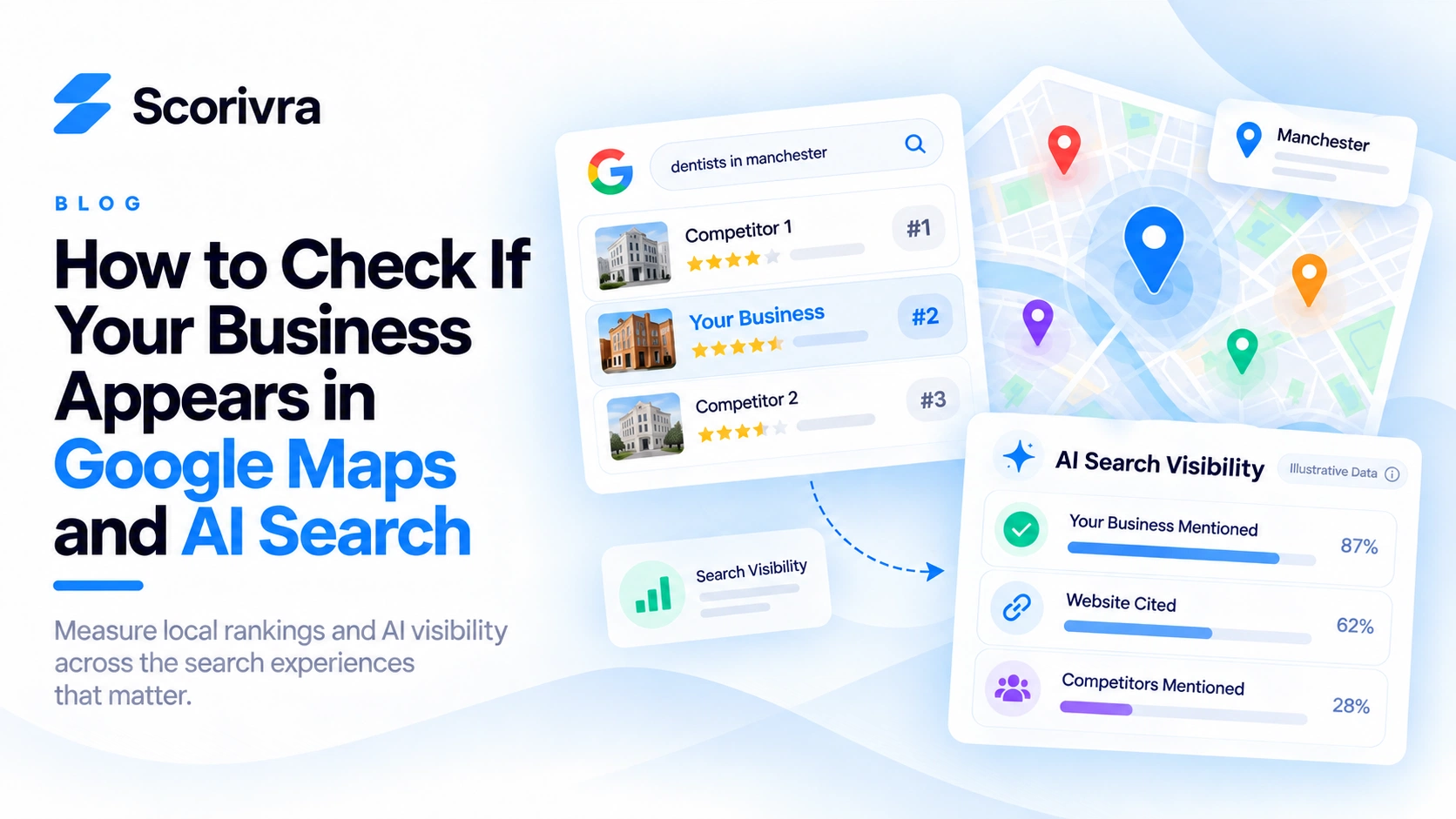
Your business might appear prominently on Google Maps but be missing when someone asks an AI assistant to recommend a local provider.
The opposite can happen, too. An AI assistant might mention your business in response to a customer question, even when your Google Maps ranking is relatively weak in parts of your service area.
For local businesses, these differences matter.
A dental clinic, law firm, estate agency, or home services company may depend on customers discovering nearby providers. But those customers do not necessarily use the same search platform, wording, or location.
To check your business visibility properly, you need to measure two different things: where your business ranks in Google Maps and whether AI search platforms mention or recommend it.
This guide explains how to check both, compare competitors, and identify gaps that deserve attention.
Quick Answer: How Do You Check Your Business Visibility?
To check whether your business appears in Google Maps and AI search:
- Search Google Maps using the services customers actually look for.
- Repeat those searches from different geographic locations.
- Test realistic customer questions in ChatGPT, Gemini, and Google AI Mode.
- Record whether your business is mentioned, recommended, or cited.
- Compare which competitors appear when your business does not.
- Repeat the measurements consistently to identify changes.
A single search is useful for a quick check. It is not enough to establish how visible your business is across an entire market.
1. Understand the Difference Between Google Maps and AI Search
Google Maps and AI-powered search experiences can both help customers discover local businesses, but their results are not interchangeable.
Google Maps presents local business listings and rankings. AI search platforms can generate answers that mention, compare, or recommend businesses based on the question and the information available to the system.
Consider a customer searching for a cosmetic dentist in Manchester.
On Google Maps, they might search:
"cosmetic dentist Manchester"
In an AI assistant, they might ask:
"Which cosmetic dentists in Manchester offer veneers and have strong patient reviews?"
Both searches concern the same service and location, but they express different levels of detail.
The business that appears in one result may not appear in the other.
| Measurement | Google Maps | AI Search |
|---|---|---|
| Primary question | Where does my business rank? | Does AI mention or recommend my business? |
| Search input | Local keywords | Conversational questions |
| Main result | Business listings and positions | Generated answers and recommendations |
| Geographic variation | Important | Can be important, depending on platform and context |
| Useful metrics | Rank, geographic coverage, competitors | Mentions, citations, recommendation coverage, competitors |
This distinction is important because improving your Google Maps position does not automatically guarantee inclusion in AI-generated answers.
Each discovery channel requires its own measurement.
2. Check Whether Your Business Appears on Google Maps
Start with the simplest test.
Open Google Maps and search for the services that customers are likely to use when looking for a business like yours.
For example:
- "emergency electrician Manchester"
- "dental implants Birmingham"
- "accountant for small business Leeds"
- "estate agents Bristol"
Avoid relying entirely on searches for your exact business name.
A branded search shows whether people can find a business they already know.
A non-branded search is more useful for understanding whether potential customers can discover your business before they know its name.
What should you record?
For each keyword, record:
- Whether your business appears.
- Its position within the results you inspect.
- Which competitors appear above it.
- The location used for the search.
- The date of the measurement.
Be careful when interpreting manually checked results.
Google Maps rankings can vary based on search location, query wording, and other contextual factors. A manual check is only a snapshot of the conditions under which that search was performed.
Why one location is not enough
Suppose a dental clinic ranks third when someone searches near its premises.
That does not mean the clinic ranks third throughout Manchester.
A customer searching several miles away might encounter a different group of businesses.
Google explains that local ranking is primarily influenced by relevance, distance, and prominence.
Because distance matters, rankings can change across neighbourhoods.
This is where geographic rank tracking becomes useful.
For a more detailed explanation, read How to Track Google Maps Rankings Across a City.
3. Measure Google Maps Visibility Across Multiple Locations
A local search grid checks the same keyword from multiple points across a defined area.
Instead of asking whether your business ranks third at one location, it helps answer a more useful question:
In which parts of our market can customers find us?
For example, a 9×9 grid contains 81 measurement points.
The same local keyword can be checked across those locations, creating a geographic picture of search visibility.
Consider this hypothetical result for a Manchester dental clinic:
| Area | Google Maps position |
|---|---|
| Near the clinic | 2 |
| Northern area | 4 |
| Eastern area | 9 |
| Southern area | 6 |
| Western area | Not found within the tracked range |
These numbers are illustrative, not actual measurements.
The important observation is that the business performs differently depending on where the customer searches.
What should you look for?
Focus on three questions.
Where are rankings strongest?
Identify locations where your business consistently appears near the top.
Where does visibility decline?
Look for neighbourhoods where your business ranks lower or disappears from the tracked results.
Who appears instead?
A weak ranking becomes more actionable when you know which competitors are visible in that area.
Scorivra's Local Search tools include Google Maps ranking tracking and a geographic Maps Grid for comparing local visibility across different locations.
A grid does not explain every reason behind a ranking difference. It helps identify where further investigation is needed.
4. Check Whether ChatGPT, Gemini, and Google AI Mode Recommend Your Business
Google Maps visibility is only one part of local discovery.
Customers can also ask AI assistants to recommend businesses.
To check your visibility, test questions that reflect realistic customer needs rather than repeatedly asking whether an assistant knows your brand.
Example questions for a local business
For a dentist:
"Which dental clinics in Manchester offer dental implants?"
For an accountant:
"What accounting firms in Leeds help small businesses with tax planning?"
For an electrician:
"Who provides emergency electrical repairs in Birmingham?"
For an estate agency:
"Which estate agents in Bristol specialise in selling residential property?"
These are examples of question formats. Your own tests should reflect your actual services and market.
What should you record?
For each question, check:
- Was your business mentioned?
- Was it recommended as a relevant provider?
- Did the answer link to or cite your website?
- Which competitors were mentioned?
- Did the result change when the question was rephrased?
A brand mention and a website citation are not the same measurement.
An AI assistant may name your company without linking to your website.
It may also cite a page from your website without explicitly recommending your business.
Recording these outcomes separately provides a clearer understanding of your AI search visibility.
Why AI results require repeated testing
AI-generated answers are not guaranteed to remain identical.
Results may vary because of question wording, platform, available sources, search context, and changes over time.
A business appearing in one response is evidence of visibility under those conditions, not proof of consistent recommendations.
Likewise, one missing response does not establish that your business is invisible across the entire platform.
For meaningful comparisons, use a defined set of questions and repeat them over time.
5. Does Your Search Location Affect AI Business Recommendations?
Location can matter in AI-powered local discovery, but geographic testing capabilities differ between platforms.
Google Maps naturally places significant emphasis on geographic relevance.
AI search results can also reflect location, especially for questions involving nearby services, but different AI platforms handle geographic context differently.
For example, someone asking:
"Recommend a reliable electrician near me"
may receive a different answer from someone asking:
"Recommend an electrician in central Manchester."
That does not mean every AI platform supports precise, repeatable location-based testing.
Comparing Google Maps Grid and AI Local Grid
Scorivra provides two geographic views for local discovery:
Google Maps Grid
Measures local ranking positions across multiple points in a defined market.
AI Local Grid
Uses Gemini-based location-targeted measurements to examine where a business is mentioned or recommended across geographic points.
The distinction matters.
Scorivra's AI Local Grid uses Gemini for geographic grid measurements. It does not claim that ChatGPT or Google AI Mode provide identical coordinate-level testing.
Broader AI Visibility monitoring separately tracks selected questions across ChatGPT, Gemini, and Google AI Mode.
Together, these measurements help businesses investigate two different questions:
- Where does Google Maps rank our business?
- Where does location-based AI search mention or recommend our business?
The results should be analysed separately before comparing geographic patterns.
6. Compare Google Maps Rankings With AI Recommendations
Once you have results from both discovery channels, the next step is to identify differences.
Imagine a hypothetical local visibility report:
| Area | Google Maps | AI recommendation |
|---|---|---|
| Central Manchester | Strong | Mentioned |
| Northern area | Strong | Not mentioned |
| Eastern area | Weak | Mentioned |
| Southern area | Weak | Not mentioned |
This example illustrates four possible visibility situations.
Strong on Google Maps and visible in AI
Your business appears in both measured channels.
The priority is to maintain accurate business information, keep service content current, and monitor whether visibility remains consistent.
Strong on Google Maps but missing in AI
Your business performs well in local listings, but the tested AI responses do not mention it.
Review whether your website clearly explains your services, service areas, business identity, and distinguishing information.
Also inspect which competitors AI platforms mention and which sources they cite.
Do not assume that a missing AI recommendation is necessarily caused by a technical SEO issue.
Weak on Google Maps but mentioned in AI
Your business appears in the tested AI answers despite weaker Google Maps rankings.
Investigate local ranking coverage separately. Your Google Business Profile, geographic competition, service relevance, and local prominence may warrant closer inspection.
Weak in both channels
Your business has limited visibility across the measured Google Maps locations and AI questions.
This provides a reason to investigate both local search performance and website readiness.
However, improving one channel does not guarantee better results in the other.
7. What Should You Improve When Your Business Is Missing?
Finding a visibility gap is the beginning of the process, not the solution itself.
The next step is to identify which factors can be meaningfully improved.
Review your Google Business Profile
Check that your business information accurately represents your operation.
Pay particular attention to:
- Primary and additional business categories.
- Accurate contact information.
- Business hours.
- Relevant services.
- Customer reviews and responses.
- Website and location details.
Avoid changing categories or business details simply to target additional keywords.
Accuracy should come first.
Improve service information on your website
Make sure important services have clear, useful explanations.
A potential customer should be able to understand:
- What your business provides.
- Who the service is intended for.
- Which areas you serve.
- What makes the service relevant to their needs.
- How they can contact or choose your business.
For example, an electrical company should explain its emergency repair services rather than relying only on a generic homepage description.
Check technical website accessibility
Review whether important pages can be crawled and indexed where applicable.
Useful checks include:
- Crawl accessibility.
- Indexing status.
- Canonical URLs.
- Internal links.
- Structured data accuracy.
- Clear headings and page content.
These are important website fundamentals, but passing an audit does not guarantee that an AI assistant will recommend your business.
Compare competitors with evidence
If a competitor repeatedly appears where your business does not, examine the actual differences.
Does the competitor have clearer service pages?
Are its location details more relevant?
Does it have stronger local prominence or more useful content?
Is it cited by AI search platforms for the questions you are testing?
Use the findings to determine what deserves improvement rather than copying a competitor's website.
8. Track Visibility Changes Instead of Relying on One Report
A single measurement tells you what happened during one test.
Repeated measurements help you determine whether your visibility is changing.
For meaningful comparisons, keep the testing conditions as consistent as possible.
For Google Maps, maintain the same keywords, geographic area, and grid configuration.
For AI search, maintain a consistent question set, platform selection, and measurement methodology.
It can also be useful to track new questions separately rather than mixing them into an existing comparison.
Which metrics matter?
| Metric | What it helps measure |
|---|---|
| Google Maps position | Local ranking strength |
| Geographic ranking coverage | Where your business appears |
| AI mention rate | How frequently your business appears in tested answers |
| Website citation rate | How frequently your website is cited in tested answers |
| Competitor presence | Which other businesses appear |
| Search clicks | Visits initiated from Google Search results |
| Website engagement | What visitors do after arriving |
These metrics should not be treated as interchangeable.
For example, Google Search Console impressions do not directly measure how often your business is recommended in ChatGPT.
Likewise, AI mentions do not automatically translate into website traffic or new customers.
Visibility is a discovery indicator. Business performance must be evaluated separately.
9. How Scorivra Helps You Measure Both Channels
Checking every keyword, AI question, location, and competitor manually can become difficult as your monitoring requirements grow.
Scorivra brings several visibility measurements into one workspace.
Its local search tools include:
- Daily local Google Maps rank tracking for configured keywords.
- Weekly Google Maps Grid measurements.
- Weekly Gemini-based AI Local Grid measurements.
- Geographic competitor comparisons.
Its AI Visibility tools also track selected questions across ChatGPT, Gemini, and Google AI Mode, including brand mentions, website citations, and competitive visibility.
For businesses that want to investigate website readiness, Scorivra also provides technical site audits covering SEO, AEO, GEO, and local search signals.
The purpose is not to promise a particular ranking or AI recommendation.
It is to establish which parts of your online visibility can be measured, where gaps exist, and what should be investigated next.
You can explore Scorivra's local visibility features or start with a free website audit to assess your site's technical readiness.
Frequently Asked Questions
How do I know whether my business appears on Google Maps?
Search for relevant non-branded service keywords in Google Maps and check whether your business appears. To understand geographic coverage, repeat the measurement across multiple locations rather than relying on one search.
Can I check whether ChatGPT recommends my business?
Yes. Ask realistic customer-style questions and record whether ChatGPT mentions or recommends your business. Repeat tests using a consistent question set because responses can vary.
Does ranking highly on Google Maps guarantee AI search visibility?
No. Google Maps rankings and AI-generated business recommendations are different outputs. Strong rankings on one platform do not guarantee inclusion in another.
Can Google Search Console show my ChatGPT visibility?
No. Google Search Console reports performance within Google's search ecosystem. It does not provide a comprehensive report of brand mentions or recommendations across ChatGPT and other independent AI platforms.
What is the difference between AI Visibility and AI Local Grid?
AI Visibility measures whether selected AI questions produce brand mentions or citations across supported platforms. AI Local Grid examines geographic variation in Gemini-based local recommendations across defined measurement points.
How often should a local business check search visibility?
The appropriate frequency depends on the business and how actively it is making changes. Consistent weekly or monthly reviews can help reveal patterns, while more frequent tracking may be useful for competitive keywords. Scorivra provides daily local rank tracking and weekly geographic grid measurements.
Final Takeaway
Your business visibility is not one ranking, one keyword, or one AI answer.
Google Maps can show where your business ranks geographically.
AI search monitoring can reveal whether assistants mention, cite, or recommend your business in response to relevant questions.
Comparing both helps you identify where customers may encounter your business, where competitors appear instead, and which gaps are worth investigating.
Start with a manageable set of keywords, locations, and customer questions. Measure them consistently, separate rankings from AI mentions, and use the results to guide improvements.
The goal is not simply to appear once.
It is to understand how reliably your business can be discovered across the search experiences that matter to your customers.