
Is a 60/100 Website Audit Score Good? How to Read Your Site Audit Results
You run a website audit and get a score of 60 out of 100.
Is that good?
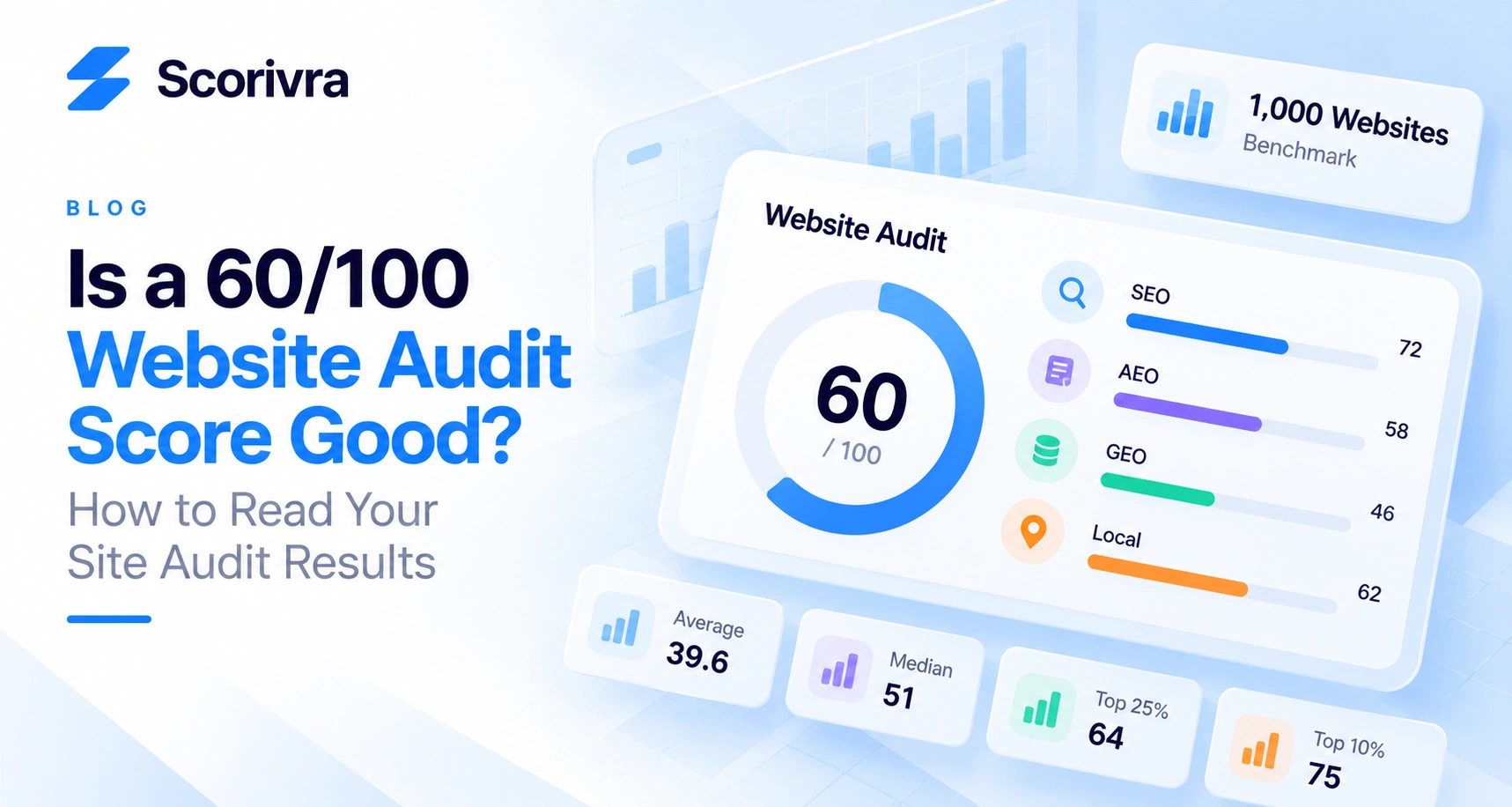
The short answer: a 60/100 score is above the average in Scorivra's current 1,000-site benchmark, but it still leaves meaningful room for improvement.
As of September 17, 2026, Scorivra's benchmark shows:
- Overall average: 39.6/100
- Median: 51/100
- Top 25% threshold: 64/100
- Top 10% threshold: 75/100
So a score of 60 would be above both the benchmark average and median, but below the current top-quarter threshold.
However, the overall score should not be the only thing you look at.
The more useful question is:
What is lowering the score, which pages are affected, and which problems should you fix first?
This guide explains how to interpret a website audit without treating the score as the goal itself.
What Does a Website Audit Score Actually Mean?
A website audit score summarizes the checks included in that particular audit system.
It is not a universal Google ranking score.
Google does not assign websites a public "SEO score" from 0 to 100 that determines where they rank.
Instead, an audit score is a diagnostic tool.
It helps you answer questions such as:
- Are important pages crawlable?
- Are there indexing problems?
- Is page metadata configured correctly?
- Can important information be extracted clearly?
- Are supporting sources and authorship signals present?
- Is local business information structured consistently?
- Which URLs are affected by technical problems?
That distinction matters.
A score of 90 does not guarantee high rankings.
A score of 40 does not mean a website cannot rank.
The score helps you find technical and structural weaknesses that deserve investigation.
Is 60/100 a Good Website Audit Score?
Against Scorivra's current benchmark, 60/100 is above average but below the top 25%.
Scorivra applied the same audit standard to 1,000 sites and published these thresholds:
| Benchmark | Score | |---|---:| | Overall average | 39.6 | | Median | 51 | | Top 25% threshold | 64 | | Top 10% threshold | 75 |
This gives a 60-point score useful context.
It is:
- 20.4 points above the overall average
- 9 points above the median
- 4 points below the top 25% threshold
- 15 points below the top 10% threshold
That is much more informative than simply labeling 60 as "good" or "bad."
You can compare your own result with the latest benchmark here:
https://scorivra.com/benchmark
Why Shouldn't You Focus Only on the Overall Score?
Because two websites can receive similar overall scores for very different reasons.
Imagine two businesses both score 60/100.
Website A:
- SEO: strong
- AEO: strong
- GEO: weak
- Local: weak
Website B:
- SEO: weak
- AEO: moderate
- GEO: strong
- Local: strong
The overall score is identical.
The work required is not.
Website A may need better source, authorship, and local business signals.
Website B may have more fundamental crawlability, indexing, metadata, or document-structure problems.
That is why category scores matter.
What Are SEO, AEO, GEO, and Local Audit Scores?
Scorivra separates its Site Audit into four categories:
- SEO
- AEO
- GEO
- Local
Each category contains 30 checks.
The full audit therefore contains 120 checks.
These categories look at different parts of website discoverability.
What Does the SEO Audit Check?
The SEO category focuses on technical signals involved in search discovery and interpretation.
Examples include:
- crawlability
- indexing
- metadata
- canonical configuration
- document structure
- search-related technical signals
Google explains that crawling and indexing are fundamental steps required for pages to become eligible for Search.
A technically inaccessible page can have excellent content and still create a discovery problem.
That is why serious crawl or indexing failures usually deserve attention before cosmetic optimization.
What Does the AEO Audit Check?
AEO stands for Answer Engine Optimization.
This category looks at whether information is structured in a way that makes clear answers easier to extract and understand.
Scorivra checks areas such as:
- direct-answer structure
- FAQs
- entities
- answer-oriented page structure
This does not mean adding an FAQ automatically makes a page rank or appear in an AI answer.
The purpose is to identify whether the page communicates important information clearly enough to be understood and reused.
What Does the GEO Audit Check?
GEO stands for Generative Engine Optimization.
Scorivra's GEO audit reviews evidence and source-related signals such as:
- citations
- supporting sources
- authorship
- generative-search trust signals
This category is especially useful when a page contains useful information but does not clearly demonstrate where claims came from or who is responsible for the content.
GEO should not be interpreted as a guaranteed formula for appearing in ChatGPT, Gemini, or another AI system.
It is a technical and content-evidence diagnostic layer.
What Does the Local Audit Check?
The Local category focuses on signals relevant to businesses with physical or service-area locations.
Examples include:
- LocalBusiness structured data
- NAP information
- location pages
- Maps-related signals
- local business identity
NAP means:
Name, Address, Phone number.
For a local business, inconsistent identity or location information can create a different class of problem from traditional technical SEO.
That is why Local is evaluated separately.
What Does Scorivra's 1,000-Site Benchmark Show?
The benchmark reveals something that an individual audit cannot:
how your result compares with other websites measured using the same standard.
Scorivra's September 17, 2026 benchmark includes 1,000 sites.
The overall average is 39.6/100.
The median is 51/100.
A score of 64 reaches the current top-quarter threshold, while 75 reaches the top-10% threshold.
The benchmark also shows that the most common score band is 0–19, containing 352 of the 1,000 measured sites.
That represents 35.2% of the benchmark.
The category results are also revealing.
GEO is currently the weakest category in the benchmark, with an average score of 35.3.
This does not mean every website should immediately prioritize GEO.
It means GEO-related checks are a common weakness across the sites included in this benchmark.
Your own priorities should still come from your own audit results.
What Should You Fix First After a Website Audit?
Do not automatically start with the easiest failed check.
Start with the issue that creates the largest meaningful barrier.
A practical prioritization order is:
1. Discovery and Indexing Problems
Ask:
- Can crawlers reach the page?
- Is the page indexable?
- Is an important page accidentally blocked?
- Are redirects working correctly?
- Is the intended canonical URL clear?
These problems can affect whether search engines can discover, process, or select the intended version of a page.
Google recommends using crawlable URLs and provides specific controls for crawling, indexing, canonicalization, and sitemaps.
If an important commercial page cannot be properly discovered or indexed, fixing its title wording first is unlikely to be the highest priority.
2. Canonical and Duplicate URL Problems
A canonical URL tells search engines which URL you prefer as the representative version when similar or duplicate URLs exist.
For example, a site could unintentionally expose:
https://example.com/service
and:
https://www.example.com/service
without consolidating them properly.
Google may choose a canonical itself, but consistent redirects, canonical annotations, sitemap URLs, and internal links help communicate your preference.
Scorivra's Site Audit identifies canonical consolidation problems and shows affected URLs when evidence is available.
3. Page-Level Structural Problems
Next, investigate issues such as:
- missing or weak metadata
- unclear document structure
- poor internal linking
- missing crawlable links
- inconsistent page signals
Google states that links help it discover pages and understand relevance, while descriptive titles and metadata help explain page content.
These problems may not completely block a page, but they can make the site harder to interpret.
4. Answer and Evidence Problems
Once fundamental technical problems are under control, look at AEO and GEO weaknesses.
Ask:
- Does the page answer its primary question directly?
- Are important claims supported?
- Are sources identifiable?
- Is authorship clear where relevant?
- Are entities and relationships understandable?
- Is the page useful without forcing the reader to infer the answer?
This is where content structure and evidence quality become important.
5. Local Business Problems
If you operate a local business, also inspect:
- business name consistency
- address information
- phone information
- location pages
- LocalBusiness structured data
- Maps-related links and signals
A technically healthy informational website and a technically healthy local-business website do not necessarily require exactly the same signals.
Should You Fix Every Failed Audit Check?
Not necessarily.
A failed check means the audit found a condition that deserves review.
It does not automatically mean:
"Change this immediately."
Context matters.
For every failed check, ask:
- What exactly failed?
- Which URL is affected?
- Why did the check fail?
- Could this issue affect discovery, interpretation, trust, or local identity?
- What would satisfy the fix criteria?
- Could changing it create another problem?
This is why evidence is more useful than a score alone.
Scorivra's Site Audit is designed to show the affected URL, decision evidence, and fix guidance for supported checks.
The goal is not simply to turn every red indicator green.
The goal is to understand what should actually change.
Can a Website With a Low Audit Score Still Rank Well?
Yes.
An audit score is not a Google ranking score.
A website can have technical weaknesses and still rank for particular queries.
Likewise, a technically clean website is not guaranteed to rank.
Search visibility depends on many factors beyond a technical audit, including the relevance and usefulness of the content and the competitive environment.
Think of a site audit as a health check rather than a ranking prediction.
It helps identify preventable weaknesses.
It does not predict a specific search position.
Does a Higher Site Audit Score Guarantee Better AI Visibility?
No.
The same principle applies to AI visibility.
Passing technical, AEO, or GEO checks does not guarantee that ChatGPT, Gemini, or Google AI Mode will mention or cite your website.
AI visibility is a separate outcome that should be measured separately.
Scorivra's Site Audit asks:
"What technical or structural issues can we identify on the website?"
Scorivra's AI Visibility asks:
"Does the business actually appear for the questions being tracked?"
Those are related questions, but they are not the same measurement.
If you want to understand the distinction between being named and being used as a source, read:
https://scorivra.com/blog/ai-search-mentions-vs-citations-whats-the-difference-and-what-should-you-track
Does Structured Data Automatically Improve the Audit or Rankings?
Structured data should be implemented because it accurately describes the content and entities on the page, not simply to chase a score.
Google uses structured data to understand page content and make eligible content available for supported search appearances.
But valid structured data does not guarantee a particular search result or ranking.
The same caution applies to AI visibility.
Schema markup can help machines interpret information, but schema alone does not guarantee that an AI system will cite or recommend a business.
For a deeper explanation, read:
https://scorivra.com/blog/does-schema-markup-help-ai-search-visibility-what-businesses-should-know
How Should You Use the Benchmark After Running an Audit?
Use the benchmark for context, not as a target you must blindly maximize.
A simple process is:
Step 1: Run your audit
Start with your overall and category results.
Step 2: Compare the overall score
Compare your result with:
- Average: 39.6
- Median: 51
- Top 25%: 64
- Top 10%: 75
Step 3: Compare categories
Identify whether SEO, AEO, GEO, or Local is creating the largest gap.
Step 4: Inspect failed checks
Move from category score to individual failures.
Step 5: Inspect affected URLs and evidence
Determine where the problem actually occurs.
Step 6: Prioritize
Fix serious discovery and interpretation problems before chasing minor score improvements.
Step 7: Re-audit
After meaningful changes are deployed, run the audit again and verify whether the underlying issue was actually resolved.
You can run Scorivra's free audit here:
https://scorivra.com/free-site-audit
What Is a Good Website Audit Score?
There is no universal score that defines a "good website."
But a benchmark can give your score context.
Using Scorivra's September 17, 2026 benchmark:
| Score | Benchmark context | |---|---| | Below 39.6 | Below the overall benchmark average | | 39.6–50 | Above average but below the median | | 51–63 | At or above the median but below the top quarter | | 64–74 | At or above the top 25% threshold | | 75+ | At or above the top 10% threshold |
These are benchmark comparisons—not Google grades.
The benchmark population, audit rules, and measurement date matter.
As the benchmark changes, these thresholds can change too.
Website Audit Checklist
After receiving an audit result, check:
- [ ] What is my overall score?
- [ ] How does it compare with the current benchmark?
- [ ] Which category is weakest: SEO, AEO, GEO, or Local?
- [ ] Are any important pages blocked from crawling or indexing?
- [ ] Are canonical URLs configured consistently?
- [ ] Are important pages included in the intended site structure?
- [ ] Are titles and metadata descriptive?
- [ ] Can important questions be answered clearly from the page?
- [ ] Are important claims supported by identifiable evidence?
- [ ] Is authorship clear where appropriate?
- [ ] Is local business information consistent?
- [ ] Which URLs are actually affected?
- [ ] What evidence caused each check to fail?
- [ ] Which fixes would remove the biggest barriers first?
Do not stop at the score.
Move from:
Score → Category → Failed Check → Evidence → Affected URL → Fix
That is where an audit becomes actionable.
FAQ
Is 60/100 a bad website audit score?
Not against Scorivra's current benchmark.
A score of 60 is above the 39.6 average and 51 median, but below the current top-25% threshold of 64.
It should be interpreted as a starting point for investigation rather than a pass or fail grade.
What score puts a website in the top 25%?
In Scorivra's September 17, 2026 benchmark of 1,000 sites, the top-25% threshold is 64/100.
The threshold can change as benchmark data changes.
What score puts a website in the top 10%?
The current top-10% threshold is 75/100.
Again, this is a Scorivra benchmark threshold, not a Google ranking threshold.
Does Google use my Scorivra Site Audit score?
No.
The Scorivra Site Audit score is a diagnostic metric created from Scorivra's audit checks.
Google does not use your Scorivra score as a ranking signal.
How many checks does Scorivra Site Audit run?
The full Scorivra Site Audit contains 120 checks:
- 30 SEO
- 30 AEO
- 30 GEO
- 30 Local
You can also run an individual category audit.
Should I fix SEO before AEO or GEO?
If there is a fundamental crawlability or indexing problem, that issue often deserves attention first because discovery is foundational.
But there is no universal category order.
Use the failed checks, affected pages, evidence, and business importance to prioritize work.
How often should I run a site audit?
Run an audit after meaningful technical or content changes and periodically to catch new issues.
The useful question is not how frequently you can generate a new score.
It is whether enough changed since the previous audit for another measurement to provide useful information.
Final Takeaway
A website audit score is useful only when it helps you decide what to do next.
A 60/100 score may sound mediocre in isolation.
Against Scorivra's current 1,000-site benchmark, it is above both the average and median—but still below the top-quarter threshold.
That context is useful.
But the real work begins underneath the number.
Look at the weakest category.
Inspect the failed checks.
Find the affected URLs.
Read the evidence.
Prioritize the problems that create the biggest barriers to discovery, understanding, evidence, or local identity.
Then fix those problems and measure again.
The goal is not to build a website with a perfect audit score.
The goal is to build a website that search engines, answer engines, AI systems, and customers can reliably discover, understand, and use.