
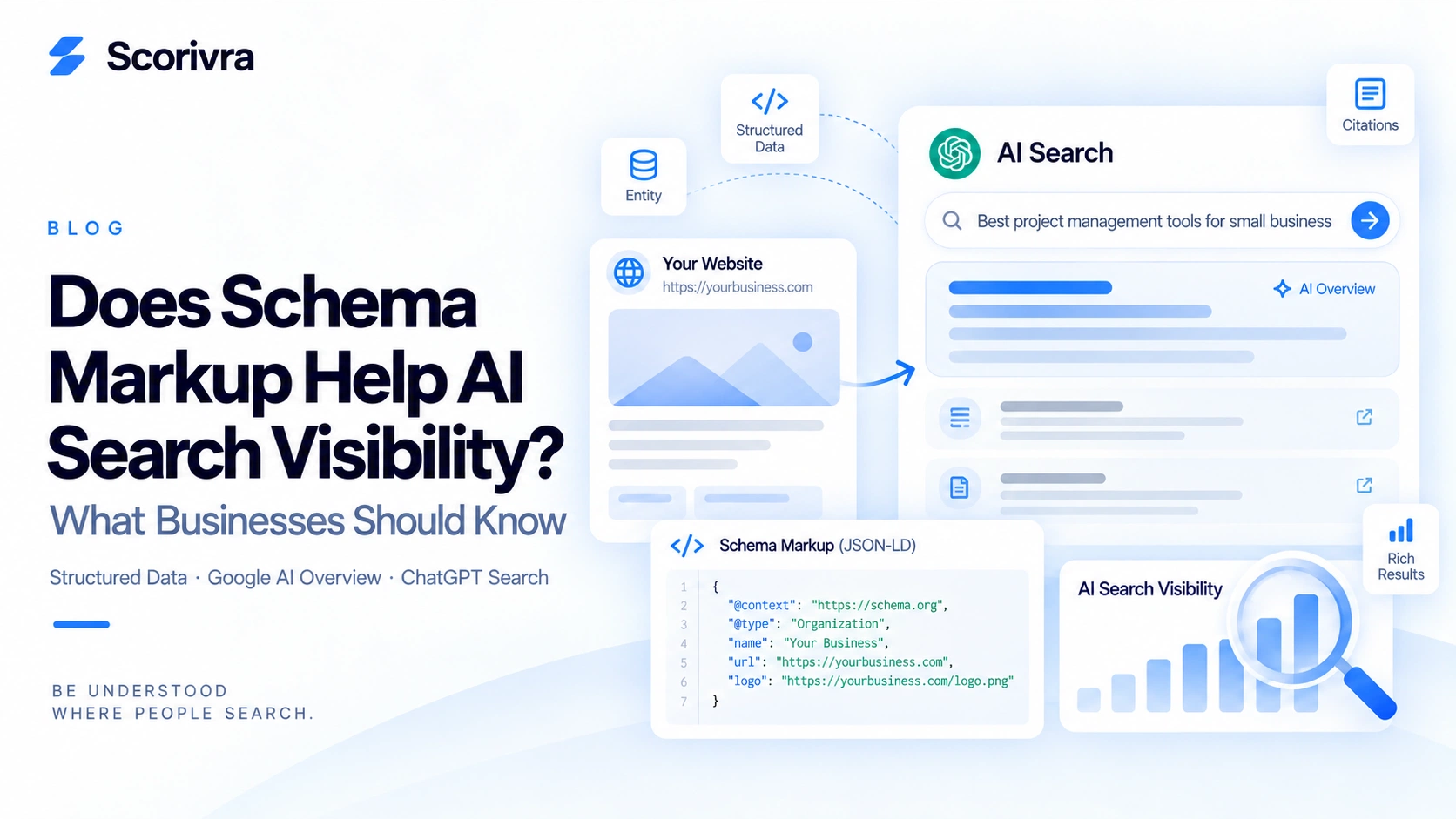
If you are trying to improve your visibility in AI search, you may have heard advice like:
“Add schema markup.”
“Use structured data for GEO.”
“Add FAQ schema so AI can understand your website.”
The problem is that these statements often mix together three different ideas:
- Helping search engines understand a page
- Becoming eligible for enhanced search features
- Appearing in AI-generated answers
They are related, but they are not the same thing.
Schema markup can be useful.
But it is not a guaranteed shortcut to AI visibility.
Here is what businesses should actually know.
What Is Schema Markup?
Schema markup is structured data that describes information on a web page in a standardized format.
It can help search engines identify things such as:
- an organization
- a local business
- a product
- an article
- a breadcrumb
- an event
- a job posting
Instead of forcing a search engine to infer every detail from the visible page, structured data provides explicit information about what the content represents.
Google describes structured data as a standardized format for providing information about a page and classifying its content.
A basic Organization example might look like this:
{
  "@context": "https://schema.org",
  "@type": "Organization",
  "name": "Example Company",
  "url": "https://example.com",
  "logo": "https://example.com/logo.png"
}
This tells a search system that the information represents an organization called Example Company.
It does not tell Google:
“Rank this company higher.”
And it does not tell an AI search system:
“Recommend this company.”
That distinction matters.
Does Schema Markup Improve AI Search Rankings?
Schema markup should not be treated as a direct AI ranking switch.
Google explicitly states that there are no additional technical requirements or special optimizations required to appear in AI Overviews or AI Mode.
Google also says:
- existing SEO fundamentals still apply
- structured data should match the visible content
- no special schema.org markup is required for AI features
- no new machine-readable AI file is required
So if someone claims that installing a particular “AI schema” will automatically make a business appear in Google AI Overviews or AI Mode, that goes beyond Google's published guidance.
Structured data can still help.
But its role is different.
What Does Structured Data Actually Do?
Structured data helps make information on a page more explicit.
For example, Organization markup can describe:
- business name
- website
- logo
- address
- contact information
LocalBusiness markup can describe:
- business type
- address
- telephone
- opening hours
- location information
Article markup can identify:
- headline
- author
- publication date
- modified date
- image
Product markup can provide information such as:
- product name
- price
- availability
- ratings
- product details
Google also uses supported structured data to determine whether pages may be eligible for certain rich search features.
That means structured data can help with understanding and presentation.
It does not guarantee rankings, rich results, citations, or AI recommendations.
Do Google AI Overviews and AI Mode Need Special Schema?
No.
Google says there is no special schema markup required for AI Overviews or AI Mode.
To be eligible to appear as a supporting link, a page generally needs to:
- be indexed
- be eligible to appear in Google Search
- be eligible to display a snippet
- meet Google Search technical requirements
- follow Search policies
Google also recommends familiar SEO fundamentals:
- allow crawling
- make important pages discoverable through internal links
- keep important information available in textual form
- maintain a good page experience
- keep structured data consistent with visible content
- keep Business Profile information accurate when relevant
The key point is:
There is no separate “AI Overview schema” that businesses need to install.
Does Schema Markup Help With ChatGPT Search?
There is no published OpenAI requirement saying that schema markup is necessary to appear in ChatGPT Search.
OpenAI's current publisher guidance focuses primarily on whether content can be discovered and crawled.
For public content that you want discoverable in ChatGPT Search, OpenAI recommends making sure that OAI-SearchBot is not blocked.
That means an important technical question is:
Can OAI-SearchBot access the page?
not:
How many schema properties does the page contain?
Structured data may still make information more explicit and organized.
But there is no official rule saying:
More schema = more ChatGPT visibility.
Businesses should not assume that adding Organization, FAQ, Article, or LocalBusiness schema will directly cause ChatGPT to mention, cite, or recommend them.
Which Schema Types Are Useful for Businesses?
There is no single schema configuration that every business should use.
The correct markup depends on what the page actually contains.
1. Organization
Organization structured data can describe the business itself.
Typical information includes:
- name
- URL
- logo
- address
- telephone
- alternate name
For many businesses, Organization markup on the homepage or company information page is a logical foundation.
2. LocalBusiness
Businesses with physical locations may use LocalBusiness or a more specific subtype.
Examples include:
- Dentist
- Restaurant
- DaySpa
- Electrician
- HealthClub
LocalBusiness markup can describe:
- address
- telephone
- opening hours
- business type
- other location information
The information should match what customers actually see on the website and across the business's public profiles.
3. Article or BlogPosting
Businesses publishing guides, research, or educational content can use Article or BlogPosting markup.
Useful properties can include:
- headline
- author
- datePublished
- dateModified
- image
This can help describe the content and its authorship more explicitly.
4. BreadcrumbList
Breadcrumb markup describes a page's position within the site's hierarchy.
For example:
Home → Blog → AI Search → Schema Markup Guide
This can help make relationships between pages clearer.
5. Product
Ecommerce businesses can use Product structured data when the page actually represents a product.
Depending on the page, this may include:
- price
- availability
- ratings
- shipping information
- product variants
The markup should accurately describe the visible page.
Should You Add Every Schema Type You Can?
No.
More structured data is not automatically better.
The markup should accurately describe the actual content of the page.
Adding irrelevant or misleading schema creates noise rather than useful context.
For example:
A service business should not add Product markup simply because it believes Product schema is more powerful.
A company should not use multiple conflicting business types just to target additional categories.
A page should not contain structured review information that does not correspond to legitimate visible content.
A better rule is:
Use the most specific structured data that accurately describes the page.
Can Incorrect Schema Cause Problems?
Yes.
Common structured data problems include:
- incorrect properties
- missing required values
- information that contradicts the visible page
- outdated business information
- incorrect URLs
- misleading review markup
- markup for content users cannot see
- invalid JSON-LD
Correct syntax alone is not enough.
The markup must also accurately represent the content.
Google can remove eligibility for structured-data-powered search features when its guidelines are violated.
That is why structured data should be validated rather than added blindly.
Does FAQ Schema Help AI Search Visibility?
This is where an important distinction is often missed.
FAQ content and FAQ structured data are different things.
Useful FAQ content can help because it directly answers questions that customers ask.
For example:
Does your software track ChatGPT citations?
A clear answer to that question provides useful information regardless of whether FAQ structured data is attached to it.
The structured markup itself does not guarantee that an AI system will cite the answer.
The correct order is:
- Identify real customer questions.
- Write clear and factual answers.
- Make the information accessible on the page.
- Add appropriate structured data when it accurately describes the content.
Do not create thin FAQ content only because you want more schema markup.
Is Schema More Important Than Content?
No.
Structured data describes information.
It cannot replace missing information.
Consider this statement:
“We provide industry-leading solutions for modern businesses.”
Now imagine that the page has technically perfect Organization schema.
The page still does not clearly explain:
- what the company sells
- who the product is designed for
- which problems it solves
- what features it provides
- how it differs from alternatives
Perfect markup cannot compensate for vague content.
A useful page needs useful information first.
What Should You Prioritize for AI Search Visibility?
If AI search visibility is the goal, use this order.
1. Crawlability
Make sure relevant crawlers can access important pages.
Check:
- robots.txt
- noindex directives
- CDN rules
- firewall rules
- authentication barriers
2. Clear Business Information
Clearly explain:
- what your business does
- who it serves
- what products or services it provides
- which problems it solves
3. Useful Content
Answer real customer questions.
Create information that is useful even if search engines did not exist.
4. Internal Discoverability
Important pages should be accessible through logical internal links.
5. Consistent Business Information
Keep important details accurate across the website and other legitimate public sources.
6. Appropriate Structured Data
Add structured data that accurately describes the visible content.
7. Visibility Measurement
Finally, check whether the brand actually appears across relevant AI search prompts.
Technical implementation tells you what might be possible.
Measurement tells you what is actually happening.
How Do You Validate Schema Markup?
For structured data intended for Google Search features, Google's Rich Results Test can identify supported structured data and implementation issues.
Google Search Console's URL Inspection tool can also help you understand how Google sees a page.
A practical workflow is:
- Choose the appropriate structured data type.
- Add only relevant properties.
- Make sure the markup matches visible content.
- Test the page with the Rich Results Test.
- Fix critical errors.
- Publish the page.
- Inspect the URL in Search Console.
- Allow Google to recrawl the page.
- Monitor search performance afterward.
Do not stop at:
“The JSON is valid.”
Valid JSON does not automatically mean the structured data is correct or useful.
How Do You Know Whether Schema Improved AI Visibility?
Installing schema and manually asking ChatGPT one question is not enough to establish whether visibility improved.
AI-generated answers can vary depending on the prompt and measurement.
A better approach is to establish a baseline before making major changes.
Track metrics such as:
- Mention
- Citation
- Position
- Share of Voice
- Prompt gaps
- Competitor visibility
Then make the technical change.
Continue tracking the same prompt set afterward.
If visibility changes consistently, investigate the result.
But be careful with attribution.
Other factors may also have changed, including:
- page content
- crawlability
- internal links
- external references
- page freshness
- competitor activity
A change in visibility after adding schema does not automatically prove that schema alone caused it.
Schema Markup vs. AI Search Visibility
The difference can be summarized like this:
| Question | Structured Data | AI Visibility Measurement | | --- | --- | --- | | What does this page represent? | Helps describe it | Not its purpose | | What type of business or entity is this? | Can describe it | Measures whether it appears | | Can the page qualify for supported rich search features? | Can help | Not its purpose | | Is my brand mentioned in AI answers? | Does not measure this | Yes | | Is my website cited? | Does not measure this | Yes | | Where does my brand appear? | Does not measure this | Yes | | Which competitors appear instead? | Does not measure this | Yes | | Which prompts exclude my business? | Does not measure this | Yes |
Structured data is an implementation layer.
AI visibility is an outcome.
Do not confuse the two.
How Does This Fit Into Scorivra?
Scorivra separates technical website checks from actual visibility measurement.
Site Audit
Site Audit checks technical and content-related issues across:
- SEO
- AEO
- GEO
- Local
These checks can identify problems that may make a website harder for search systems to crawl, understand, or use effectively.
AI Search Visibility
AI Search Visibility measures brand visibility across supported AI search experiences:
- ChatGPT
- Google AI Overview
- Google AI Mode
Relevant metrics include:
- Mention
- Citation
- Position
- Share of Voice
- Prompt gaps
- Competitor visibility
AI Local Grid
AI Local Grid is separate from general AI Search Visibility.
It is a geographic local-visibility feature using a 9×9 grid.
It does not measure ChatGPT.
This distinction matters because technical readiness, general AI search visibility, and geographic AI visibility answer different questions.
A Practical Structured Data Checklist
Before considering a structured data implementation complete, check:
- [ ] Does the schema type accurately match the page?
- [ ] Does the markup match the visible content?
- [ ] Is the business information correct?
- [ ] Are all important URLs correct?
- [ ] Are required properties present?
- [ ] Are relevant recommended properties included?
- [ ] Is the markup valid?
- [ ] Can search engines crawl the page?
- [ ] Does the page provide useful information without relying on markup?
- [ ] Are you measuring actual search and AI visibility afterward?
If you cannot answer the final question, you still do not know whether the implementation produced a meaningful visibility outcome.
FAQ
Does Schema Markup Guarantee Google AI Overview Visibility?
No.
Google says there is no special schema markup required for AI Overviews or AI Mode, and meeting technical requirements does not guarantee inclusion.
Is There a Special Schema for GEO?
There is no official schema type that guarantees GEO or AI search visibility.
Use structured data that accurately represents the actual page and entity.
Does ChatGPT Require Schema Markup?
OpenAI does not currently state that schema markup is required for ChatGPT Search.
Its publisher guidance emphasizes ensuring that OAI-SearchBot can access content you want discoverable.
Should Local Businesses Use LocalBusiness Schema?
If it accurately represents the business, LocalBusiness structured data can provide Google with explicit information about the company and location.
Use the most specific appropriate subtype and keep the data consistent with the visible page.
Can Structured Data Replace Good Content?
No.
Structured data describes existing information.
It cannot compensate for vague, incomplete, outdated, or low-value content.
Should Businesses Still Use FAQ Content?
Yes, when customers genuinely ask those questions.
Clear question-and-answer content can be useful regardless of whether FAQ structured data is used.
Write the answer for the user first.
The Bottom Line
Schema markup is useful.
But it is often given more credit than it deserves in discussions about AI search.
Structured data can:
- clarify what information on a page represents
- reduce ambiguity
- describe businesses, products, articles, and locations
- support eligibility for certain Google Search features
It does not guarantee:
- AI mentions
- citations
- recommendations
- ChatGPT visibility
- Google AI Overview inclusion
- Google AI Mode inclusion
Treat schema markup as part of technical clarity, not as an AI search shortcut.
Then measure the outcome.
If you are new to AI visibility, read:
What Is AI Search Visibility? A Practical Guide for Businesses
If your business is missing from ChatGPT Search, read:
Why Is My Business Not Showing Up in ChatGPT Search? 10 Things to Check
For local visibility measurement, read:
How to Track Google Maps Rankings Across a City: A Local Search Grid Guide