
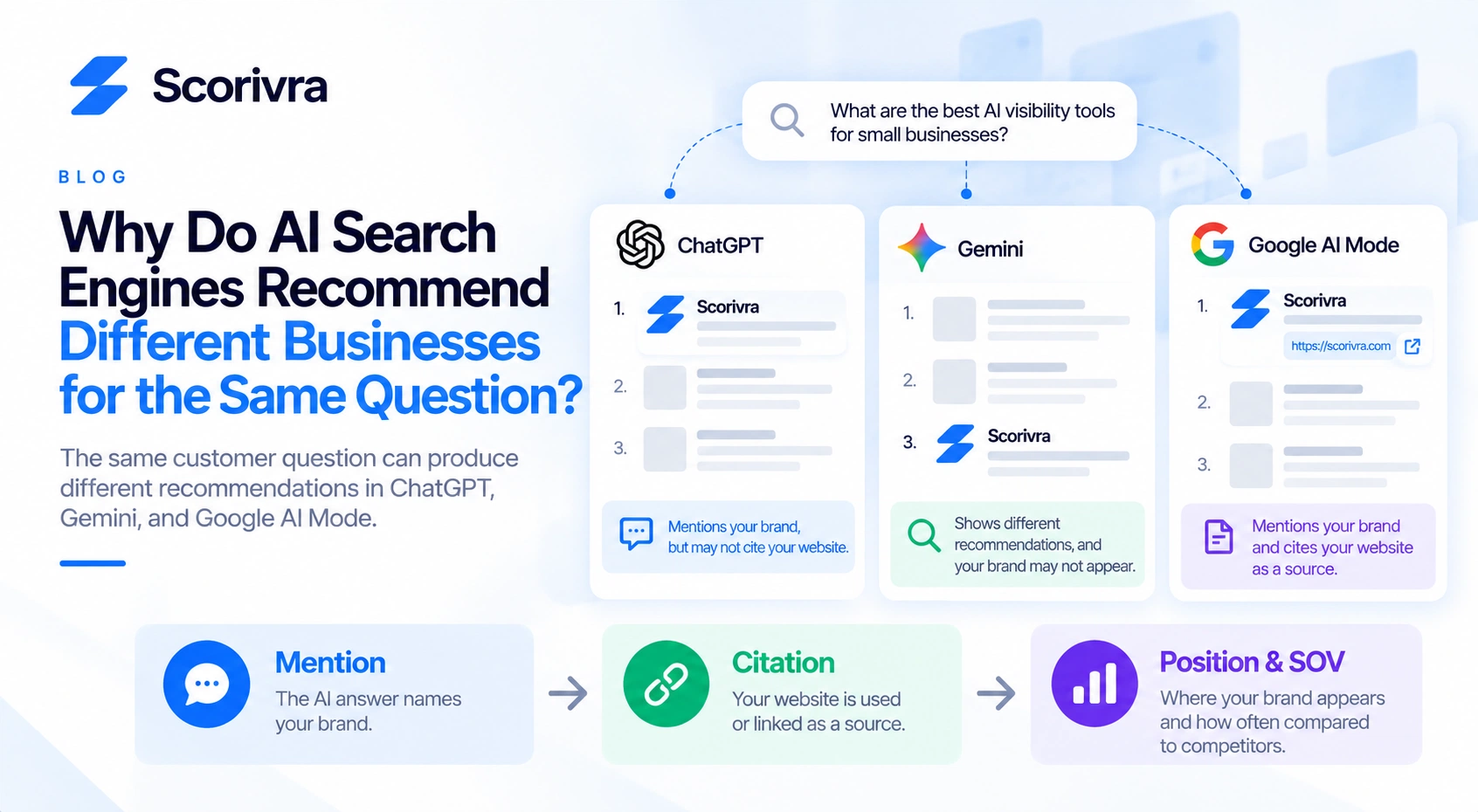
Why Do AI Search Engines Recommend Different Businesses for the Same Question?
Ask the same business recommendation question in ChatGPT, Gemini, and Google AI Mode, and you may get three different answers.
Your business might appear in ChatGPT but disappear in Gemini. A competitor might be cited in Google AI Mode while neither platform cites your website. Even when multiple AI engines mention your brand, they may position it differently or rely on different sources.
For businesses trying to improve AI search visibility, this creates an important question:
Why do AI search engines recommend different businesses for the same question?
The short answer is that AI search engines do not use one shared index, retrieval system, source set, or answer-generation process.
That means AI visibility should not be treated as a single ranking.
You need to measure where your business appears, where it disappears, which competitors appear instead, and which sources support those answers.
Can the Same Question Produce Different AI Search Results?
Yes.
Consider a potential customer asking:
“What are the best AI visibility tools for small businesses?”
You could see results like this:
ChatGPT: Your business is mentioned, but your website is not cited.
Gemini: Your business is absent, while two competitors are recommended.
Google AI Mode: Your business appears and your website is cited as a source.
The question is essentially the same.
The visibility outcome is not.
This is why checking one AI engine cannot tell you how visible your business is across AI search as a whole.
Why Do ChatGPT, Gemini, and Google AI Mode Give Different Answers?
There is no single cause.
Several layers can contribute to the difference.
1. AI Engines Do Not Use Identical Information Sources
Different AI search experiences can retrieve and prioritize different sources when generating an answer.
One engine might rely heavily on:
- Your website
- Third-party articles
- Review platforms
- Business directories
- Comparison pages
- Publisher content
Another may retrieve a different combination of sources for the same question.
If those sources describe your business differently, the resulting answer can also differ.
This means your website is important, but it is not the only place that can influence how an AI system understands your business.
2. Each Engine Has Its Own Retrieval and Answer System
AI search is not simply a traditional search results page rewritten into paragraphs.
Each platform has its own systems for finding information, interpreting the question, selecting supporting material, and generating the final response.
As a result, two engines can evaluate the same business differently even when the user asks a very similar question.
That is why:
“Do I rank in AI search?”
is usually the wrong measurement question.
A better question is:
“Where does my business appear across the AI engines my customers may use?”
3. The Sources Supporting Competitors May Be Different
Suppose your competitor appears in Gemini but your business does not.
The immediate conclusion should not be:
“Gemini likes my competitor more.”
Instead, investigate the evidence around the result.
Ask:
- Which sources mention the competitor?
- Does the competitor have stronger category-specific pages?
- Are reputable third-party sites discussing them?
- Is their business information clearer?
- Are they included in relevant comparison content?
- Are important facts easier to verify?
The useful signal is not simply that the competitor appeared.
The useful signal is what may be supporting that visibility.
4. Your Brand May Be Mentioned Without Your Website Being Cited
A mention and a citation are not the same thing.
An AI answer could say:
“Several platforms in this category include Brand A, Brand B, and Your Brand.”
Your business has been mentioned.
But the supporting sources may link only to Brand A and Brand B.
In that situation:
Mention = Yes
Citation = No
That distinction matters.
A mention tells you that your brand entered the answer.
A citation tells you that your website appeared as a source or supporting reference in the measured response.
For a deeper explanation, read:
https://scorivra.com/blog/ai-search-mentions-vs-citations-whats-the-difference-and-what-should-you-track
Does Appearing in One AI Engine Mean You Have Good AI Visibility?
Not necessarily.
Suppose you monitor 50 customer questions.
Your business appears frequently in ChatGPT but rarely in Gemini or Google AI Mode.
Calling that simply “good AI visibility” hides an important gap.
The more useful interpretation is:
Your visibility is strong for one measured engine and weak for others.
The opposite can also happen.
You may perform poorly in ChatGPT while appearing frequently in Gemini.
That is why engine-level measurement matters.
What Should Businesses Measure Across AI Search Engines?
At minimum, separate four signals.
1. Mention
Was your business named in the answer?
This is the most basic visibility signal.
2. Citation
Was your website used or linked as a source?
Citation visibility can help you understand whether your own content is appearing as supporting evidence.
3. Position
Where did your business appear relative to other businesses in the measured answer?
Being mentioned first and appearing near the end of a long list are not identical outcomes.
4. Share of Voice
How often does your brand appear compared with competitors across the questions you track?
Looking at a single answer can be misleading.
Share of Voice provides a broader view across a defined question set.
Why Should You Track the Same Questions Across Multiple AI Engines?
Because consistent questions make differences easier to interpret.
Suppose you ask ChatGPT:
“What are the best accounting tools for small businesses?”
but ask Gemini:
“What accounting software is cheapest?”
Those results cannot be cleanly compared because the intent changed.
Instead, maintain a consistent set of important customer questions.
For example:
- “What are the best accounting tools for small businesses?”
- “Which accounting software is good for a five-person company?”
- “What are alternatives to [Competitor]?”
- “Which accounting tools are best for recurring invoices?”
Then monitor those questions across the AI engines you want to compare.
This creates a more useful measurement framework.
Which AI Search Questions Should a Business Track?
Do not build your tracking list from random prompts.
Start with questions connected to real customer decisions.
Category Questions
Examples:
“What are the best CRM platforms for small businesses?”
“Which cosmetic dentists specialize in dental implants?”
These test whether AI systems associate your business with the category you compete in.
Problem Questions
Examples:
“How can I track where my business ranks across a city?”
“How can I tell whether AI search engines recommend my company?”
Customers often describe their problem before they know the category of product or service they need.
Comparison Questions
Examples:
“Brand A vs. Brand B”
“What are the differences between these two platforms?”
These questions represent customers actively evaluating options.
Alternative Questions
Examples:
“What are the best alternatives to [Competitor]?”
“Which tools are similar to [Competitor]?”
These can reveal whether your business enters the consideration set when customers already know a competitor.
High-Intent Questions
Examples:
“Which AI visibility platform should a small agency use?”
“What is the best cosmetic dentist for dental implants in Manchester?”
These questions are particularly useful because the customer is closer to choosing a provider.
What Should You Do When a Competitor Appears and You Do Not?
Do not immediately rewrite your entire website.
Start by diagnosing the gap.
Step 1: Confirm the Pattern
One answer is not enough to establish a meaningful visibility problem.
Check whether the competitor repeatedly appears across relevant tracked questions and measurements.
Step 2: Review the Sources
Look at the sources associated with answers where possible.
Determine whether competitors are supported by:
- Their own pages
- Industry publications
- Comparison sites
- Directories
- Review platforms
- Other authoritative sources
Step 3: Compare the Content
Ask whether your website clearly explains:
- What your business does
- Who it serves
- Which problems it solves
- Where it operates
- How its products or services differ
- Important facts customers need before choosing
Step 4: Check Technical Readiness
Strong content can still be difficult for search and AI systems to understand if the site has technical problems.
Review:
- Crawlability
- Indexability
- Canonical URLs
- Internal linking
- Structured data
- Direct-answer structure
- Entity information
Scorivra Site Audit checks SEO, AEO, GEO, and Local technical signals separately so technical readiness can be evaluated independently from actual AI visibility.
Step 5: Measure Again
After making meaningful improvements, continue tracking the same questions.
Do not judge success solely by whether a page was edited.
The relevant question is whether visibility changes over time.
Should You Optimize Separately for Every AI Engine?
Not by creating three nearly identical versions of your website.
That would usually create unnecessary duplication.
Instead, focus on making your business and content easier to understand and verify.
For example:
- Clearly describe products and services.
- Answer important customer questions directly.
- Maintain consistent business information.
- Build useful topic-specific pages.
- Support claims with evidence.
- Use accurate structured data where appropriate.
- Strengthen internal linking.
- Keep important information accessible in page text.
Then measure whether those improvements correspond with changes across individual AI engines.
The objective is not to create a “ChatGPT page,” a “Gemini page,” and a “Google AI Mode page.”
The objective is to build clear, useful, verifiable information and measure how different systems respond to it.
How Does Scorivra Measure AI Search Visibility?
Scorivra AI Visibility tracks selected customer-style questions across:
- ChatGPT
- Gemini
- Google AI Mode
For each tracked question, businesses can review signals including:
- Mention
- Citation
- Position
- Share of Voice
- Competitor visibility
This makes it possible to identify situations such as:
“ChatGPT mentions us, but Gemini does not.”
“Our competitor appears more frequently for comparison questions.”
“We are mentioned, but our website is rarely cited.”
“Our Share of Voice is improving across the questions we monitor.”
These are more actionable observations than trying to reduce AI visibility to a single ranking.
Is AI Visibility the Same as Google Ranking?
No.
Traditional search ranking usually asks:
“Where does this page rank for this query?”
AI visibility asks different questions:
“Was the business included in the answer?”
“Was its website cited?”
“Where did it appear?”
“Which competitors appeared?”
“How often does it appear across the questions being tracked?”
AI-generated answers do not behave like a simple list of ten blue links.
That requires a different measurement model.
What About Local Businesses?
Local businesses have another variable:
Location.
A customer asking:
“Which cosmetic dentist should I choose?”
and a customer asking:
“Which cosmetic dentist near me specializes in implants?”
may trigger different considerations.
The customer's geographic context can also matter.
This is why general AI Visibility and geographic AI visibility should be treated separately.
How Is AI Local Grid Different?
Scorivra AI Local Grid is not the same feature as general AI Visibility.
General AI Visibility asks:
“Does my business appear for this tracked question?”
AI Local Grid asks:
“Where across my local market does AI mention or recommend my business?”
Scorivra AI Local Grid uses Gemini to evaluate the same local-intent question across a 9×9 geographic grid.
That creates 81 measurement points across the selected market.
It can reveal areas where your business appears and areas where competitors appear instead.
AI Local Grid does not use ChatGPT.
ChatGPT, Gemini, and Google AI Mode are tracked separately through general AI Visibility.
For geographic Google Maps measurement, read:
https://scorivra.com/blog/how-to-track-google-maps-rankings-across-a-city-a-local-search-grid-guide
AI Visibility Review Checklist
When reviewing your AI search visibility, ask:
Question Coverage
- [ ] Are we tracking real customer questions?
- [ ] Do we include discovery questions?
- [ ] Do we include comparison questions?
- [ ] Do we include high-intent questions?
- [ ] Are important products and services represented?
Engine Visibility
- [ ] Do we appear in ChatGPT?
- [ ] Do we appear in Gemini?
- [ ] Do we appear in Google AI Mode?
- [ ] Which engine shows our strongest visibility?
- [ ] Where are the largest gaps?
Competitive Visibility
- [ ] Which competitors appear when we do not?
- [ ] Which competitors are cited most often?
- [ ] Which questions consistently favor competitors?
- [ ] What sources support those competitors?
Website Readiness
- [ ] Can search engines crawl important pages?
- [ ] Are important pages indexable?
- [ ] Are products and services explained clearly?
- [ ] Are customer questions answered directly?
- [ ] Is structured data accurate?
- [ ] Is internal linking clear?
- [ ] Is business information consistent?
Frequently Asked Questions
Why does my business appear in ChatGPT but not Gemini?
Different AI engines use different systems and may retrieve or prioritize different information when generating an answer.
Being visible in one engine therefore does not guarantee visibility in another.
Why does Gemini mention a competitor instead of my business?
There is rarely enough evidence from a single answer to identify one cause.
Review repeated results, cited sources, competitor content, business information, and your own site's technical and content signals before drawing a conclusion.
Does appearing first mean I rank number one in AI search?
Not in the same sense as a traditional search ranking.
AI answers can vary in structure, and visibility should be evaluated across multiple questions and measurements rather than treating one generated answer as a permanent ranking.
Can my business be mentioned without being cited?
Yes.
An AI system can mention your business while citing another website as the supporting source.
Does a citation guarantee traffic?
No.
A citation indicates source visibility in the measured answer. It does not guarantee that a user will click the link.
Should I track only one AI engine?
Usually not if your customers may use multiple AI search experiences.
Comparing engines can reveal visibility gaps that would remain hidden if you monitored only one.
Does Scorivra AI Local Grid track ChatGPT?
No.
AI Local Grid uses Gemini for geographic 9×9 local measurement.
ChatGPT is measured separately as part of Scorivra's general AI Visibility feature.
The Bottom Line
The same customer question can produce different business recommendations across ChatGPT, Gemini, and Google AI Mode.
That does not mean one isolated answer should determine your strategy.
The useful approach is to measure patterns.
Track a consistent set of customer questions.
Separate mentions from citations.
Compare visibility by AI engine.
Identify questions where competitors repeatedly appear instead.
Review the sources and content associated with those gaps.
Then measure whether visibility changes after meaningful improvements.
The important question is no longer simply:
“Do we rank in AI search?”
It is:
“Where does our business appear across the AI search experiences our customers use, where are we missing, and who appears instead?”
That is the visibility gap businesses need to understand.