
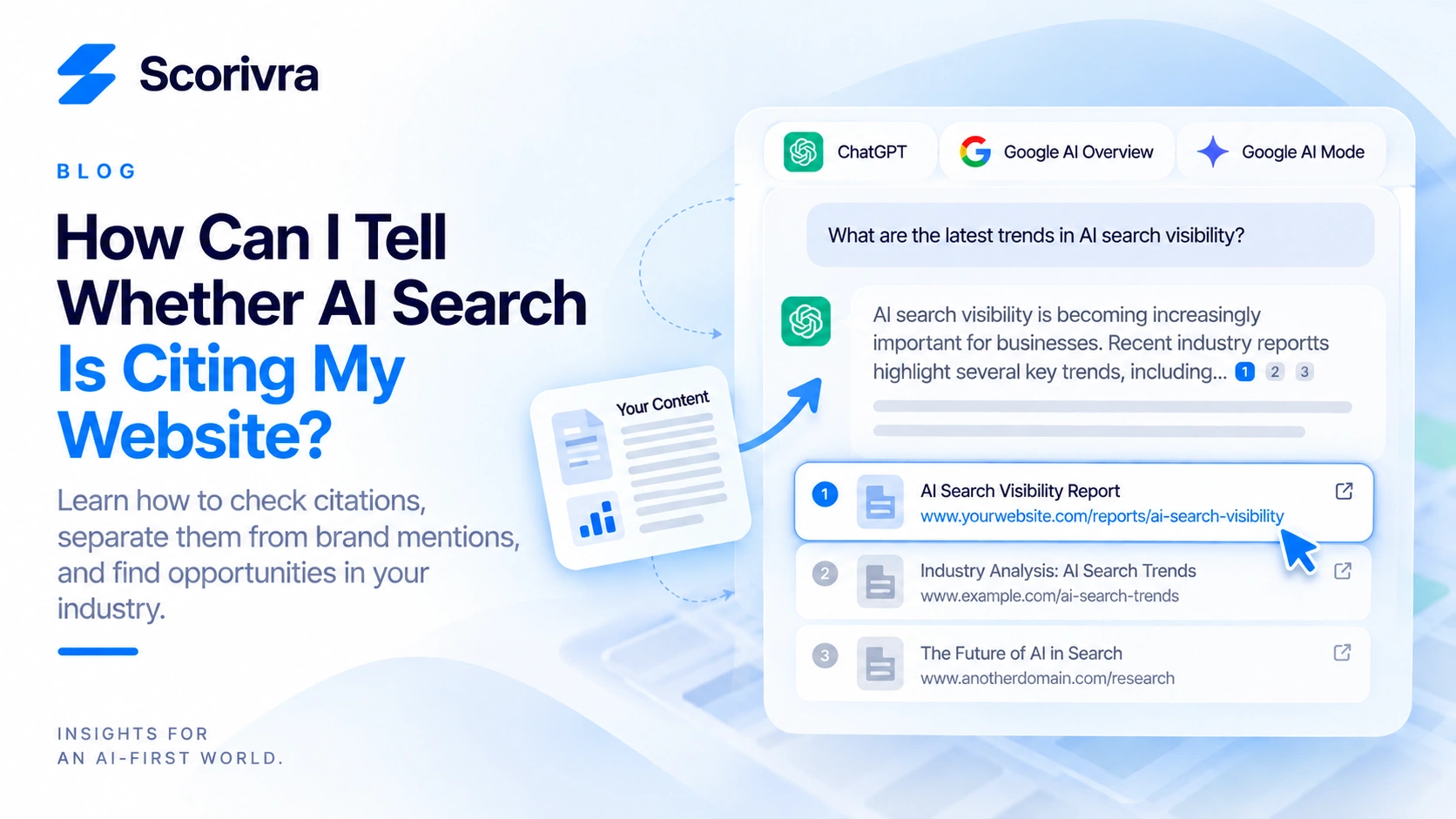
How Can I Tell Whether AI Search Is Citing My Website?
Your company publishes useful reports, guides, research, service pages, or other original content.
But when people ask ChatGPT or other AI search experiences questions related to your industry, how do you know whether your website is actually being used as a source?
Searching for your company name is not enough.
To determine whether AI search is citing your website, you need to track relevant customer questions and separate brand mentions from answers that actually cite your site as a source.
That distinction matters because your brand can appear in an AI answer without your website being cited at all.
Here is how to measure it.
What Does It Mean When AI Cites Your Website?
An AI citation means your website is presented as a source connected to information in an AI-generated answer.
That is different from a brand mention.
For example:
Brand mention:
Example Analytics is one company that provides this type of service.
Your company appears, but your website may not be used as a source.
Citation:
An AI answer uses information from a page on example.com and provides a source link or citation to that page.
These are two different visibility outcomes.
Scorivra therefore treats mentions and citations separately rather than combining them into one AI visibility metric.
If you want a deeper explanation of the distinction, see the difference between AI mentions and citations.
Why Isn't Searching for Your Brand Name Enough?
Branded searches tell you whether an AI system can discuss your company, but they do not show whether your site is being selected as a source for broader customer questions.
Consider a software company called Example Analytics.
You could ask:
What is Example Analytics?
If the company appears, that confirms some level of brand recognition.
But a potential customer may actually ask:
What platforms can help a marketing team measure AI search visibility?
Or:
How can I track whether AI systems cite our industry reports?
Or:
What tools measure brand citations in AI search?
Those questions are much more valuable for visibility analysis because the company is not named in advance.
The AI system has to decide which brands and sources are relevant to the question.
That is closer to real discovery.
Which AI Questions Should You Track?
Track questions that represent real discovery, comparison, and decision-making behavior rather than creating a large list of arbitrary prompts.
A useful question set usually contains several types of intent.
Category Discovery
These questions ask what products, companies, or resources exist.
Examples:
What tools can track AI search visibility?
What platforms measure whether a brand appears in AI answers?
Problem Discovery
These start with a problem rather than a product category.
Examples:
How can I tell whether ChatGPT is citing our website?
How do I know if AI systems are using our research as a source?
Comparison and Evaluation
These questions appear later in the decision process.
Examples:
What should I compare when choosing an AI visibility platform?
Which metrics matter when measuring brand visibility in AI search?
Informational Questions
These are especially relevant if your business publishes research, reports, statistics, or educational content.
For example:
What factors influence customer trust in AI search?
If your organization has published original research about that topic, you may want to know whether the report is cited when AI systems answer related questions.
The goal is not to predict every possible prompt.
It is to create a consistent set of questions that represents the topics where your business has a legitimate reason to appear.
Should You Track Mentions and Citations Separately?
Yes. Mention rate and citation rate answer different questions and should not be treated as interchangeable metrics.
A simple measurement framework looks like this:
| Result | What it tells you | |---|---| | Brand mentioned, site cited | Your brand appears and your site is used as a source | | Brand mentioned, site not cited | AI recognizes or recommends the brand without citing your site | | Brand not mentioned, site cited | Your content contributes as a source without producing a brand recommendation | | Neither mentioned nor cited | Your brand and site are absent from that answer |
The third situation is particularly easy to overlook.
Your content can have source visibility even when the surrounding answer is not recommending your company.
That is why simply counting how often your brand name appears can hide part of the picture.
How Do You Build an AI Citation Baseline?
An AI citation baseline is a repeatable set of questions against which you can compare your website's citation visibility over time.
Start with a manageable question set.
For each question, record:
- whether your brand appears
- whether your website is cited
- which page is cited
- which competitors appear
- which competing sources are cited
- where your brand appears in the answer
- which questions consistently exclude you
Then repeat the same measurement over time.
This gives you something much more useful than occasional screenshots from manual AI searches.
You can begin asking:
Are we being cited more often?
Which topics produce citations?
Which pages are being used?
Where are competitors being cited instead?
Are our important questions improving?
Check whether your site is actually being cited
If you want to move beyond occasional manual searches, Scorivra AI Visibility separates mentions from citations across the questions you choose to track.
This helps you identify questions where your brand appears, questions where your website is actually used as a source, and gaps where competitors appear instead.
What If My Brand Is Mentioned but My Website Is Rarely Cited?
Frequent mentions with few citations indicate that brand presence and source visibility are developing differently.
That does not automatically mean something is wrong.
But it gives you a specific problem to investigate.
Start with the questions producing mentions without citations.
Then examine:
- What information is the AI answer providing?
- Which sources are being cited instead?
- Do you have a page that directly addresses that information?
- Is your page accessible to search systems?
- Is the relevant information specific and easy to identify?
- Are important claims supported by useful evidence?
Do not immediately rewrite your entire website.
First identify where the citation gap actually occurs.
What If Competitors Are Being Cited Instead?
Competitor citations can reveal which questions and sources deserve investigation, but they should be treated as diagnostic evidence rather than a template to copy.
Suppose you track 20 important questions.
Your site is cited for three.
A competitor is cited for twelve.
Instead of asking:
How do I copy this competitor?
Ask:
Which types of questions produce the largest citation gap?
You may discover that your site performs well for basic category questions but disappears when users ask for:
- statistics
- comparisons
- implementation guidance
- original research
- detailed service information
- specific use cases
That gives you a much clearer content problem to investigate.
You can then compare the cited competitor pages with your relevant pages.
Look at differences in:
- subject coverage
- specificity
- evidence
- original information
- page structure
- freshness where relevant
- clarity
- accessibility
The objective is not to imitate the wording.
It is to understand why your existing page may not satisfy the same information need.
Can Technical Access Prevent AI Citations?
Yes. If an AI search crawler cannot access important pages, those pages may have less opportunity to be surfaced as sources.
For ChatGPT Search specifically, OpenAI states that publishers should allow OAI-SearchBot if they want their content to be eligible for inclusion in ChatGPT summaries and snippets.
OpenAI also distinguishes OAI-SearchBot from GPTBot.
OAI-SearchBot is associated with search visibility, while GPTBot controls potential use of content for model training.
They are not the same setting.
If citation visibility is unexpectedly low, check:
- robots.txt
- noindex directives
- HTTP status codes
- CDN restrictions
- firewall rules
- bot protection
- canonical URLs
- whether the important page is publicly accessible
For a complete explanation, see how robots.txt can affect AI search access.
Crawler access, however, is only eligibility.
It does not guarantee that a page will be cited.
Does Schema Markup Make AI Cite a Page?
Schema markup can help machines interpret structured information, but it does not guarantee that an AI system will cite your website.
Adding more schema is therefore not a reliable response to weak citation visibility by itself.
First determine whether:
- the page answers the relevant question
- the information is clear
- the page is accessible
- the business or author is identifiable
- important claims have appropriate support
- the page provides information worth sourcing
Structured data can support machine understanding, but it does not replace useful content.
We cover this distinction in more detail in what schema markup actually does for AI search visibility.
Can Google Analytics Tell You Whether AI Cited Your Website?
Analytics can show visits that reach your website, but referral traffic and AI citations are not the same measurement.
This distinction is important.
A user may:
- See your website cited in an AI answer
- Read the answer
- Never click the citation
That is still citation visibility, but it produces no website session.
The reverse question is also different:
How much traffic are AI systems sending to my site?
That belongs to traffic and performance analysis.
OpenAI states that ChatGPT adds utm_source=chatgpt.com to referral URLs from ChatGPT search, which can help publishers identify inbound ChatGPT search traffic in analytics.
But referral traffic answers:
Did someone visit?
Citation tracking answers:
Was my website used as a source?
Measure both when relevant, but do not combine them into one metric.
What Should You Do After Finding a Citation Gap?
A citation gap should lead to investigation of the specific question and page involved, not a site-wide attempt to “optimize for AI.”
Use this decision process:
| What you find | What to investigate | |---|---| | Brand mentioned and site cited | Maintain and monitor | | Brand mentioned but site rarely cited | Source and content gap | | Competitors repeatedly cited | Competitor source gap | | Relevant page exists but is inaccessible | Technical access | | No page addresses the question | Content coverage | | Citations exist but produce little traffic | Performance and referral behavior | | Results vary significantly by question | Prompt-specific visibility |
This keeps the response proportional to the evidence.
If one important question has a citation gap, investigate that question.
Do not assume your entire website has an AI visibility problem.
How Often Should You Check AI Citations?
AI citation visibility is more useful as a trend than as a one-time test.
Individual AI answers can vary.
That makes repeated measurement of the same commercially relevant question set more useful than constantly changing prompts.
The objective is to see whether patterns emerge.
For example:
- citation visibility is improving
- one topic consistently performs well
- another topic never produces citations
- competitors are gaining visibility
- a newly improved page begins appearing as a source
Those patterns are much more actionable than asking the same question manually once and treating the answer as permanent.
FAQ
Can AI Mention My Brand Without Citing My Website?
Yes.
A brand mention means your company appears in the answer. A citation means your website is used as a source. One can occur without the other.
Can My Website Be Cited Without My Brand Being Recommended?
Yes.
An AI answer can use information from your website as a source without recommending your company as a product, service, or business.
Does a Citation Guarantee Traffic?
No.
A citation can create visibility without producing a click. Referral traffic should be measured separately.
Can I Force ChatGPT to Cite My Website?
No.
OpenAI provides technical guidance for making public content eligible for ChatGPT Search, including allowing OAI-SearchBot, but placement is not guaranteed.
Should I Track Every Possible AI Question?
No.
Start with questions that represent meaningful customer discovery, comparison, evaluation, or topics where your content has a legitimate reason to be used as a source.
What Is the Difference Between Citation Tracking and AI Visibility?
Citation tracking is one component of AI visibility.
A broader AI visibility measurement can include mentions, citations, position, Share of Voice, competitor presence, and questions where your brand is missing.
Final Takeaway
The best way to determine whether AI search is citing your website is to track a consistent set of relevant questions and measure citations separately from brand mentions.
Do not rely only on branded searches.
Do not assume traffic equals citation visibility.
And do not make site-wide changes because of one AI answer.
Instead:
- Define the questions that matter.
- Measure mentions and citations separately.
- Identify questions where competitors are cited instead.
- Inspect the pages and sources connected to those gaps.
- Track the same questions over time.
That turns “Is AI using our content?” from a guess into something you can actually monitor.
If you want to check this across the questions that matter to your business, use Scorivra AI Visibility to see where your brand is mentioned, where your website is cited, and where competitors appear instead.