
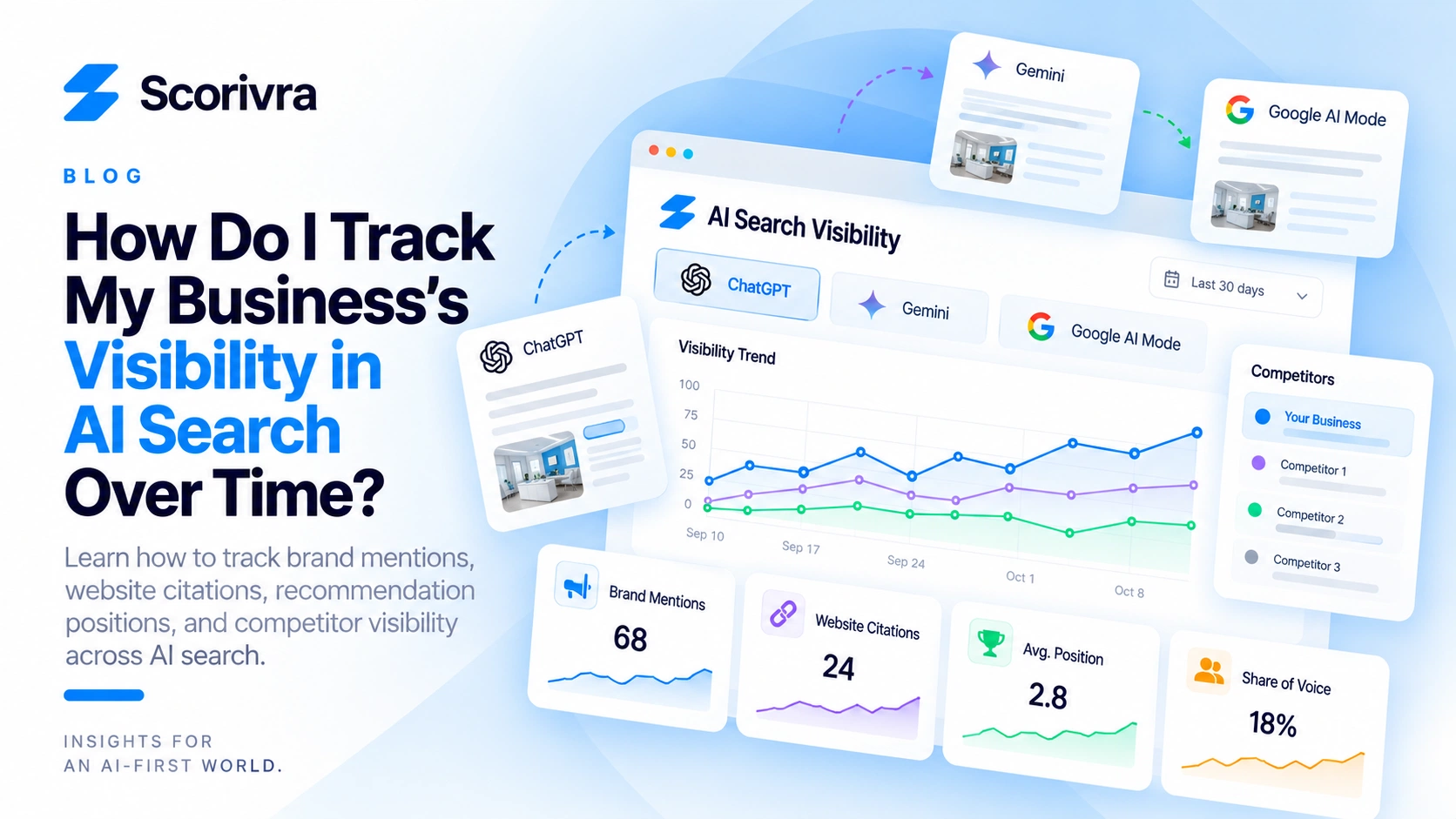
AI search visibility is becoming an important part of how businesses understand their online presence.
Your business might appear in a ChatGPT response today, disappear from a similar question tomorrow, and be recommended by Gemini the following week.
A competitor might appear ahead of your business in Google AI Mode. Your website might be cited as a source without your business being directly recommended.
These differences raise an important question:
How do you know whether your business is actually becoming more visible in AI search over time?
The answer is not to check one AI-generated response and assume it represents your overall performance.
Instead, businesses need to monitor relevant customer questions consistently, distinguish between different visibility metrics, and compare results across platforms and reporting periods.
This guide explains how to track AI search visibility, which metrics matter, and how to use the findings to make practical business decisions.
What Does AI Search Visibility Tracking Actually Measure?
AI search visibility tracking measures whether and how a business appears in a defined set of AI-generated responses across selected platforms and reporting periods.
Unlike traditional search rankings, AI-generated answers do not always present businesses in a fixed list of links.
For example, a potential customer might ask:
"Which cosmetic dental clinics in Manchester offer dental implants?"
The AI-generated answer could:
- Recommend your clinic as one of several providers.
- Mention your business without explicitly recommending it.
- Cite information from your website.
- Recommend competing clinics instead.
- Leave your business out entirely.
Each outcome represents a different form of visibility.
A brand mention is not necessarily a recommendation. A website citation is not the same as a customer enquiry. And appearing in one response does not mean your business will appear in every similar search.
If you are new to this topic, start with our guide to what AI search visibility means for businesses.
Which AI Search Platforms Should Businesses Monitor?
Businesses should monitor the AI search platforms their potential customers are likely to use.
However, results from different platforms should be evaluated separately because similar questions can produce different answers.
Scorivra's AI Search Visibility feature monitors three AI search experiences:
ChatGPT
ChatGPT can generate answers that identify, discuss, compare, or recommend businesses.
For example, someone researching dental implants might ask ChatGPT to suggest clinics in their area.
A business may appear in the response as a recommendation, a general mention, or a referenced source.
Gemini
Gemini is Google's AI assistant.
Users can ask Gemini questions about businesses, products, and services.
The businesses mentioned in Gemini responses may differ from those appearing in ChatGPT.
This makes platform-specific monitoring useful when evaluating brand visibility.
Google AI Mode
Google AI Mode is Google's conversational AI search experience.
It allows users to explore questions through AI-generated responses and follow-up searches.
A business might appear in Google AI Mode even when it does not appear in a comparable response from another AI platform.
What about Google AI Overviews?
Google AI Overviews are AI-generated summaries that can appear within traditional Google Search results.
AI Overviews and Google AI Mode are distinct Google search experiences.
Their answers and cited sources should not automatically be assumed to be identical.
When discussing Scorivra's monitoring capabilities, it is important to distinguish Google's broader AI search ecosystem from the specific platforms supported by the product.
Why should you compare platforms separately?
Imagine that your business appears in seven out of ten monitored ChatGPT responses but only three out of ten monitored Gemini responses.
An overall visibility percentage could hide this difference.
Your business may be relatively visible on one platform but difficult to discover on another.
Comparing platforms separately helps identify where your business appears and where further investigation may be useful.
AI recommendation positions should also remain separate from Google Maps rankings.
A Google Maps ranking represents visibility in a local map search context. An AI recommendation position represents placement within a measured AI-generated response.
These are different metrics.
Which AI Search Visibility Metrics Matter Most?
The most useful AI search visibility metrics are brand mentions, website citations, recommendation positions, share of voice, and prompt gaps.
Each metric answers a different business question.
1. Brand Mentions: Is Your Business Being Named?
What it measures: Whether your business is named in monitored AI-generated responses.
Why it matters: Shows where your brand is recognized.
For example, an AI response might say:
"Several clinics in Manchester offer dental implant consultations, including Example Dental."
Your business has been mentioned.
However, the response may not explain why someone should choose it.
A brand mention should not automatically be interpreted as a recommendation, website visit, or conversion.
2. Website Citations: Is Your Website Being Used as a Source?
What it measures: Whether your website is referenced as a source in a monitored response.
Why it matters: Helps identify where your website supports AI-generated answers.
For example, an AI response might reference your dental implant treatment page when explaining available procedures.
That is different from simply naming your clinic.
A business can be mentioned without its website being cited.
A website can also be cited without the response explicitly recommending the business.
For a detailed explanation, read our guide to AI search mentions versus citations.
3. Recommendation Position: Where Does Your Business Appear?
What it measures: Where your business appears within a measured AI-generated recommendation response.
Why it matters: Helps evaluate how prominently your business appears relative to competitors.
Imagine an AI response recommends three providers:
- Competitor A
- Your Business
- Competitor B
Your business appears in the response, but another provider is listed first.
This information can help evaluate relative visibility.
However, recommendation position is not a universal ranking.
AI-generated answers can change depending on the question, platform, context, and time.
4. Share of Voice: How Visible Are You Compared With Competitors?
What it measures: Your business's relative visibility within a defined set of monitored AI responses.
Why it matters: Helps compare your presence with competing businesses.
For example, if competitors repeatedly appear in relevant monitored questions while your business is rarely mentioned, that difference may deserve investigation.
Share of voice can help identify these patterns.
However, share of voice within monitored prompts is not the same as total market share, customer demand, or overall AI search traffic.
Its interpretation depends on the monitoring methodology.
5. Prompt Gaps: Which Customer Questions Are You Missing?
What it measures: Relevant monitored questions where your business is absent or underrepresented.
Why it matters: Highlights potential opportunities to improve business discovery.
For example, your clinic might appear for:
"Cosmetic dentists in Manchester"
But not for:
"Where can I get dental implants in Manchester?"
This difference could indicate an opportunity to review how clearly your website communicates its dental implant services.
However, a missing mention does not prove that a specific website issue caused the result.
How Do You Choose the Right AI Search Questions to Track?
The quality of your monitoring questions matters as much as the number of questions being tracked.
Businesses should focus on questions that reflect genuine customer needs rather than prompts designed simply to produce a brand mention.
Start with your most important services.
Then identify questions customers might ask before contacting a provider.
For a cosmetic dental clinic, useful examples include:
- Which dental clinics in Manchester offer implants?
- How do I choose a cosmetic dentist for veneers?
- Where can I book a clear aligner consultation?
- What should I ask before getting dental implants?
- Which clinics offer cosmetic dentistry consultations near Manchester?
These questions represent different stages of the customer journey.
Some involve direct comparisons between providers.
Others involve research before making an appointment.
Both can be useful, but they should not automatically be treated as equivalent.
Should You Track Branded or Non-Branded Prompts?
Businesses should monitor both branded and non-branded questions for different reasons.
A branded question might be:
"What services does Example Dental provide?"
This helps evaluate whether the AI system recognizes and describes your business.
A non-branded question might be:
"Which clinics offer dental implants in Manchester?"
This helps evaluate whether your business appears when a potential customer has not already selected a provider.
For customer acquisition, non-branded service and comparison questions are often particularly valuable.
What Makes a Prompt Useful?
A useful monitoring prompt should:
- Relate to a service your business actually offers.
- Reflect a realistic customer question.
- Include location context when relevant.
- Remain consistent enough for meaningful comparisons.
- Support a clear business decision.
Avoid collecting hundreds of unrelated prompts simply to increase the amount of data.
A smaller set of relevant questions can provide more actionable insights.
How Do You Establish an AI Search Visibility Baseline?
An AI search visibility baseline is the initial set of measurements used to evaluate future changes.
Without a baseline, it is difficult to determine whether your visibility is improving, declining, or simply fluctuating.
Start by defining:
- The AI platforms being monitored.
- The customer questions included in the monitoring set.
- The competitors you want to compare.
- The reporting period.
- The metrics used to evaluate performance.
Then record your initial results.
For example, imagine you monitor 20 relevant questions on one platform.
Your business is mentioned in six measured responses.
Three responses cite your website.
Two responses place your business ahead of a particular competitor.
Those results establish a starting point.
They do not represent your share of every real-world AI search.
Why Does Consistency Matter?
Suppose you monitor 20 dental implant questions in September.
In October, you replace half of them with general cosmetic dentistry questions.
Your mention rate might change substantially.
But that change could reflect the new monitoring set rather than an actual improvement or decline in your business's visibility.
To interpret trends correctly, compare similar questions, platforms, and measurement conditions whenever possible.
How Can You Check Your Business's AI Search Visibility?
You can evaluate AI search visibility by reviewing monitored responses, identifying whether your business appears, and comparing relevant measurements across available reporting periods.
Manual searches can provide useful examples.
However, they are difficult to use as a consistent historical measurement process.
One response might mention your business.
Another response to a similar question might recommend a competitor.
Without structured monitoring, it becomes difficult to determine whether these differences represent a recurring pattern.
Check Your Own Visibility Instead of Relying on Isolated Responses
Not sure whether your business appears consistently when customers ask AI systems about your services?
Explore Scorivra's AI Search Visibility to review monitored brand mentions, website citations, recommendation positions, share of voice, and competitor comparisons across ChatGPT, Gemini, and Google AI Mode.
Use available historical measurements to identify recurring gaps and changes rather than relying on a single AI-generated answer.
How Often Should You Review AI Search Visibility?
AI search visibility should be reviewed across consistent reporting periods, with enough historical context to distinguish recurring trends from individual response changes.
There is no universal reporting interval that suits every business.
Shorter periods help identify recent movement.
Longer periods provide more context for interpreting patterns.
7-Day Review
A seven-day view can help identify recent changes in monitored AI search visibility.
It is useful for observing short-term movement, but a single week may not establish a lasting trend.
30-Day Review
A 30-day period provides a broader view of short-term performance.
It can help identify whether changes in mentions, citations, or competitor appearances are recurring.
90-Day Review
A 90-day period can help evaluate longer-running patterns.
It may reveal persistent prompt gaps or differences between platforms.
365-Day Review
A 365-day period can support longer-term analysis when sufficient historical data exists.
It can be useful for reviewing changes across seasons or business cycles.
Custom Reporting Periods
Custom periods allow businesses to examine specific time windows, such as before and after a website update.
However, selecting a longer reporting period does not create historical measurements that were never collected.
A recently monitored business may not have enough data for meaningful long-term comparisons.
Which Changes Deserve Attention?
Look for patterns involving:
- Declining mentions across several relevant prompts.
- Changes in website citation frequency.
- Competitors appearing more consistently.
- Changes in recommendation positions.
- Prompt gaps that persist across reporting periods.
- Differences between monitored AI platforms.
Avoid treating one missing mention as evidence that your overall visibility has declined.
What If Your Business Is Mentioned but Your Website Is Not Cited?
When an AI response mentions your business without citing your website, your brand is present in the answer but your website is not identified as a supporting source in that response.
This is not necessarily an error.
AI systems can mention businesses based on information available from different sources.
A mention and a citation serve different purposes.
What Should You Investigate?
Review the website pages most relevant to the monitored questions.
Ask:
- Does the website clearly describe the relevant service?
- Are important pages accessible to search engine crawlers?
- Does the content answer common customer questions?
- Is the business information accurate?
- Are relevant service pages easy to navigate?
- Does the website provide useful, specific information?
These checks can help identify content or technical issues worth addressing.
However, improving a page does not guarantee that an AI system will cite it.
Citation selection depends on the platform and response context.
For more guidance, read how to tell whether AI search is citing your website.
What If Competitors Are Recommended More Often?
If competitors consistently appear in relevant monitored responses while your business does not, investigate the specific services and customer questions where the difference occurs.
Do not assume that a competitor's visibility proves its website has better SEO.
AI-generated recommendations can depend on the platform, query, context, and information available to the system.
1. Are the Comparisons Relevant?
A competitor might appear for a service you do not offer.
That result may not represent a meaningful business opportunity.
Focus on prompts connected to your actual services and customers.
2. Do Competitors Explain Their Services More Clearly?
Review the publicly available information on competing websites.
Look at:
- Service descriptions.
- Customer questions answered.
- Location and availability information.
- Business credentials.
- Supporting evidence.
- Website navigation and accessibility.
These observations may suggest areas for improvement.
They do not establish which factors caused a particular AI recommendation.
3. Does the Gap Appear Repeatedly?
One response is not enough to establish a consistent competitive disadvantage.
Compare results across similar prompts and reporting periods.
If the same gap persists, investigate the corresponding service or customer question before making changes.
Can Google Search Console Track AI Search Visibility?
Google Search Console helps measure Google Search performance, but it does not provide the same cross-platform measurements as dedicated AI search visibility monitoring.
Search Console reports metrics such as impressions, clicks, queries, and pages associated with Google Search.
Google's AI search features can contribute to Search performance reporting under Google's reporting rules.
However, Search Console does not provide a complete view of brand mentions, citations, recommendation positions, and competitor appearances across ChatGPT, Gemini, and Google AI Mode.
These tools answer different questions.
Google Search Console answers:
How is your website performing in Google Search?
AI search visibility monitoring answers:
How does your business appear in a defined set of AI-generated responses?
Both can be useful, but neither should be treated as a complete record of every customer interaction.
What Should You Do When AI Search Visibility Changes?
A change in AI search visibility should lead to investigation before making website or marketing changes.
Different metrics point to different questions.
If Brand Mentions Decline
Review which prompts and platforms were affected.
Check whether the decline appears repeatedly or only in isolated responses.
Compare results with an earlier period before deciding whether action is necessary.
If Website Citations Decline
Review the website pages relevant to the affected questions.
Investigate whether important information remains accessible, accurate, and useful.
Do not assume that a citation decline automatically indicates a technical problem.
If Competitors Appear More Often
Identify the specific services and customer questions where competitors appear.
Compare publicly available service information and look for meaningful differences.
Focus on recurring gaps rather than individual recommendations.
If One Platform Performs Differently
Compare the same or similar questions across supported platforms.
A business may appear in ChatGPT but not Gemini, or vice versa.
Platform-specific differences can be informative without necessarily indicating a website problem.
If New Prompt Gaps Appear
Review whether the missing questions relate to services your business actually offers.
If they do, examine whether the relevant information is clearly communicated on your website.
If Results Fluctuate Briefly
Compare a longer reporting period.
AI-generated responses can vary, and short-term movement may not represent a meaningful trend.
A Practical Review Process
- Identify which visibility metric changed.
- Determine which prompts and platforms were affected.
- Compare results with an earlier period.
- Investigate relevant content and business information.
- Make justified improvements where necessary.
- Continue reviewing comparable measurements.
This approach connects visibility data to decisions without assuming that every fluctuation requires immediate action.
AI Search Visibility Tracking Checklist
Use this checklist to evaluate whether your monitoring process is producing useful business insights.
Monitoring Setup
- Identify important services and customer questions.
- Include relevant non-branded prompts.
- Monitor the supported AI platforms.
- Select appropriate competitors.
- Establish a baseline.
Performance Measurement
- Track brand mentions.
- Track website citations separately.
- Review recommendation positions.
- Compare share of voice.
- Identify prompt gaps.
- Compare consistent reporting periods.
Business Decisions
- Investigate recurring patterns rather than isolated responses.
- Review content related to missing customer questions.
- Check technical accessibility where relevant.
- Document significant changes to the monitoring set.
- Evaluate results after meaningful improvements.
The objective is not simply to increase a visibility score.
It is to understand where your business appears, where it is missing, and which findings justify further action.
Frequently Asked Questions
Can I Track Whether My Business Appears in ChatGPT?
Yes. You can monitor whether your business appears in a defined set of ChatGPT responses.
However, those results do not represent every ChatGPT conversation or guarantee that other users will receive identical answers.
Is an AI Search Mention the Same as a Citation?
No. A mention names your business, while a citation references a source such as your website.
A response can include one without the other.
What Is AI Recommendation Position?
AI recommendation position describes where your business appears within a measured AI-generated recommendation response.
It should not be confused with Google Maps rankings or traditional organic search positions.
How Many AI Search Prompts Should I Monitor?
There is no universally correct number.
Start with questions that reflect your most important services and customer decisions.
Relevance and consistency are more important than collecting a large number of unrelated prompts.
Can Google Search Console Replace AI Visibility Monitoring?
No. Search Console provides valuable Google Search performance data, but it does not offer complete cross-platform monitoring of AI brand mentions, citations, recommendation positions, and competitor appearances.
The two approaches serve different purposes.
Does Higher AI Search Visibility Guarantee More Customers?
No. Greater visibility within monitored AI responses does not guarantee more website visits, enquiries, or sales.
Visibility measurements help identify discovery opportunities and guide investigation.
How Long Does It Take to Improve AI Search Visibility?
There is no guaranteed timeline.
Changes in AI-generated responses depend on multiple factors, including the platform, question, available information, and measurement context.
Review consistent reporting periods rather than expecting immediate changes after editing a website.
Final Thoughts: Measure Visibility That Matters to Your Business
AI search visibility becomes more useful when it is measured consistently and connected to real customer questions.
A single brand mention does not prove that your business is becoming easier to discover.
A website citation does not guarantee a visit.
And a competitor appearing first in one response does not mean your business is losing visibility across every platform.
Instead, focus on repeatable measurements.
Track relevant customer questions, distinguish mentions from citations, compare recommendation positions, and review competitor visibility over time.
Then use those findings to decide which services, website pages, or customer questions deserve closer attention.
Want to understand how your business appears in AI-generated answers? Explore Scorivra's AI Search Visibility to review monitored mentions, citations, recommendation positions, share of voice, and competitor comparisons over available reporting periods.
Start with the questions your customers actually ask. Those are the visibility signals most likely to support meaningful business decisions.