
When someone asks ChatGPT to recommend a local business, how can a company find out whether its name appears in the answer?
What happens when Gemini recommends a competitor instead? And how can a business compare those results without manually repeating dozens of questions every day?
This is the problem AI search monitoring platforms are designed to address.
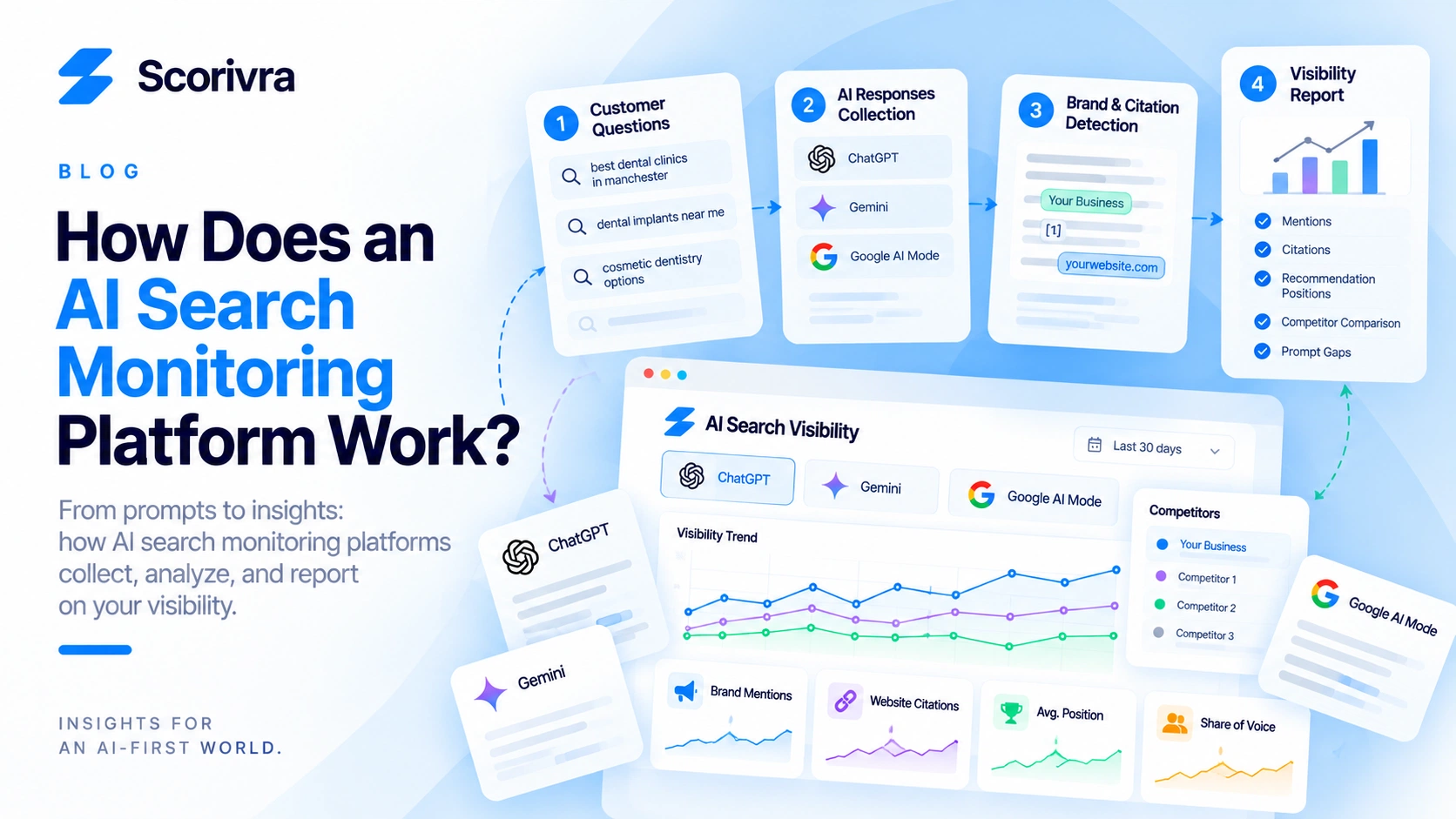
These tools help businesses observe how their brands appear in AI-generated answers by running defined questions, collecting responses, identifying relevant businesses and sources, and organizing the results into reports.
But the process is more complicated than checking whether a company name appears in a paragraph.
Different AI platforms may produce different answers. Responses can change over time. A website citation does not necessarily mean the business was recommended. And not every AI response provides a traditional ranking.
Understanding how monitoring works helps businesses evaluate tools, interpret reports, and avoid drawing conclusions from incomplete data.
In this guide, we'll explain the main components of an AI search monitoring platform, what happens behind the scenes, and which limitations businesses should understand.
What Is an AI Search Monitoring Platform?
An AI search monitoring platform is a tool that observes how a business, brand, website, or competitor appears in AI-generated responses.
Instead of measuring only traditional search engine rankings, it examines answers generated by AI search experiences.
For example, a potential customer might ask:
"Which dental clinics in Manchester offer dental implants?"
An AI monitoring platform can check whether a specified business appears in a monitored response and record relevant details.
Depending on the platform and available data, those details may include:
- Whether the business was mentioned.
- Whether its website was cited as a source.
- Where it appeared within a recommendation response.
- Which competitors were also mentioned.
- Which monitored questions did not include the business.
- How those observations changed between reporting periods.
The purpose is to make AI-generated responses easier to compare and analyze.
However, monitoring a set of questions is not equivalent to observing every AI conversation taking place worldwide.
The results describe the platform's defined monitoring coverage.
For an introduction to the broader topic, read What Is AI Search Visibility? A Practical Guide for Businesses.
How Does an AI Search Monitoring Platform Work Step by Step?
Although implementations vary, most AI search monitoring workflows can be understood through six stages.
Step 1: Define the Business and Its Competitors
Before monitoring begins, the system needs to know which business it is evaluating.
A business may have several names or variations that appear in AI-generated answers.
For example:
- Example Dental
- Example Dental Clinic
- Example Dental Manchester
A monitoring system needs rules for deciding whether those names refer to the same business.
It may also need the business's website domain and a list of competitors.
This information helps distinguish the target business from other companies with similar names.
Why it matters: Without accurate business identification, the system may miss valid mentions or incorrectly count unrelated businesses.
Step 2: Select Relevant Customer Questions
The next stage is deciding which questions to monitor.
These questions are often called prompts.
A dental clinic might monitor:
- Which dental clinics in Manchester offer implants?
- What are some cosmetic dentistry options in Manchester?
- Which clinics offer clear aligner consultations?
- Where can I find a dentist for veneers in Manchester?
Each question represents a potential customer information need.
A useful monitoring set should reflect the services the business actually offers.
It should also include relevant non-branded questions, because these help evaluate whether the business appears when a customer does not already know its name.
Some monitoring platforms allow users to configure prompts directly. Others may provide predefined or suggested questions.
The exact method depends on the product.
Why it matters: A monitoring platform can only report on the questions and conditions it measures. Poorly chosen prompts can produce reports that are technically accurate but commercially unhelpful.
Step 3: Collect Responses From AI Search Platforms
Once the monitoring questions are defined, the platform needs to obtain responses from the AI search experiences being measured.
Depending on the provider and supported access methods, this may involve approved APIs, search-data services, or other authorized collection mechanisms.
The collection method matters because different interfaces, models, locations, and settings may produce different outputs.
For example, a question submitted to ChatGPT may produce a different set of business recommendations from the same question submitted to Gemini.
The monitoring system records the observed results so they can be evaluated later.
Useful contextual information may include:
- The platform being measured.
- The question submitted.
- The collection date.
- The returned answer.
- Available source references.
- Whether collection succeeded or failed.
Not every platform exposes the same information.
Some responses may contain citations or links, while others may not.
Why it matters: Reliable monitoring requires a repeatable collection process and a clear understanding of what each platform actually returned.
Does a Monitoring Tool See Every AI Search?
No.
A monitoring platform does not automatically have access to every private conversation or every AI-generated answer shown to users.
It measures responses within its supported collection process.
That means the results should be interpreted as observations from a defined monitoring set, not as a complete census of AI search activity.
Step 4: Identify Brand Mentions and Website Citations
After collecting responses, the system analyzes the returned content.
Two important signals are brand mentions and website citations.
How Are Brand Mentions Identified?
A brand mention occurs when an AI-generated response refers to a monitored business.
For example:
"Example Dental is one of the clinics offering cosmetic dentistry services in Manchester."
A monitoring system can identify the business name in the response.
However, accurate identification may require more than a simple text search.
A business name might have different spellings, abbreviations, or naming conventions.
There may also be unrelated businesses with similar names.
Monitoring systems therefore need a method for associating references with the correct business.
The exact matching and classification approach varies by provider.
How Are Website Citations Identified?
A website citation occurs when an AI response references a website as a source.
For example, the response might include a link to:
https://example.com/dental-implants
A monitoring system can examine available source references and determine whether they belong to the monitored website.
This is different from detecting a brand mention.
An AI answer might recommend a business without citing its website.
It might also cite a website without explicitly recommending the business.
That distinction is important when interpreting reports.
For a closer look, see AI Search Mentions vs. Citations: What's the Difference and What Should You Track?.
Why Is Citation Detection Sometimes Difficult?
AI responses do not always provide citations in the same format.
A platform might show clickable source links, references embedded in the answer, or no explicit sources.
The monitoring system must work with the information available from the measured response.
As a result, citation coverage may differ between platforms.
A missing citation in a report should not automatically be interpreted as proof that an AI system never used information from the website.
Step 5: Analyze Recommendations and Competitor Appearances
After identifying mentions and citations, a monitoring platform may evaluate how businesses appear relative to competitors.
Suppose an AI response says:
"Some dental clinics to consider are Example Dental, Northside Dental, and City Smile Clinic."
The monitoring system may record which businesses were included.
When the answer presents a meaningful recommendation order, the system may also record the observed positions.
However, not every AI-generated answer is an ordered recommendation list.
Some answers mention businesses within paragraphs, group providers by service, or present alternatives without an explicit ranking.
A responsible monitoring approach should not treat every mention as a universal numerical rank.
What Is Competitor Monitoring?
Competitor monitoring compares the target business's visibility with other businesses within the same monitored questions.
For example, the platform might reveal that:
- Your business appears in several dental implant questions.
- Competitor A appears in more of those monitored responses.
- Competitor B is frequently mentioned for clear aligners.
- Your business is absent from certain service-specific questions.
These observations help identify where further investigation may be useful.
They do not prove that a competitor is receiving more customers or generating more revenue.
What Are Prompt Gaps?
A prompt gap is a relevant monitored question where the target business is missing or underrepresented.
For example:
Your business appears when an AI system is asked about cosmetic dentistry in Manchester.
But it does not appear when the question specifically asks about dental implants.
This gap may be worth investigating if dental implants are an important service.
The absence alone does not establish why the business was omitted.
Step 6: Store Results and Generate Visibility Reports
Individual AI responses are difficult to evaluate at scale.
A monitoring platform becomes useful when it organizes observations into a consistent reporting structure.
The system can associate collected responses with their questions, platforms, businesses, and reporting periods.
This makes it possible to compare measurements across time.
A report may include:
- Brand mention activity.
- Website citation activity.
- Recommendation positions.
- Relative competitor visibility.
- Share of voice within the monitored set.
- Prompt gaps.
- Changes across available reporting periods.
The exact metrics and reporting options vary between products.
Why Does Historical Data Matter?
Imagine a business is mentioned in five monitored responses this week.
Is that good or bad?
Without context, it is difficult to know.
Historical measurements can help answer more useful questions:
- Did the business appear in fewer responses last month?
- Are citations becoming more common?
- Are competitors appearing more consistently?
- Is a particular service repeatedly missing from recommendations?
A monitoring platform helps organize these comparisons.
However, the results are most meaningful when the underlying prompts and measurement conditions remain comparable.
How Does Scorivra Monitor AI Search Visibility?
Scorivra provides AI Search Visibility monitoring for three AI search experiences:
- ChatGPT
- Gemini
- Google AI Mode
Its AI Search Visibility feature helps businesses examine monitored brand mentions, website citations, recommendation positions, share of voice, prompt gaps, and competitor comparisons.
Businesses can review available historical measurements to understand how their visibility changes over time.
Scorivra's AI Search Visibility reporting is distinct from its local search grid functionality.
A business's position in a Google Maps result should not be treated as the same measurement as its position in an AI-generated recommendation.
Explore AI Search Visibility Monitoring
Want to see how your business appears in monitored AI-generated answers?
Explore Scorivra's AI Search Visibility to review brand mentions, citations, recommendation positions, and competitor visibility across supported AI platforms.
Use the available reports to investigate recurring patterns rather than relying on a single AI response.
What Can an AI Search Monitoring Platform Actually Tell You?
A monitoring platform can provide useful observations about how a business appears within its measured AI search environment.
For example, it may help you understand:
Whether Your Business Is Being Mentioned
You can identify whether monitored responses include your business.
This helps distinguish complete absence from occasional or recurring appearances.
Whether Your Website Is Being Cited
You can examine whether available source references include your website.
This helps separate brand recognition from website citation activity.
Which Competitors Appear in Similar Questions
You can compare your business's presence with competing providers within the monitored set.
This may highlight services or customer questions worth reviewing.
Where Your Business Is Missing
You can identify relevant prompts that do not include your business.
These gaps may guide further investigation into your website content, service descriptions, and business information.
How Observations Change Over Time
You can compare historical results when sufficient data is available.
This makes it easier to distinguish recurring patterns from isolated responses.
What Can't an AI Search Monitoring Platform Tell You?
AI search monitoring has important limitations.
Understanding them helps prevent misleading conclusions.
It Cannot Observe Every Private AI Conversation
Monitoring platforms evaluate the responses available through their supported measurement processes.
They do not automatically see every question asked by every user.
It Cannot Guarantee Identical Responses for Every Customer
AI-generated answers can vary.
Two users asking similar questions may receive different results.
Monitoring provides observations, not guarantees about every future response.
It Cannot Prove Why an AI System Recommended a Business
A competitor may appear in a response while your business is absent.
That observation does not reveal the complete internal reasoning behind the AI system's output.
Website quality, content, and publicly available information may be worth reviewing, but the monitoring result alone does not establish causation.
It Cannot Directly Measure Revenue From a Mention
A brand mention does not necessarily produce a website visit.
A citation does not guarantee a customer enquiry.
And a recommendation does not guarantee a sale.
AI search visibility should be considered alongside website analytics, enquiries, and other business performance data.
It Cannot Create Historical Data Retroactively
A platform can report historical measurements that were collected and retained.
Selecting a longer reporting period does not generate missing observations from before monitoring began.
How Is AI Search Monitoring Different From Traditional Rank Tracking?
Traditional rank tracking generally focuses on where a website appears in search results for selected keywords.
AI search monitoring focuses on how a business appears within AI-generated answers to selected questions.
The distinction matters because AI responses may not resemble a conventional list of ranked webpages.
Traditional Search Rank Tracking
A traditional rank tracker might monitor:
"dentist Manchester"
It may report the website's position in organic search results.
AI Search Monitoring
An AI monitoring platform might evaluate:
"Which dental clinics in Manchester should I consider for implants?"
It may record whether the business is recommended, whether its website is cited, and which competitors appear.
These measurements describe different discovery experiences.
A business may perform well in traditional search while appearing inconsistently in AI-generated recommendations.
The reverse may also occur within a particular monitoring set.
Neither metric should automatically replace the other.
What Should You Look for When Choosing an AI Search Monitoring Tool?
Not all AI search monitoring tools provide the same coverage or reporting features.
Before selecting a platform, evaluate the following areas.
1. Supported AI Platforms
Check which AI search experiences the product actually monitors.
Do not assume that support for one Google AI feature automatically means support for every Google AI experience.
2. Clear Metric Definitions
Look for clear explanations of mentions, citations, recommendation positions, and competitor comparisons.
The meaning of each metric should be understandable.
3. Relevant Prompt Coverage
Consider whether the monitored questions reflect your services and customers.
A large number of irrelevant prompts may be less useful than a smaller, carefully selected set.
4. Historical Reporting
Check whether you can compare results over meaningful periods.
Also verify how much historical data is actually available.
5. Competitor Comparisons
Evaluate whether the tool helps identify competing businesses appearing in relevant AI responses.
Competitor data is more useful when the comparison set is relevant to your market.
6. Transparent Limitations
A trustworthy monitoring tool should distinguish observed responses from universal claims about AI search visibility.
Be cautious of products that imply they can guarantee recommendations or reveal every AI search made by customers.
7. Practical Reporting
A useful report should help answer a business question.
For example:
"Which important customer questions repeatedly exclude our business?"
That is often more actionable than a single overall score without context.
How Can Businesses Use AI Search Monitoring Results?
The purpose of monitoring is not simply to collect more data.
It is to identify patterns that justify further investigation.
Suppose a dental clinic repeatedly appears in general cosmetic dentistry responses but rarely appears in monitored dental implant questions.
A practical next step might be to review the clinic's dental implant service page.
The business could investigate whether the page clearly explains:
- The service offered.
- Who the service is intended for.
- Relevant treatment information.
- The clinic's location.
- How patients can request a consultation.
- Common questions patients ask.
These improvements may make the website more useful and easier to understand.
However, they do not guarantee an increase in AI recommendations.
After making justified changes, the business can continue monitoring comparable questions to observe whether the measured results change.
For more on interpreting historical results, read How Do I Track My Business's Visibility in AI Search Over Time?.
Frequently Asked Questions
Do AI Search Monitoring Platforms Use AI Themselves?
Some monitoring platforms may use automated text analysis or AI-based classification to identify businesses and interpret responses.
Others may rely on rules, structured data, or combinations of techniques.
The implementation varies by provider.
Using AI to analyze responses is different from the AI system that originally generated the monitored answer.
Can an AI Search Monitoring Tool Track ChatGPT?
Yes, if the monitoring provider supports ChatGPT.
However, monitoring results represent the provider's defined collection process rather than every private ChatGPT conversation.
Can These Platforms Detect Website Citations?
Many AI search monitoring tools can identify citations when the measured responses expose usable source references.
Citation availability and detection methods may vary between AI platforms.
Is AI Search Monitoring the Same as GEO?
No.
Generative Engine Optimization (GEO) refers to efforts intended to improve how content or businesses are represented in generative search experiences.
AI search monitoring is the measurement process used to observe relevant responses.
Monitoring can inform GEO decisions, but it is not the same activity.
Can Monitoring Tell Me Why My Competitor Appears Instead of Me?
It can identify where the competitor appears and where your business is missing.
However, the observation alone cannot establish the exact cause of the recommendation.
Further investigation is necessary.
How Often Should AI Search Responses Be Collected?
The appropriate frequency depends on the monitoring platform, the business's needs, and the cost and consistency of data collection.
More frequent collection is not automatically more useful.
Reliable comparisons require a consistent methodology.
Can Google Search Console Replace an AI Search Monitoring Platform?
Not completely.
Google Search Console reports Google Search performance.
Dedicated AI search monitoring examines defined AI-generated responses, including supported platforms outside Google Search.
The tools answer different questions and can complement each other.
Final Thoughts: Understanding the Monitoring Process Matters
An AI search monitoring platform does more than search for a business name.
It starts with a defined set of customer questions, collects AI-generated responses, identifies relevant businesses and sources, evaluates available recommendation information, and organizes the observations into reports.
That process makes it possible to examine how a business appears across monitored AI platforms.
But the value of monitoring depends on the quality of the questions, the consistency of collection, and the interpretation of the results.
A mention is not a conversion.
A citation is not a guarantee of traffic.
And an observed recommendation position is not a universal search ranking.
Businesses should use monitoring data to identify recurring gaps, compare relevant competitors, and make informed decisions about their online presence.
Want to examine your business's presence in AI-generated answers? Explore Scorivra's AI Search Visibility to review monitored mentions, citations, recommendation positions, and competitor comparisons across ChatGPT, Gemini, and Google AI Mode.
The goal is not to predict every AI-generated answer. It is to understand the patterns that can help your business make better decisions.