
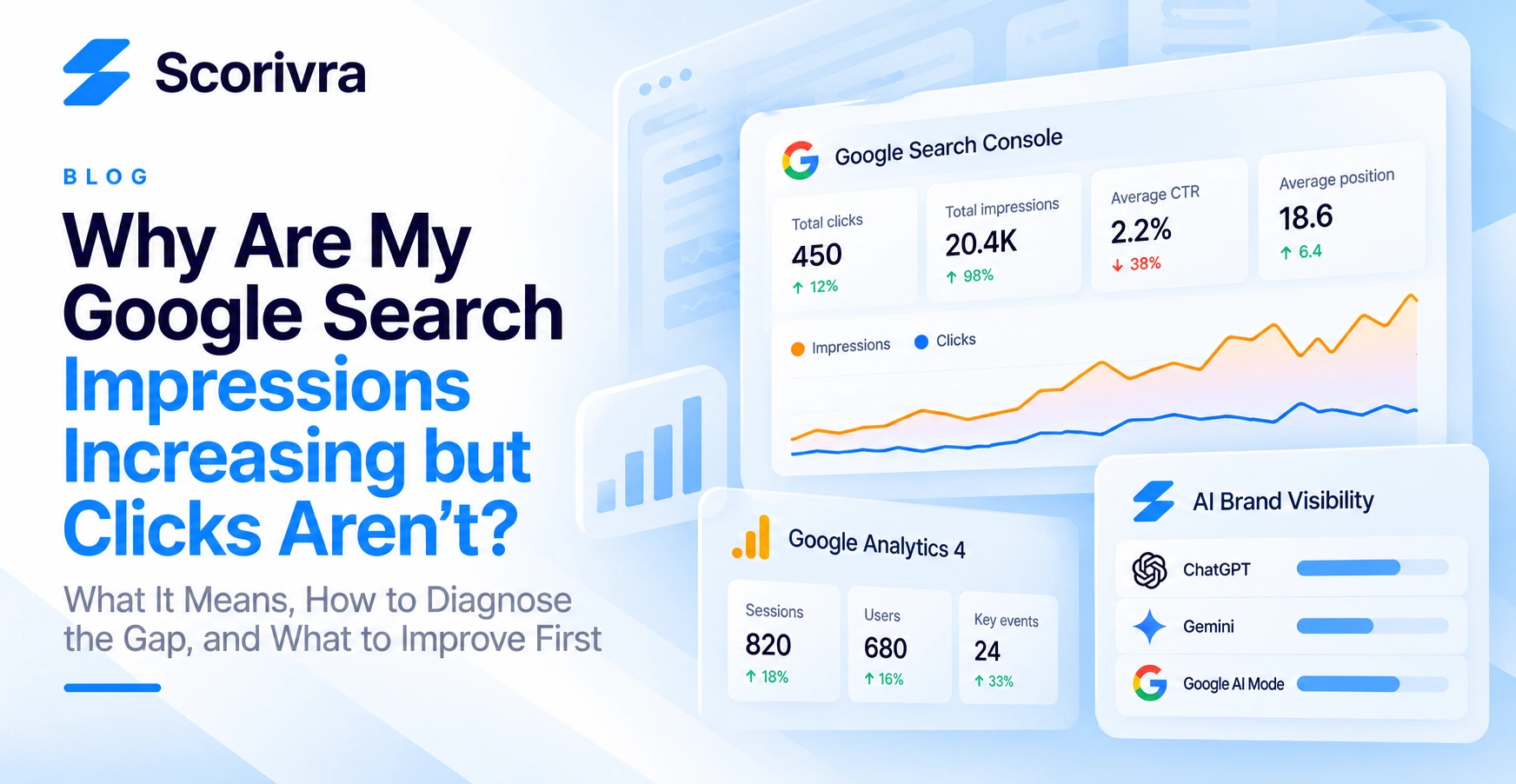
Your Google Search Console impressions are increasing.
But your clicks are barely moving.
Is that good or bad?
The short answer is:
More impressions mean your website is appearing in Google Search more often. They do not necessarily mean more people are visiting your website.
The important question is not simply whether impressions increased.
It is:
Which searches are generating those new impressions, and why are they not producing clicks?
Understanding that difference can help you determine whether your search visibility is genuinely improving, whether you have a CTR problem, or whether Google is simply testing your pages across a wider range of searches.
What Does a Google Search Impression Actually Mean?
An impression generally means that a link to your website appeared in Google Search.
A click means someone selected a search result that led to your website.
CTR, or click-through rate, compares those two metrics:
CTR = Clicks ÷ Impressions
That means impressions can increase dramatically without clicks increasing at the same rate.
For example:
| Period | Impressions | Clicks | CTR | |---|---:|---:|---:| | Month 1 | 10,000 | 400 | 4.0% | | Month 2 | 20,000 | 450 | 2.25% |
Your search visibility doubled.
Your search traffic did not.
That does not automatically mean your SEO became worse.
You need to identify what created the additional impressions.
Why Are My Impressions Increasing but Clicks Staying Flat?
Several different situations can produce the same pattern.
1. Your Website Is Appearing for More Search Queries
This can be an early sign of expanding search visibility.
Suppose one page originally appeared for 20 queries.
After Google develops a better understanding of the page, it begins appearing for 100 queries.
Those additional queries can generate impressions before the page ranks competitively enough to earn many clicks.
In this situation:
Impressions can rise before clicks rise.
Open Google Search Console and compare the Queries report between two periods.
Look specifically for queries that:
- did not previously generate impressions,
- suddenly gained impressions,
- gained significant visibility,
- or are relevant to your products and services.
The total number of impressions matters less than the searches creating them.
2. Your Average Position May Still Be Too Low
An impression does not mean your result appeared near the top of Google.
A page can start appearing for many additional searches while still holding relatively weak positions.
That can produce:
Impressions ↑
while:
Clicks →
This is why impressions should be analyzed alongside:
- queries,
- pages,
- CTR,
- average position,
- device,
- country,
- and time.
No single Search Console metric tells the whole story.
3. Searchers May Be Choosing Other Results
Sometimes ranking is not the main problem.
Your page may already appear in a useful position, but users choose another result.
For an important query with meaningful impressions but weak CTR, investigate:
- Does the title clearly match the search intent?
- Does the search result explain what the page offers?
- Is another result answering the question more directly?
- Is your title vague or generic?
- Does the page actually satisfy the query?
- Does competing content appear more current or specific?
Do not rewrite titles simply to make them more attention-grabbing.
The objective is to make the result accurately communicate why the page is relevant to the searcher.
4. Your New Impressions May Come From Different Search Intent
Not every impression has the same business value.
Imagine a local HVAC company.
Two searches might be:
“HVAC repair near me”
and:
“how does an HVAC system work?”
Both can generate Google impressions.
But the commercial intent is very different.
If informational content begins appearing for hundreds of new questions, total impressions may increase substantially without producing the same number of potential customers.
Instead of asking:
“How many impressions did we get?”
ask:
“Which queries produced those impressions?”
Then determine whether those searches matter to the business.
5. Your Audience Mix May Have Changed
Search Console lets you analyze performance by dimensions such as country and device.
An increase in impressions may come primarily from:
- mobile searches,
- desktop searches,
- a new country,
- or a different group of queries.
That can change your site-wide CTR even when performance for your existing audience remains relatively stable.
If the overall numbers suddenly change, segment the data before drawing conclusions.
Is Falling CTR Bad If Impressions Are Increasing?
Not necessarily.
Consider this example:
Before
- 10,000 impressions
- 500 clicks
- 5% CTR
After
- 30,000 impressions
- 900 clicks
- 3% CTR
CTR declined.
But clicks increased by 80%.
Your website reached a much larger search audience and generated substantially more visits.
Now compare that with:
Before
- 10,000 impressions
- 500 clicks
- 5% CTR
After
- 30,000 impressions
- 500 clicks
- 1.67% CTR
This deserves more investigation.
The website now receives the same number of clicks from three times as many search appearances.
The correct next question is:
Where did those additional impressions come from?
What Should I Check First in Google Search Console?
Use a structured process instead of changing pages immediately.
Step 1: Compare Two Periods
Compare a recent period with the previous equivalent period.
Look at changes in:
- impressions,
- clicks,
- CTR,
- and average position.
Avoid making decisions based on one unusual day.
Step 2: Check Queries
Identify which queries gained the most impressions.
For each important query, ask:
- Did impressions increase?
- Did clicks increase?
- Did CTR change?
- Did average position change?
- Is this query relevant to the business?
This is one of the most useful ways to turn Search Console data into content and SEO decisions.
Step 3: Check Pages
Find which pages generated the additional visibility.
One new article may account for most of the increase.
Alternatively, several commercial pages may be gaining impressions.
Those situations should not be treated the same way.
Step 4: Connect Queries to Pages
Site-wide averages can hide the real opportunity.
Instead of asking:
“Why did our CTR fall?”
ask:
“Which query-page combinations gained impressions without gaining clicks?”
That question is much more actionable.
Step 5: Segment by Device and Country
If the explanation is still unclear, compare:
- mobile vs. desktop,
- major countries,
- branded vs. non-branded searches,
- informational vs. commercial queries.
A change in search mix can alter your overall metrics without indicating a site-wide SEO problem.
Which High-Impression Queries Should I Improve First?
Not every high-impression query deserves optimization.
A practical prioritization framework is:
High Priority
Relevant query + meaningful impressions + competitive position + weak CTR
Your website is already visible.
Investigate whether the title, search result, page intent, or competing results are limiting clicks.
Medium Priority
Relevant query + growing impressions + weaker position
This may be an emerging SEO opportunity.
The page may need stronger topical coverage, internal links, clearer structure, or other SEO improvements.
Low Priority
High impressions + irrelevant search intent
Do not optimize for traffic simply because Google is willing to show your page.
Traffic has value only when it supports the goals of the business.
Should I Rewrite a Page Because CTR Is Low?
Not automatically.
First identify the underlying pattern.
If you have:
High impressions + useful position + weak CTR
investigate search intent and how the result appears.
If you have:
High impressions + weak position + few clicks
ranking competitiveness may be the bigger issue.
If you have:
Impressions ↑ + Clicks ↑ + CTR ↓
your website may simply be expanding into more searches.
The same CTR number can therefore require completely different actions.
What If Impressions and Clicks Are Both Increasing?
Then continue following the customer journey.
Google Search Console primarily explains what happens in Google Search.
Google Analytics 4 helps explain what happens after visitors reach the website.
You might see:
Impressions ↑ → Clicks ↑ → Sessions ↑
but still find that important actions remain flat.
At that point, search visibility may no longer be the primary bottleneck.
The problem may occur after visitors reach the website.
Search Console clicks and GA4 sessions also should not be expected to match exactly because they measure different things.
Why Should Businesses Track AI Brand Visibility Too?
Because customers no longer discover businesses through traditional search alone.
People can also ask AI systems questions such as:
- “What are the best tools for tracking AI search visibility?”
- “Which businesses provide this service?”
- “What are the alternatives to this company?”
- “Which local businesses would you recommend?”
- “What should I use to solve this problem?”
Traditional search metrics cannot fully answer what happens inside those responses.
Google Search Console can help answer:
- Is my website appearing in Google Search?
- Which queries generate impressions?
- Which pages receive clicks?
- Is CTR improving?
AI visibility answers different questions:
- Is my brand mentioned in relevant AI answers?
- Is my website cited as a source?
- Where does my brand appear within the response?
- Which competitors appear when my business does not?
- How consistently does my brand appear across tracked questions?
These are different discovery environments and should be measured separately.
For example:
Google impressions ↑ Google clicks → AI mentions ↑
could indicate that the business is becoming more visible across multiple discovery surfaces even though Google organic traffic has not yet increased proportionally.
The opposite can also happen:
Google impressions ↑ Google clicks ↑ AI mentions →
Traditional search performance may be improving while the business remains relatively absent from AI-generated answers.
That is why AI brand visibility should be monitored alongside—not substituted for—traditional search performance.
How Does Scorivra Separate Search Performance and AI Visibility?
Scorivra keeps these measurement areas separate.
The Performance workspace uses Google Search Console data such as:
- impressions,
- clicks,
- CTR,
- and queries.
GA4 provides post-arrival metrics such as:
- sessions,
- users,
- acquisition channels,
- and key actions.
This helps businesses examine the sequence:
Visibility → Click → Visit → Action
AI Visibility measures a different discovery environment.
Scorivra tracks brand presence across ChatGPT, Gemini, and Google AI Mode using metrics including:
- Mention,
- Citation,
- Position,
- and Share of Voice.
These metrics should not be combined into a single search-performance number.
A business can perform well in Google Search while remaining relatively invisible in AI-generated answers—or vice versa.
For a deeper explanation of two important AI visibility signals, read:
AI Search Mentions vs. Citations: What’s the Difference and What Should You Track?
If your business does not appear when customers ask ChatGPT relevant questions, see:
Why Is My Business Not Showing Up in ChatGPT Search? 10 Things to Check
What If the Problem Is Technical?
Performance data can show that something changed.
It does not always explain why.
If important pages are struggling, investigate technical factors such as:
- crawl restrictions,
- indexability,
- canonical inconsistencies,
- structured data,
- and other site-level issues.
Scorivra's Site Audit evaluates SEO, AEO, GEO, and Local checks separately and provides evidence and remediation guidance for detected issues.
If you are unsure how to interpret an audit score, read:
Is a 60/100 Website Audit Score Good? How to Read Your Site Audit Results
Frequently Asked Questions
Are More Google Search Impressions Always Good?
No.
More impressions mean greater search exposure.
Their value depends on which queries generated them, where your pages appeared, and whether those searches are relevant to the business.
Can Impressions Increase Before Clicks Increase?
Yes.
A page can begin appearing for additional searches before it becomes competitive enough to generate significant clicks from those queries.
Why Are My Impressions Increasing While CTR Is Falling?
Your website may be appearing for more queries, weaker positions, different devices or countries, or searches with different intent.
A declining overall CTR does not automatically mean your existing rankings became worse.
Should I Optimize Every Query With High Impressions?
No.
Prioritize queries that are relevant to the business and represent useful search intent.
High visibility for an irrelevant query is not necessarily an opportunity.
Should I Change My Page Title When CTR Is Low?
Sometimes.
But first examine the query, average position, search intent, page, device, and competing results.
Changing a title will not solve a problem caused primarily by weak rankings or irrelevant impressions.
Why Should I Track AI Brand Visibility?
Because traditional search metrics do not tell you whether your business is being mentioned or cited when customers use AI systems for discovery and comparison.
Google Search performance and AI visibility measure different parts of modern discovery.
Is AI Visibility the Same as Website Traffic?
No.
A brand can be mentioned or cited in an AI-generated answer without immediately producing a website visit.
Visibility, citation, traffic, and on-site actions are separate signals.
The Bottom Line
If Google Search impressions are increasing but clicks are not, do not immediately assume your SEO is failing.
And do not assume it is succeeding.
Find out:
- which queries gained impressions,
- which pages gained visibility,
- whether those searches matter to your business,
- how CTR and average position changed,
- whether device or country mix changed,
- what visitors do after they click,
- and whether your brand is also becoming visible in AI search.
The useful question is no longer simply:
“Are our Google impressions increasing?”
It is:
“Are we becoming more visible wherever potential customers are searching for businesses like ours?”
That is a much more useful way to measure modern search visibility.