
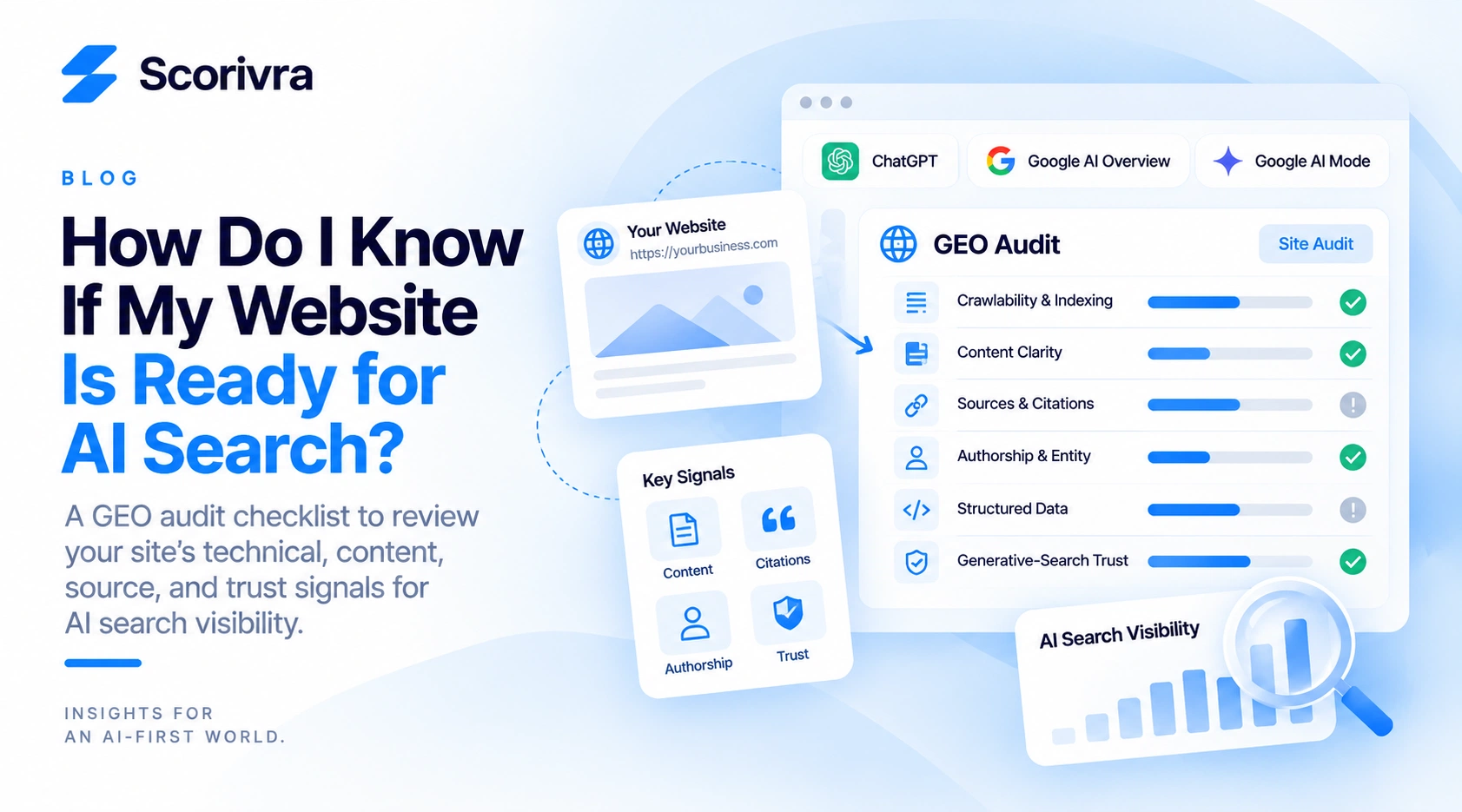
How Do I Know If My Website Is Ready for AI Search? A GEO Audit Checklist
A website can perform well in traditional search and still have gaps worth investigating for AI search.
If you want your content to appear in experiences such as ChatGPT search, Google AI Overviews, or Google AI Mode, the useful question is not simply:
“Is my website optimized for AI?”
A better question is:
“Can AI search systems access, understand, and evaluate the information and evidence on my website?”
That is where a GEO audit becomes useful.
A GEO audit does not predict or guarantee that an AI system will mention or cite your website. Instead, it helps you identify technical, content, source, authorship, and trust signals that may deserve attention before you evaluate actual AI search visibility.
What Should a GEO Audit Actually Check?
A useful GEO audit should examine whether your content is accessible, understandable, attributable, and supported by clear evidence.
This goes beyond adding keywords or publishing more pages.
A practical review should investigate areas such as:
• crawler accessibility • indexability and page availability • clear page purpose • answer-friendly content structure • source attribution • citations and supporting references • authorship information • identifiable organization information • structured data where appropriate • consistency between claims and supporting content
The objective is not to satisfy a secret AI ranking formula.
There is no single markup or optimization that guarantees inclusion in AI-generated answers.
Instead, the goal is to remove avoidable weaknesses that can make your website harder to access, understand, or evaluate.
Can AI Search Systems Access Your Content?
AI search visibility starts with accessibility.
If important pages cannot be accessed by the systems involved in search and retrieval, improvements to the content itself may have limited value.
Start by checking:
• robots.txt rules • page-level robots directives • authentication requirements • accidental noindex directives • broken or unavailable pages • conflicting canonical signals
For ChatGPT search specifically, OpenAI uses OAI-SearchBot for search-related crawling. This is separate from GPTBot, which is associated with potential model training.
Blocking GPTBot does not mean the same thing as blocking OAI-SearchBot.
If you want more detail on this distinction, see:
Can Robots.txt Block Your Website From AI Search? What Businesses Should Check
https://scorivra.com/blog/can-robots-txt-block-your-website-from-ai-search-what-businesses-should-check
Can an AI System Understand What the Page Is About?
A page should make its primary subject and purpose clear without requiring the reader to infer them from vague marketing language.
Consider a page for a dental implant service.
A weak page might say:
“We provide advanced solutions designed around your individual needs.”
That sentence provides very little context by itself.
A clearer page explains:
• what the service is • who it is intended for • what problem it addresses • where the service is offered • who provides it • what supporting information is available
Clear content helps human visitors as well.
The objective is not to write mechanically for AI systems. It is to reduce ambiguity about the subject, entity, service, and evidence presented on the page.
Does Your Content Answer Specific Questions Clearly?
Content that directly answers useful questions is easier to extract and understand than pages filled with broad promotional language.
For example, compare:
“Our innovative approach delivers exceptional results.”
with:
“Dental implants replace missing teeth using an implant placed in the jawbone and a restoration attached above it.”
The second statement provides a self-contained answer.
This does not mean every paragraph needs to sound like a dictionary.
Instead, important sections should answer the question they introduce before expanding on details.
A useful structure is:
Question
Direct answer
Supporting explanation
Evidence or source where appropriate
Next step
This structure also makes sections easier for traditional search users to scan.
Are Important Claims Supported by Sources?
Claims that depend on external facts should be distinguishable from your own marketing statements.
If you publish statistics, research findings, medical information, industry data, or other factual claims, ask:
• Where did the information come from? • Is the original source identifiable? • Is the source still current? • Can a reader verify the claim? • Are links pointing to the primary source where practical?
Adding random outbound links does not make content authoritative.
The purpose of source attribution is to make important claims easier to verify.
Can Readers Tell Who Created the Content?
Authorship can provide useful context about who is responsible for a piece of content.
This is especially relevant when expertise matters.
Check whether appropriate pages make it clear:
• who wrote or reviewed the content • what organization published it • whether the author has relevant credentials where applicable • whether an author or organization page provides additional context
Not every page needs an elaborate author biography.
But publishing substantial informational content without making its origin clear can remove useful context for both readers and systems evaluating the page.
Does Structured Data Solve AI Visibility by Itself?
No. Structured data can help machines interpret information on a page, but it does not guarantee AI mentions or citations.
Use schema markup when it accurately represents visible page content and the relevant entity or content type.
Do not add markup simply because you hope it will trigger an AI citation.
If you are deciding whether schema should be part of your AI search strategy, read:
Does Schema Markup Help AI Search Visibility? What Businesses Should Know
https://scorivra.com/blog/does-schema-markup-help-ai-search-visibility-what-businesses-should-know
A Practical GEO Audit Checklist
Use this checklist as a first-pass review.
Accessibility
□ Important pages are accessible □ robots.txt does not unintentionally block relevant search crawlers □ important pages are not accidentally set to noindex □ key URLs return normally □ canonical signals are consistent
Content clarity
□ Each important page has a clear primary topic □ Important questions receive direct answers □ Service and product descriptions are specific □ Important entities are clearly identified □ Vague promotional language does not replace useful information
Sources and evidence
□ Important factual claims can be verified □ Original or primary sources are used where practical □ Statistics include enough context to understand them □ Supporting references are relevant to the claim
Authorship and organization
□ Readers can identify the organization behind the website □ Important informational content has appropriate authorship context □ Relevant author credentials are available where expertise matters □ Business and organization information is consistent
Structured information
□ Structured data accurately reflects visible content □ Relevant schema types are used where appropriate □ Markup is not being treated as a shortcut to AI visibility
A failure in one of these areas does not prove that your website cannot appear in AI search.
The checklist is diagnostic.
Its purpose is to show you what deserves investigation.
How Can I Check These Issues Without Reviewing Every Page Manually?
A site audit can turn a broad question like “Are we ready for AI search?” into a specific list of checks and affected pages.
Scorivra separates its Site Audit into SEO, AEO, GEO, and Local areas rather than treating every search problem as the same issue.
The GEO portion checks signals related to areas such as citations, sources, authorship, and generative-search trust.
If you want to see whether these issues appear on your own site, start with the free Scorivra Site Audit.
https://scorivra.com/free-site-audit
Does Passing a GEO Audit Mean My Website Will Be Cited?
No. Passing technical and content checks does not guarantee that ChatGPT, Google AI Overview, Google AI Mode, or another system will cite your website.
This distinction is important.
A GEO audit evaluates signals on your website.
AI Search Visibility measures what is actually happening in AI search results.
Think of them as two different questions:
GEO Audit: “Are there identifiable issues on my site that may deserve attention?”
AI Search Visibility: “Is my brand actually being mentioned or cited for the questions I care about?”
You should not use one as a substitute for the other.
What If My GEO Audit Looks Good but AI Still Does Not Cite My Website?
A strong audit result does not mean your website must appear as an AI source.
If obvious site-level problems have been addressed, the next step is to measure the actual outcome.
Check:
• which questions mention your brand • which questions cite your website • which pages receive citations • which competitors appear instead • which sources are being used • whether the pattern changes over time
This moves the investigation from site readiness to actual AI visibility.
For a practical method, see:
How Can I Tell Whether AI Search Is Citing My Website?
https://scorivra.com/blog/how-can-i-tell-whether-ai-search-is-citing-my-website
What Is the Difference Between a GEO Audit and AI Visibility Tracking?
A GEO audit evaluates your website, while AI visibility tracking evaluates your presence in AI-generated search experiences.
They answer different questions.
GEO Audit
Purpose: Diagnose website-level signals
Examples: Accessibility, sources, citations, authorship, content structure
Main question: What should I investigate or improve on my site?
AI Search Visibility
Purpose: Measure actual AI search presence
Examples: Mentions, citations, position, share of voice, prompt gaps
Main question: Where is my brand actually appearing?
This distinction matters because improving a website and measuring the result are two separate stages.
Scorivra's AI Search Visibility covers ChatGPT, Google AI Overview, and Google AI Mode.
It should not be confused with AI Local Grid, which is a separate location-based feature and does not measure ChatGPT.
Should I Optimize Every Page for AI Search?
No. Start with pages that have a legitimate reason to become a source or answer a commercially important question.
Prioritize pages such as:
• original research • detailed service explanations • useful guides • comparison pages • methodology pages • statistics and data resources • expert educational content • pages answering important customer questions
A thin page with little original or useful information does not become a strong source simply because its markup is technically correct.
Start with content that genuinely deserves to be discovered and referenced.
FAQ
What does GEO audit mean?
A GEO audit is a structured review of website signals relevant to generative search visibility, including accessibility, content clarity, sources, citations, authorship, and other trust-related signals. It is a diagnostic process rather than a guarantee of AI visibility.
Is GEO the same as SEO?
No. SEO and GEO overlap in areas such as crawlability, technical quality, content clarity, and structured information, but they evaluate different outcomes. Traditional SEO focuses on search discovery and ranking, while GEO examines readiness and signals relevant to generative search experiences.
Do I need special AI schema?
There is no special markup that guarantees inclusion in AI-generated answers. Use structured data that accurately describes the visible content and follows the relevant search engine guidelines.
Can a GEO audit tell me whether ChatGPT cites my website?
A GEO audit can identify website-level issues, but actual ChatGPT citations must be measured separately. Site readiness and observed AI visibility are different measurements.
Does a high GEO audit score guarantee AI visibility?
No. An audit score summarizes the checks being evaluated. It does not guarantee mentions, citations, rankings, traffic, or recommendations from AI systems.
How often should I run a GEO audit?
Run another audit after meaningful technical or content changes and periodically as the site evolves. The objective is to catch new issues and verify changes rather than repeatedly auditing an unchanged website without a reason.
Conclusion
A GEO audit is most useful when it turns the vague goal of “getting into AI search” into specific things you can inspect.
Start with accessibility.
Then review whether important pages clearly explain their subject, support factual claims, identify their authors or organization where appropriate, and use structured information accurately.
After those signals have been reviewed, measure AI search visibility separately to determine whether your brand is actually being mentioned or cited.
The distinction is simple:
Audit the website first.
Measure the AI search outcome separately.
If you want to identify GEO issues on your own site before guessing what needs to change, start with Scorivra's free Site Audit.
https://scorivra.com/free-site-audit